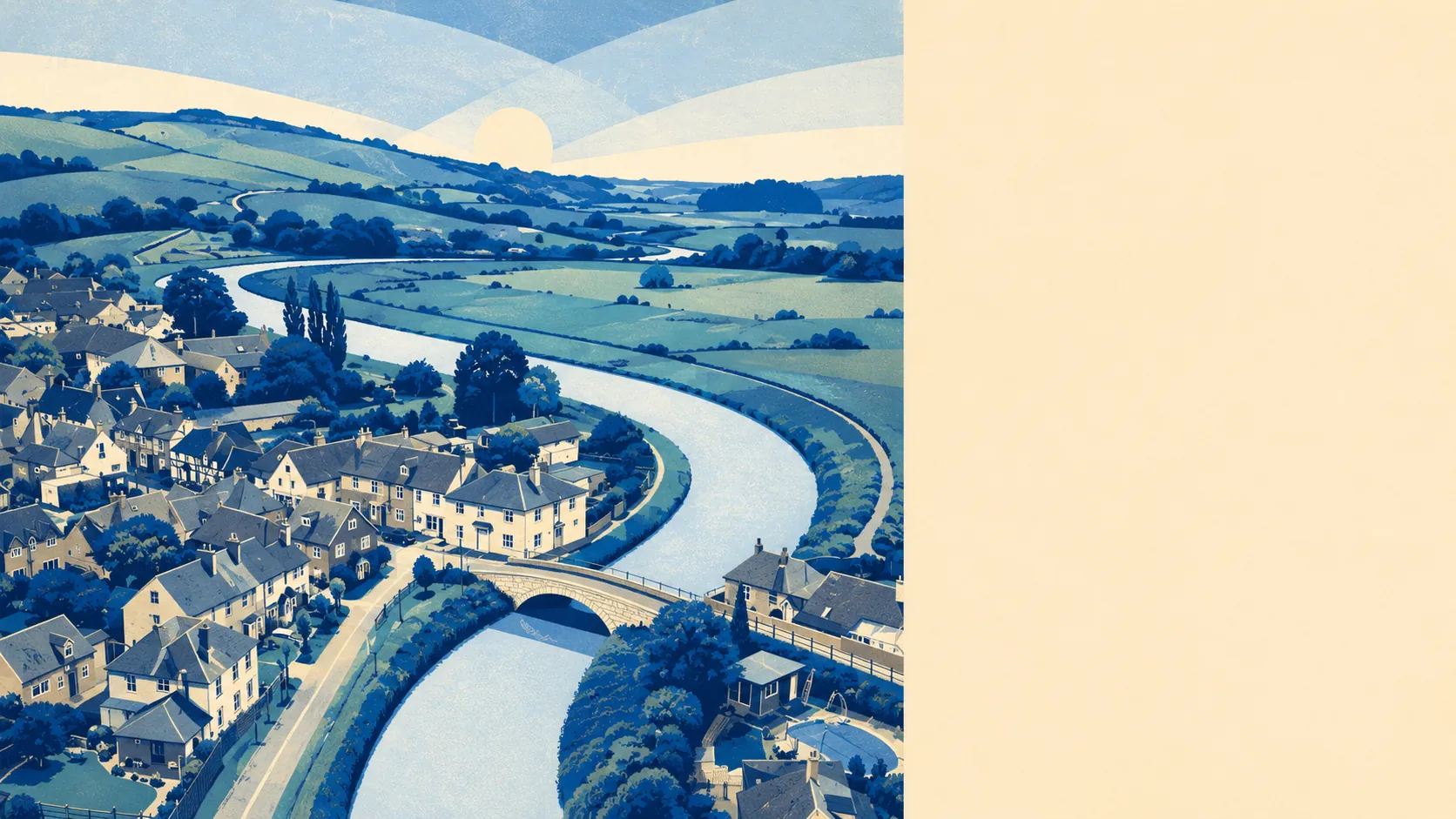
Upper Beeding is the working half of a three-village clump nobody tells apart. Bramber has the castle ruins. Steyning has the grammar school. Upper Beeding has the bridge, three thousand residents, and the historical embarrassment that its "Upper" prefix distinguishes it from Lower Beeding twelve miles away, which was itself named by monks who arrived from Upper Beeding. Same view of the South Downs. Half the reputation.
The housing does not match the postcard. Nearly two-thirds of homes went up between the war and 1982, and only about one in ten predates 1930. Houses dominate at two-thirds of the stock, with flats and bungalows splitting the rest almost evenly. Half the homes are rated Energy Band D, about one in six sit at Band E or worse, and only about a third reach Band A to C. This is post-war semi and bungalow country on the edge of the South Downs, and most buyers who arrive expecting thatched cottages find that thatched cottages account for a small minority of what got built.
A typical Upper Beeding home sold in the last year went for about £375,000 across roughly fifty completions. Detached houses cleared around £600,000 on average. Semi-detacheds landed near £377,500. Terraces held around £327,500. The three flats that changed hands traded near £210,000. Council tax lands mostly in Band C, and only about one in six homes sits in the cheaper A or B bands. Not expensive by Sussex standards. Not cheap.
Rent numbers here are the Horsham District figure, not a village-specific one. Typical private rent across the Horsham area sits at about £1,450 a month. The village itself does not produce enough rental churn to publish its own number, which is what a place with three-quarters owner-occupation looks like on paper.
The published crime rate here is around thirty incidents per thousand residents a year, roughly forty-eight percent below the Horsham District average. Rural West Sussex safe. The kind of village where people leave shed doors unlocked and then act mildly surprised when the shed does eventually get done.
Trains are absent. There is no station in the village, and the nearest platforms are at Shoreham-by-Sea and Southwick, both a drive away. Under one percent of the working population uses a train to get to work. Buses run, with about eight stops inside the built area, but under one percent of commutes go by bus either. More than half the working population drives to work. Over a third works from home, which is the number that matters here. Broadband compensates: gigabit reaches nine in ten postcodes, and superfast covers the lot. Good enough that the missing station stops being the crisis it looks like on paper.
Flood risk is present but manageable. About eight percent of postcodes carry a high probability of some flood type, roughly a quarter carry a medium probability, and nearly half carry some low risk. Under seven percent of the area sits in Environment Agency Flood Zone Three, mostly the low ground by the Adur. No home here has flooded in the historic record. Greenspace is genuinely walking distance for everyone: the average nearest patch is about two hundred metres away, with typically six separate greenspaces inside a kilometre. This is not marketing. This is what living on the edge of the South Downs looks like day to day.
Thirty-four listed buildings serve a village of three thousand people, which is a lot. One is Grade One-listed, one is Grade Two-Star, and thirty-two are Grade Two. Three separate conservation areas overlap the village: Bramber's, plus two Upper Beeding ones covering the High Street and Hyde Street. Two scheduled ancient monuments sit within the area. Practically, this means if you buy an older cottage or anything on the historic streets, the paperwork for altering it is not negotiable. Plastic windows are a fantasy. Loft conversions attract questions. The constraint arrives with the postcard view and is not the constraint most buyers expect.
About seventy-seven percent of homes are owner-occupied, which is high. Median age is 49, which is older. Median household income is around £61,000. About one in six households is a single pensioner, and around a fifth are couples with children. This is a mature, settled village where people move in and stay. Not a young village. Not a churning village.
It is for buyers who want the South Downs without the tourist coach traffic, who do not need a train to work, who commute by car or work from home, and who want a village with real shops, pubs, and the kind of neighbours you keep running into at the Co-op. The three-village cluster of Upper Beeding, Bramber, and Steyning together provides enough amenities that nothing feels like a hamlet, without any of it feeling like a town.
It is not for buyers who need a station, who want new-build low-maintenance property, who want Band A council tax bills, or who thought "South Downs village" meant thatched cottages and got surprised by post-war semis. If you want the picture, buy in Steyning and pay for the postcode. If you want the working village, this is it.
The rating lands at 3.5 out of 5, above average. Safety is the standout at 5 out of 5, roughly forty-eight percent below the local-authority average. Transport and connectivity is the weakest at 2.5: no station, a thin bus service, and gigabit broadband doing more of the heavy lifting than the roads. It is a good place to live if you can drive or work from home. It is a difficult place to live if you cannot. Which is West Sussex village life delivered honestly, not marketed.