Totnes is a good place to live if you have already finished being ambitious somewhere else. The median resident is 50. Nearly four in ten work from home. Green space starts about a hundred and fifty metres from the average front door. This is not a town on the way up, and it is not a town in decline. It is a town that arrived, unpacked, and stopped checking the traffic.
The housing stock is more mixed than the postcard suggests. On the council tax valuation list, terraces are the largest single type at about 27%, with semi-detached and detached houses each near 19%, bungalows about 17% and flats about 17%. Around 31% of the stock went up before 1930, which in a town with a Norman motte-and-bailey counts as a recent development. Of the 3,482 homes carrying an energy certificate, about 51% sit in bands A to C, about 34% in band D and about 15% in band E or worse. Roughly 64% run on mains gas. About 15% run on electricity alone, which in an older Devon terrace is the difference between a comfortable January and a standing order you resent.
The Land Registry recorded 107 sales in the twelve months to late May 2026, at a median of £388,000. Flats came in around £300,000, terraces about £373,000, semi-detached houses £390,000 and detached houses £520,000. The official house price index put the local average at about £364,000 in May 2026, down about 7% over the year and up about 8% across five years. Council tax sits low on the table: band B is the most common, about 36% of dwellings fall in bands A or B, and a band D bill runs to about £2,615 a year.
Rent is published across the district rather than the town. The typical private rent across the South Hams area is about £1,000 a month, up about 3% over the year, with one-bedroom homes near £730, two-bedroom near £910 and three-bedroom near £1,120. Those are South Hams figures covering a lot of countryside, not a Totnes street price.
Recorded crime runs at a published rate of about 56 offences per 1,000 residents over the twelve months to May 2026, against about 49 across South Hams, so roughly 16% above the district average. Violence and sexual offences account for about 41% of the total against about 35% across England and Wales, a statutory grouping broad enough to include common assault without injury. Anti-social behaviour is about 13%, criminal damage about 10%, shoplifting about 9%. Devon and Cornwall Police charged about 8% of cases across the whole force over the same period, against about 12% nationally. That is a force number rather than a Totnes one, and it is the number that turns a stolen bike into a reference code.
Ofsted has graded 172 settings across Devon, of which 138 are good or better and three outstanding, with 31 requiring improvement and three inadequate. Ten primary schools in these postcodes averaged about 107 in Key Stage 2 maths, and a primary sits around thirteen minutes' walk away on average. King Edward VI Community College, the town's secondary and the direct descendant of the school chartered here in 1553, scored about 45 on Attainment 8, with the average secondary walk closer to 35 minutes or eleven by car. The town also carries a run of alternative independents, including the South Devon Steiner School and Park School, which is either the entire point of Totnes or the reason your new neighbour has firm views about screen time.
Totnes Rail Station sits on the Exeter to Plymouth main line with direct trains to London Paddington, Plymouth and Penzance, and about 1% of residents actually commute on it. About 2% take the bus, because about 39% drive and about 37% never leave the house. There are 77 bus stops, and the 69 with published timetables average about 33 weekday departures each, roughly 1.7 buses per stop in the peak hour, with about 78% seeing a weekend service. Gigabit broadband reaches about 88% of premises, superfast about 99%, and nothing falls below the universal service obligation. About 91% of the area gets a mobile signal from every operator. The town that started the transition movement in 2006 has three public charging locations and six connectors, one of them rapid.
Water is the honest problem. About 16% of postcodes fall inside the Environment Agency's river and sea flood zone 3, the highest zone, with about 3% in zone 2 and about 12% inside the zone modelled for climate change. On the broader postcode indicators, which include surface water, about 10% carry a high rating and about 17% a medium one. About 8% have a recorded historic flood, and 31 flood events are on the record. Everything else outdoors is close to ideal: green space about 150 metres away with around 15 sites inside a kilometre, water about 300 metres away, and the South Devon National Landscape starting where the houses stop. Every postcode also sits in the higher radon bands, topping out at the highest, so a radon test belongs on the survey list rather than the worry list.
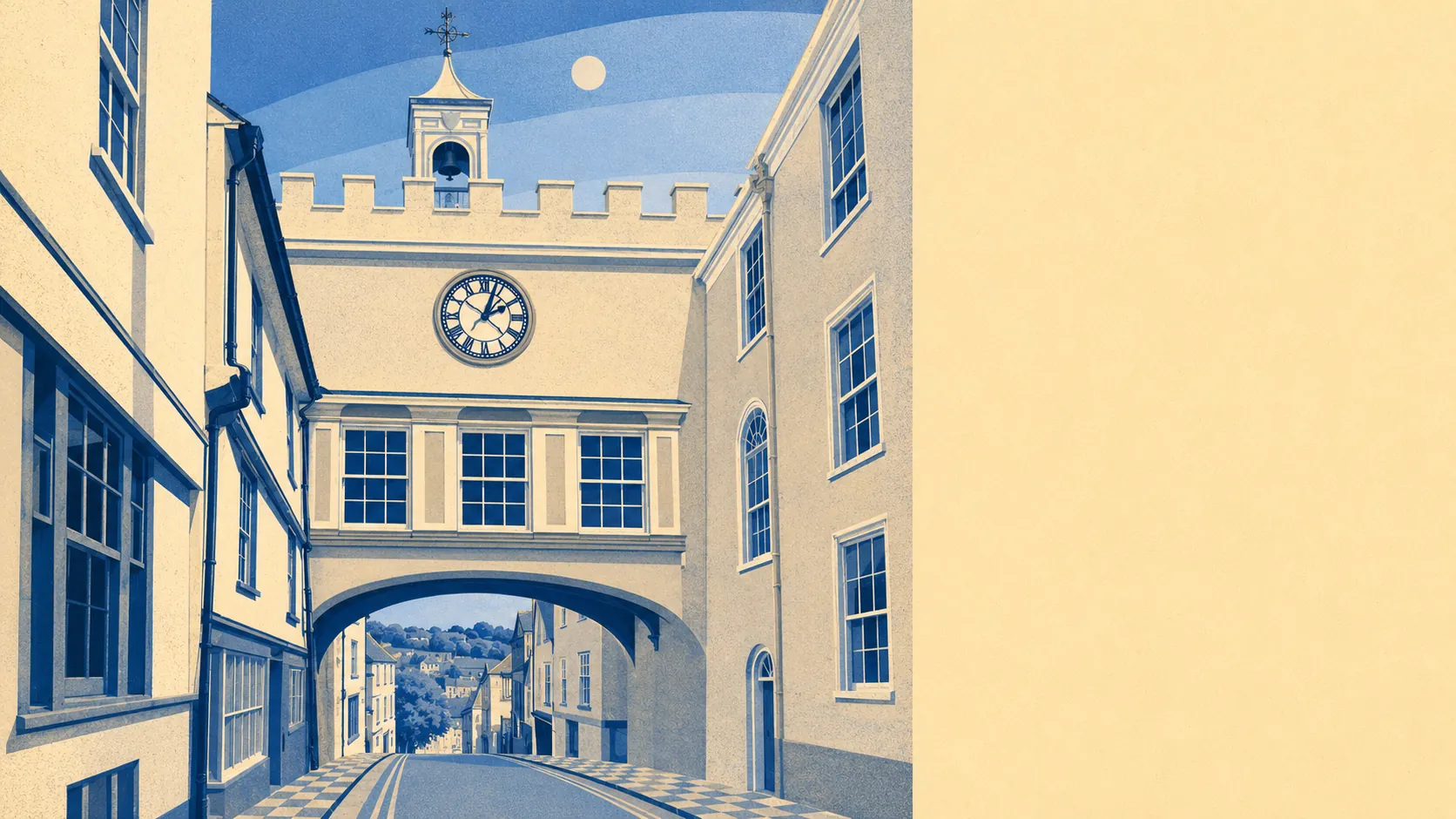
There are 324 listed buildings here, six of them Grade I and 28 Grade II star, plus five scheduled monuments including Totnes Castle and Totnes Priory, and two entries on the heritage at risk register. No conservation area is recorded across the area, so the constraint arrives building by building rather than street by street. If the Butterwalk, the Guildhall or one of the Fore Street frontages is yours, window replacements and anything involving plastic become a correspondence rather than a weekend. The Eastgate arch over the main street burned down in 1990 and was rebuilt, which tells you what the town thinks of its own silhouette.
About 59% own their homes, with roughly 21% renting privately and 18% socially. Median household income is about £53,000 before tax in the financial year to March 2023, or about £41,000 after it, and about 46% of adults hold a degree. About 37% of households are one person and about 20% are a pensioner living alone. The page takes in Dartington, where the hall estate carried an arts college until it moved to Falmouth in 2010 and Schumacher College until 2024, and Stoke Gabriel down towards the creek, which keeps its own primary school and considerably less footfall.
It suits people who work from home or have stopped working, who want a walkable town with a proper station attached, and who would rather have a river and a national landscape than a driveway and a retail park. It suits families willing to trade a short primary walk for a longer secondary one.
It does not suit anyone who needs a frequent bus after six, anyone buying an unmodernised period house on an electric meter and hoping for the best, or anyone who wants to change the front of their home without permission from someone in an office. Buyers who want a market town's character and a new estate's running costs are asking for two different houses.
The town has form for producing quietly odd achievers. Edward Lye, born here, compiled the first dictionary of Anglo-Saxon. John Huxham spent a medical career studying fevers. The founding story, meanwhile, is a granite boulder set into the Fore Street pavement where local legend has Brutus of Troy stepping ashore, first written down in 1697 and sited well above the highest tide anyone has measured. Geoffrey of Monmouth recorded a prophecy of Merlin about the boar of Totnes oppressing the people with grievous tyranny, which is roughly how the town still discusses anyone proposing to build something.
So Totnes is a good place to live, in the specific way that means it is right for some people and a slow disagreement for others. Its real strength is what surrounds it: green space at the end of the street, water past that, and a national landscape beginning where the last house does. The weak spot is water arriving from the other direction, with about 16% of postcodes in the highest river and sea flood zone and a tidal river that has been overtopping since records began. Buy up the hill and this is one of the better small towns in Devon. Buy near the bridge without reading the flood mapping and the Dart will introduce itself.