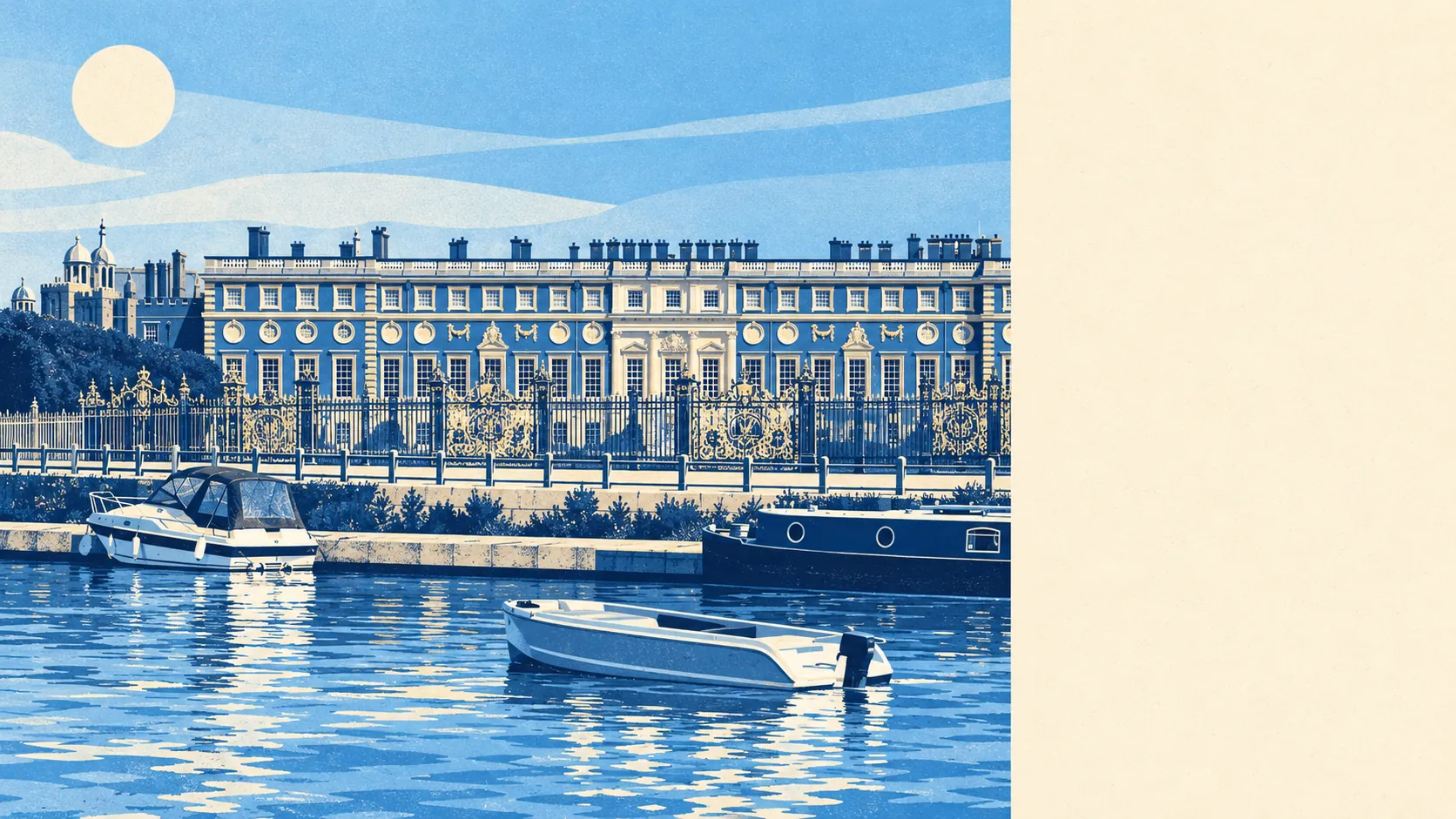
Yes, provided you're happy to share the place with a river that keeps its own diary. Nearly eight in ten households own their home. Six in ten working residents were at home on census day. Half the postcodes fall inside a recorded flood outline. A very comfortable village with one damp asterisk.
The housing is a fairly even mix for somewhere this expensive. The council-tax valuation list covers every home, and on it semis lead with 28%, flats make up 24%, and detached and terraced houses take 22% each, with bungalows at 2%. A third of homes were built before 1930. Mains gas heats 84% of them. The energy certificates come out middling: 43% of certificated homes reach band C or better, 39% are band D and 17% are E or worse. The pre-1930 houses look lovely from the towpath and rather less lovely on a gas bill.
The Land Registry recorded 125 sales in the twelve months to May 2026, at a median of £780,000. Split by type, flats went for around £400,000, terraces about £620,000, semis about £1,014,000 and detached houses about £1,280,000. The semi-detached house, England's most modest ambition, clears a million here. Band D is the most common council-tax band, and only 3% of homes are in bands A or B, so there's no cheap end tucked behind the High Street.
Elmbridge puts its typical private rent at about £1,830 a month as of April 2026, down about 3% on a year earlier. That's an average across the whole borough, and a landlord with a mooring at the bottom of the garden will see it as an opening offer.
Surrey Police recorded crime at about 52 per 1,000 residents in the year to May 2026, roughly 18% below the Elmbridge average. Violence and sexual offences make up 36% of it, close to the national share. Vehicle crime is the odd one out, at 10% of recorded crime against 5% nationally. In a village where nearly four in ten households run more than one car, the thieves have done the same arithmetic.
Schools are a strength. Ofsted has graded 147 of 159 schools across Surrey good or better, 30 of them outstanding, though that's a county-wide count. Closer to home, the three primary schools in the postcode district averaged 108 in end-of-primary maths. Thames Ditton Infant School and Thames Ditton Junior School carry the village's name, and Long Ditton St Mary's CofE Junior School is close by. St Paul's Catholic Primary School is the other local option, though a Catholic school's admissions rules can count a baptism certificate as heavily as a postcode. For sixth form there's Esher Sixth Form College.
Thames Ditton Rail Station is on the Hampton Court branch line into London Waterloo, and Surbiton Rail Station is close enough for the faster trains. On census day in 2021, 60% worked from home, 24% drove and only 5% took the train, a snapshot from a year when half the country had moved its desk into the dining room. Gigabit broadband reaches 94% of premises. The area has 168 bus stops, and the average one sees about 272 scheduled departures on a weekday, with weekend service at 94% of them. A branch line whose last stop is a Tudor palace is about as Surrey as public transport gets.
Flood risk is the weak spot, and two different measures apply. In the Environment Agency's river-and-sea flood zones, 14% of the area is in zone 3, the highest-risk category, and 32% in zone 2. Counting every flood indicator, surface water included, about 20% of postcodes carry a high risk on at least one and 23% a medium one. The last recorded flood was in January 2003, when an ordinary watercourse overtopped its channel. Put the exact address into the Environment Agency's long-term flood-risk checker and get an insurance quote while the survey is still being booked. The compensation is the outdoors: the nearest green space is on average about 118 metres away, with 27 within a kilometre, and open water is roughly 190 metres off. The river is why people come, and why underwriters ask so many questions.
Heritage rules a lot of what you can do. Historic England lists 172 buildings across the wider area, 16 of them Grade I, though Hampton Court across the water swells that count. 23 conservation areas cross the same map, including Thames Ditton itself, Giggs Hill Green and Weston Green. Inside one, replacing windows or a front door can need consent, the kind of job that elsewhere needs only a builder and a skip.
The people are settled and comfortable. 78% of households own their home, the median age is 43, and modelled gross household income averaged about £94,000 in the financial year to March 2023. Weston Green, part of Thames Ditton until 1901, runs on the same terms. Surrey's commuters turned into Surrey's home-workers here and kept the postcode.
Thames Ditton suits families who want good primary schools, a cricket green and a train to Waterloo, and who can spend a million on a semi without it costing them sleep. It also suits anyone working from home who wants the river on the doorstep and fast broadband.
It suits first-time buyers poorly, unless a flat is the plan, and anyone who wants to remodel a period house without asking permission. Buyers on a stretched budget who ignore the flood maps tend to meet the insurer later than they'd like.
The village has always had residents with ambitions. Sydney Camm, who designed the Hawker Hurricane, lived here, and so did Trevor Bannister, Mr Lucas in Are You Being Served?. The Ferry Works on the riverbank built Willans engines that powered the Vienna State Opera, and cricket has been played on Giggs Hill Green since 1833. In 1792, local men met at the Harrow Inn and formed a society for "the protection of persons and property" against highwaymen on the Portsmouth road. The car thieves are, in a sense, keeping up a local tradition.
Thames Ditton is a good place to live with a soggy footnote. Its real strength is the community: owners who stay, schools Surrey rates highly and crime below the borough average. The weak spot is flood risk, and it changes from street to street. Pick the right street and the village is as comfortable as it looks. Pick the wrong one and the Thames gets a say in the insurance.