The area around Teddington is mostly park and river, with a town attached. Green space is a couple of minutes' walk from the typical front door. The Thames is not much further. A royal park is next door. The high street keeps its chain shops on one stretch and its independents on another.
Teddington homes are, on average, about 130 metres from the nearest public green space, and the typical address has about 30 green spaces within a kilometre. Bushy Park takes up the western edge of town. It was enclosed from Teddington's common land in 1540 as a royal hunting ground, and these days the people using it are dog walkers.
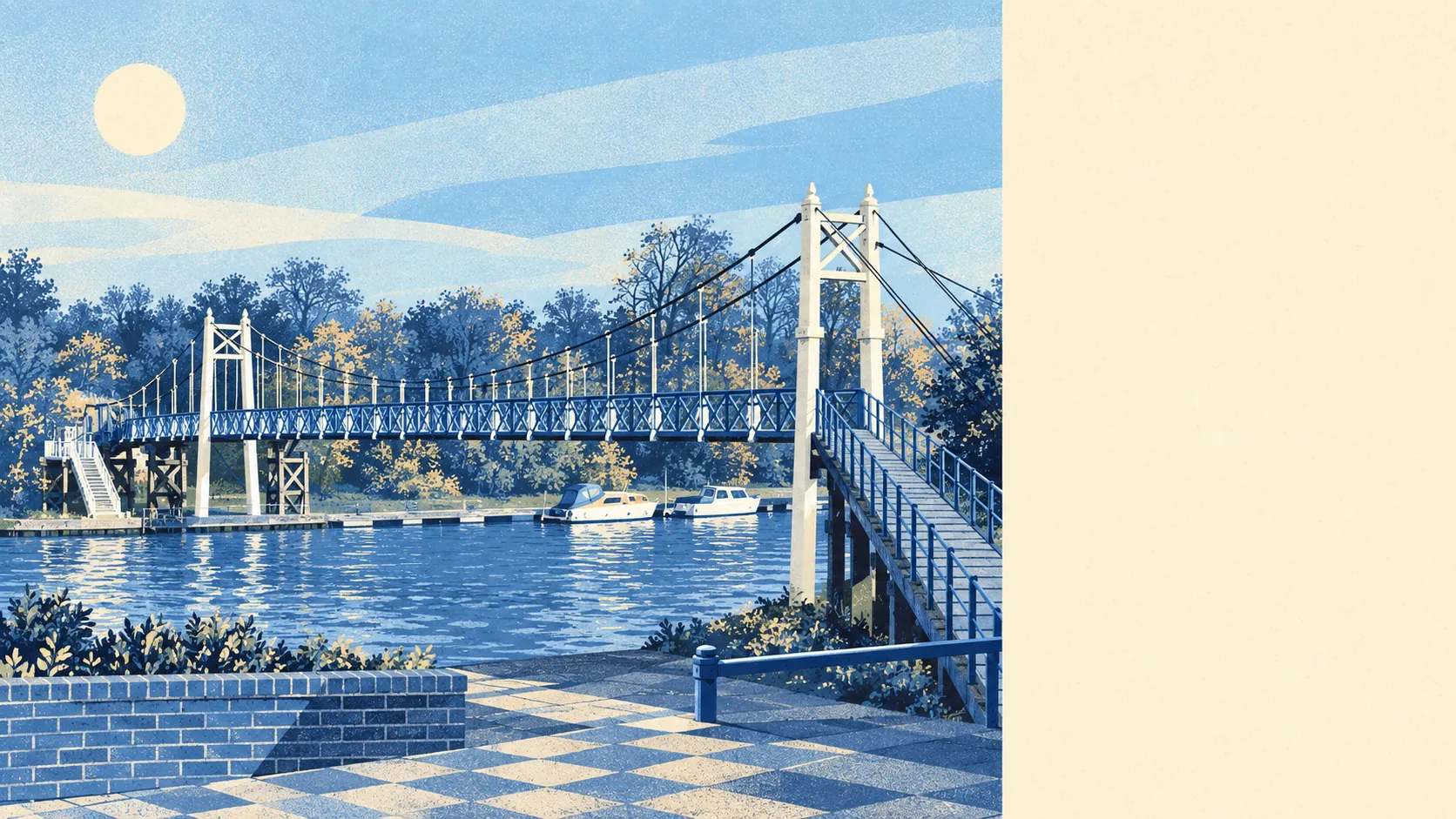
Water is almost as close. The average home is about 420 metres from river or other open water, with about 51 bodies of water within a kilometre, and most of them belong to the Thames and its edges. Teddington Lock is the obvious destination. The Lock footbridges, finished in 1889 and paid for by local business and public subscription, carry walkers across to Ham. Locals put up the money for their own route to the riverside walks, and they still use it as a commute.
The National Cycle Network is about a kilometre from the average home, and about 14% of postcodes are close to it.
The town centre follows the A313, which goes by three names, Hampton Road, Broad Street and High Street, along its route. Broad Street has the supermarkets, the chains and some independents. The High Street is almost entirely independent. Broad Street takes the chains so the High Street doesn't have to. The rated-premises figures count 208 shops, 16 pubs and 23 restaurants.
Fine-particle pollution across Richmond upon Thames averaged about 8 micrograms per cubic metre in 2024, a figure for the whole borough.
The town's character comes from its heritage as much as its parks. The High Street Teddington and Park Road (Teddington) conservation areas protect the Victorian and Edwardian streets that went up after the railway arrived. St Alban's, the unfinished Victorian church, now runs as the Landmark Arts Centre. The National Physical Laboratory still fills the edge of Bushy Park. Normansfield and Teddington Lock have their own conservation areas too, so the riverside and the old hospital grounds are protected as firmly as the shopping street.
Private gardens are generous for London, at about 55,000 square metres of garden for every 1,000 residents across the town's 17 neighbourhood areas. Ask the seller for the garden's actual dimensions and which way it faces. A town-wide average covers the riverside flat with a balcony as well as the semi with a lawn running down to the back fence.
The council's valuation list counts 650 rateable premises in Teddington. The largest groups are 208 shops and 165 offices, then 23 restaurants and 16 pubs. Those are premises on a tax list, so some may be empty at any given time. The offices are a reminder that the town still has a working day: the science cluster by Bushy Park, and offices around the station.
The Food Standards Agency has rated 128 food outlets in Teddington, and about 77% have the top hygiene score. About 2% are at the bottom of the scale.
Teddington has no area of outstanding natural beauty and no ancient woodland. The only protected wildlife designation is the Bushy Park and Home Park Site of Special Scientific Interest, which overlaps under 1% of the area at the edge of town. The green space here is mostly park, garden and towpath, kept for people to use, not reserved for wildlife.
Teddington's surroundings are one of its real strengths. Parkland, the river and an independent high street are within a short walk of almost every home, and even the busy bits are a short walk from somewhere green.