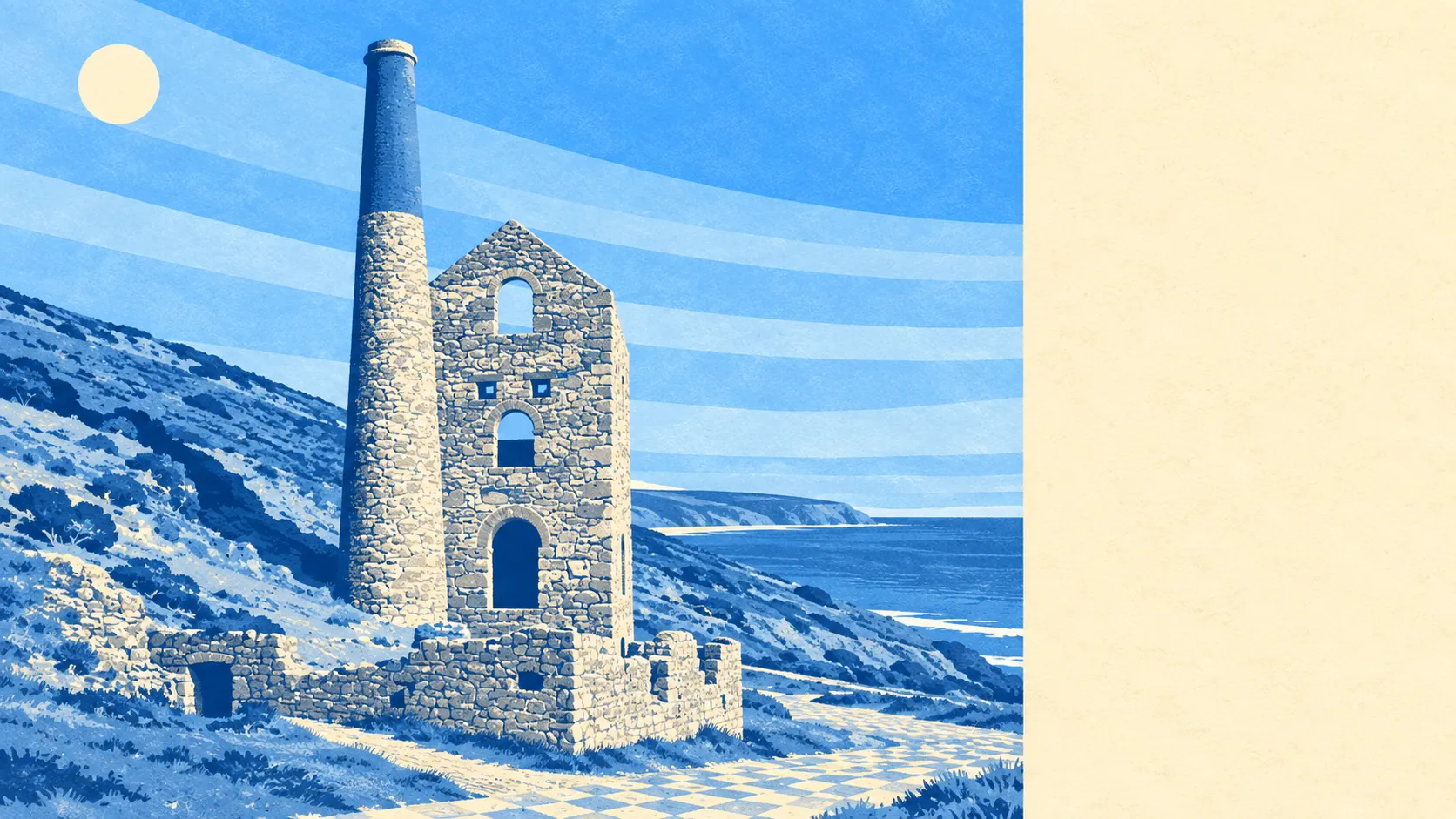
Yes, provided you can afford the view and don't mind living on top of a hole. The mining stopped a century ago and the village has been selling the scenery ever since. Nearly three-quarters own their homes. The typical resident is closer to fifty than forty. Half drive to work and a third never leave the house to do it. This isn't a place that's arriving. It arrived, cashed out, and put the kettle on.
The housing is lower, wider and older than the postcard suggests. Detached houses make up about a third of the dwellings on the council tax list and bungalows another 29%, which is the clearest tell you'll get about who has been buying here for the last forty years. Semis and terraces take roughly 15% each, and flats barely register at 6%. About 35% of the stock was built before 1930, and it shows in the energy certificates: 44% sit at band E or worse, against 32% managing A to C. Only 7% of households are on mains gas. Around 18% run on electricity alone and another 5% have no central heating at all. Buy a granite cottage above Trevaunance and the running costs are a fact you meet in January, not at the viewing.
Prices are the part that stings. The Land Registry's last twelve months, to May 2026, records 48 sales at a median of £450,000. Detached houses did most of that work at £532,000 across 29 sales, semis at about £434,000 across ten, and terraces at £283,000 across eight. So the cheap door into St Agnes is a terrace, and there were eight of them in a year. Council tax lands mostly in band D, with 25% of dwellings in bands A or B, which is a reminder that the valuation list was drawn up long before second-home money arrived and rearranged the arithmetic.
Renting is the softer option and not by much. The typical private rent across the Cornwall area sits at about £1,000 a month as of April 2026, up roughly 5% over the year. That's an area figure rather than this village's own, and given what sale prices do locally, the village end of it is unlikely to be the bargain end.
Safety is where St Agnes quietly walks it. The published crime rate is about 32 offences per 1,000 residents over the year to May 2026, roughly 56% below the Cornwall average. That is a genuine gap, not a rounding artefact. Devon and Cornwall Police charge in about 8% of cases against 12% nationally, so the force behind the number is not an especially triumphant one. It just doesn't have much to do here.
For schools, the parish is served by primaries including Mithian School and St Agnes Academy, with the two schools in the district averaging 104 in the national maths measure at the end of primary, slightly above the expected standard. Ofsted has graded 120 settings across Cornwall, of which 95 are good or outstanding and three outstanding, with five inadequate. Primary is a 19-minute walk on the modelled journey times. Secondary is 22 minutes by car and just under two hours on foot, which is a polite way of saying the teenage years involve a bus or a parent.
Connectivity is the weakest structural thing about the place. Around 51% drive to work and 35% work from home, while trains and buses between them account for under 1% of commuting. There are 29 bus stops, of which 27 carry timetable data averaging 30 weekday departures, and all of them run at weekends, which is better than most rural Cornwall manages. The nearest town centre is 21 minutes by car and 53 by public transport, a gap that tells you everything about which one people actually use. Broadband redeems it: superfast reaches 92% of premises, gigabit 60%, and only 0.5% fall below the universal service minimum. Nearly every premise gets a mobile signal from at least one operator and 95% from all of them. The working-from-home third are not doing it on heroics.
On flooding, 18% of postcodes carry a high rating on at least one indicator including surface water, with 12% medium and 31% low. Only about 2% sit inside the Environment Agency's river-and-sea flood zone 3. The two measures answer different questions, and the surface-water one is the one that matters when a lane on a hillside becomes a stream. Green space is 318 metres away on average with about seven sites within a kilometre, and water is closer still at 345 metres. The other ground facts are more particular to a mining parish: every postcode has abandoned workings within 500 metres, averaging 23 of them, the nearest around 19 metres away, and 157 postcodes have a mine directly beneath. Every postcode also sits in radon band 3 or above, with the maximum in the highest band. None of that stops a sale. All of it belongs in the survey.
Heritage is dense for a village this size. There are 112 listed buildings, 110 of them grade II and two grade II star, three conservation areas covering St Agnes, Mithian and Mingoose, and 11 scheduled monuments in the area. Much of the Cornwall and West Devon Mining Landscape World Heritage Site lies in the parish. Practically, that means windows, render, roof slates and anything visible from a lane become a conversation with the planners rather than a weekend. There were 133 planning applications in the last twelve months, so the conversation is one people are clearly having.
Character-wise, about 73% own their homes, the median age is 47, and median household income ran to roughly £51,000 in the financial year to March 2023. There are also 169 holiday lets on the business rating list, which is the number that explains the winter. The page covers Mithian, a mile inland and quieter for it, and Porthtowan over the cliff with its own beach and its own parking arguments.
It suits people who want a small place with a coast path at the end of it, who are buying outright or close to it, and who treat a car as equipment rather than a lifestyle statement. It suits retirement extremely well, which the bungalow count already confessed.
It doesn't suit first-time buyers on one Cornish salary, anyone who needs a train, or anyone who wants to put in modern glazing without a planning officer developing opinions. Households with teenagers should price the secondary school run before they price the kitchen.
The village has been producing people worth mentioning for a while. John Opie, who became a serious painter, was born at Trevellas. John Passmore Edwards built and gave the Miners and Mechanics Institute in 1893, back when a village like this expected lectures and a library. Thomas Tonkin's family spent their entire fortune trying to build a harbour here, which is the single most St Agnes thing in the record.
So: average overall, with the average made of extremes rather than mediocrity. Its real strength is safety, where the gap below the county rate is wide enough to be worth something on a dark lane in February. The weak spot is what you pay to get in, where a median approaching half a million buys you a house that will likely need its heating rethinking. St Agnes is worth the money to people who understand exactly what they're buying, and a long expensive lesson to everyone else.