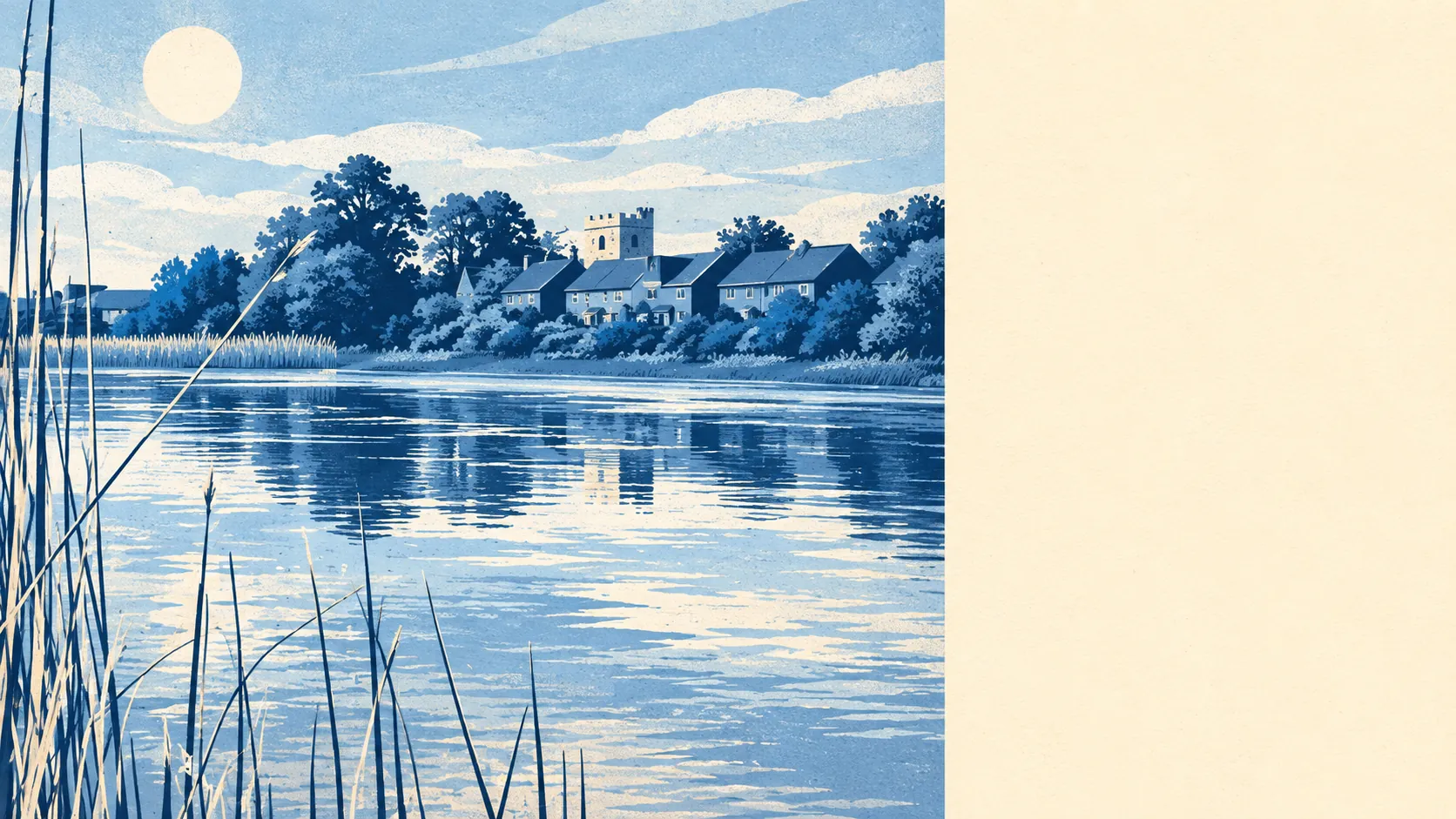
The area around Snodland is better than most people driving through on their way to somewhere else would guess. There's green space round almost every corner. Water is closer than the nearest shop for plenty of households. The downs sit on one side and the river on the other. The old industrial holes in the ground have been turned into the best bits.
The average home in Snodland is roughly 140 metres from the nearest public green space, with about 20 green spaces within a kilometre. That's closer than the walk to most people's car in a city. Nobody here needs to plan a trip to find grass.
Water is even more present. Blue space, meaning lakes, rivers and wetland, is roughly 230 metres away on average, with about 75 bodies of water within a kilometre. Leybourne Lakes Country Park was made from disused gravel pits that were flooded and landscaped for fishing and wildlife, and across the Medway the Burham Marsh nature reserve is a tidal reed bed. The quarrying left scars, and somebody had the sense to fill them with water and stock them with fish.
The National Cycle Network is less convenient, about 3,400 metres away on average, and no postcodes sit close to it. Cyclists here ride the roads or the lake paths, not a signed national route.
Across the wider area that the rated-premises data covers, there are 432 shops, 54 pubs and 56 restaurants. That's a working town's mix, heavier on the practical than the precious.
For air quality, fine-particle pollution across the Tonbridge and Malling council area averaged about 7 micrograms per cubic metre in 2024. That figure covers the whole borough, not Snodland's own streets.
On designations, the Kent Downs Area of Outstanding Natural Beauty only just touches the edge, overlapping less than 1% of the area. There's no Site of Special Scientific Interest and no ancient woodland inside the boundary. That isn't a failing. It just means the countryside here is the working kind, not the kind with an information board.
The town sits between the North Downs to the west and the Medway to the east, which gives it a rare mix: chalk hills at one end of the view and tidal river at the other. Local life includes cricket at Rectory Meadow and Snodland Town's football teams on weekends. It's a place where people use the outdoors rather than photograph it.
Private outdoor space is generous. There are about 106,000 square metres of private garden for every 1,000 residents, across all nine of the area's neighbourhood statistical zones. For a town full of terraces, that's more garden than the housing type would suggest.
On the valuation list, Snodland has 151 rateable business premises. Shops are the largest category at 53, followed by 18 warehouses and 10 offices, with a scattering of other uses below that. These are premises on the rating list, not a guarantee of anything currently trading. The high street is a place for getting errands done, not for spending a Saturday.
There are 45 food outlets with a hygiene rating, and about 76% hold the top score of five. About 2% sit at the bottom end. The kitchens here are clean, even if nobody's writing reviews about them.
The surroundings are one of Snodland's real strengths: lakes, marsh, downs and river all within easy reach, with more water within a kilometre than most towns can claim. Plenty of pricier places would swap their high street for this view.