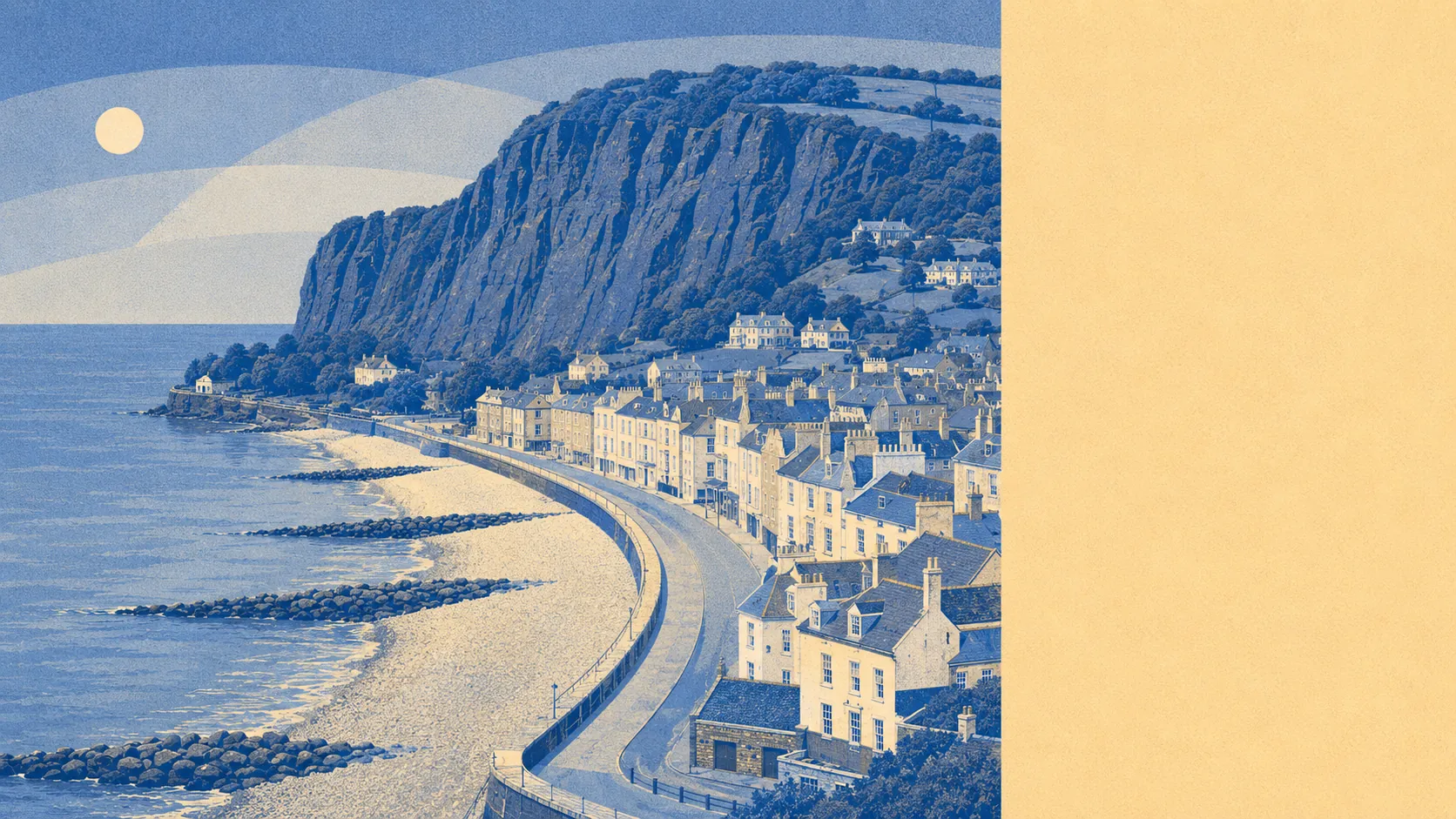
Sidmouth is a good place to live if what you want from a town is for it to stay exactly as it is. Three in four households own their homes. The typical resident is sixty. A large part of the town is a conservation area, and the hills at either end stop it sprawling even if it wanted to. Nobody moves here to find out what happens next.
The housing is more mixed than the seafront postcards suggest. Terraces are the largest single type at about 24% of dwellings, with flats at 23%, bungalows at 20%, detached houses at 19% and semis at 13%. That bungalow share is the honest signal, and it tells you what the town spent the post-war decades building and for whom. Around 30% of dwellings went up before 1930, which here means the Georgian and Regency fronts along the esplanade and the villas stacked up the valley behind them. Heating is mostly conventional, with about 78% on mains gas, though roughly 8% run on electricity alone, and an electric-only flat carved out of a Regency villa is a running cost worth understanding before the viewing rather than after the first January. Energy certificates put about 44% of the certificated stock at band D, 41% at band C or better, and 15% at band E or worse.
The Land Registry's last twelve months, ending in May 2026, record 229 sales at a median of £410,000. The spread underneath that is the part worth reading. Flats sit at around £277,000, terraces at £320,000, semis at £362,000, and detached houses at £610,000, so the difference between a foot in the door and a proper house here is roughly the price of a second house. Council tax is most commonly band C, and about 20% of dwellings sit in bands A or B, which is a useful corrective to the idea that the whole town is Regency stucco.
Renting is priced across the district rather than the town. Typical private rent across the East Devon area runs at about £970 a month as of April 2026, up around 7% over the year. Sidmouth's own rents are not published separately, so read that as the area figure it is, and factor in the 179 holiday lets on the local rating list, which are not competing for the same tenants so much as removing the flats they would have lived in.
Recorded crime runs at about 50 offences per 1,000 residents over the twelve months to May 2026, effectively level with the East Devon average of roughly 50. Devon and Cornwall Police record violence and sexual offences as the largest single category at about 47% of offences against about 35% across England and Wales, a broad statutory grouping that includes common assault without injury. Anti-social behaviour runs lower here than nationally, at about 10% against 16%. A retirement coast does not mean an empty crime sheet, it means a differently shaped one.
Getting anywhere is a car question. The branch line closed in 1967 and never came back, so about 48% of residents drive to work, 29% work from home and 13% walk. The bus network is better than the reputation of rural Devon suggests, with 63 stops in the town, an average of 58 scheduled weekday services per stop and weekend services at about 94% of them. The Department for Transport's modelled journey times put the town centre at about nine minutes by car, the nearest employment centre at about twelve, and the nearest hospital at about 38, which is the number that matters most and gets mentioned least. Broadband is strong for a town this size, with superfast available to about 99% of premises, gigabit to about 60%, and none below the universal service standard. About 97% of premises get 4G or 5G from every operator.
The surroundings are the reason people put up with the rest. Green space averages about 150 metres from the front door with around 18 sites within a kilometre, water is about 260 metres away, and roughly 10% of the area falls inside the East Devon Area of Outstanding Natural Beauty. The sea is the complication as well as the selling point. Around 23% of postcodes carry a high rating on at least one flood indicator, including surface water, and about 10% sit in the river and sea flood zone 3 on the Environment Agency's mapping. Roughly 9% have a recorded historic flood, from 120 recorded events, the most recent in July 2012 when channel capacity was exceeded on the main river. The shoreline plan is to hold the line across all its horizons, and the cliffs east of the river mouth are eroding towards homes and the coast path. Flood risk here is a live question, not a filing formality.
Heritage constraint is the other thing to price in. There are 242 listed buildings, two of them grade one and ten grade two star, and five conservation areas covering Sidmouth Town Centre, Sid Vale, Elysian Fields, Bickwell Valley and Sidford. In practice that means windows, doors, render, roofs and anything visible from the street stop being your decision and start being an application. The town made itself beautiful by making itself difficult to change, and it charges the current owners for the privilege.
Ownership sits at about 75%, with 13% renting privately and 10% in social housing, and the median age of 60 is not a rounding artefact but the defining fact of the place. Around 35% of households are single people, a quarter of them pensioners living alone. Median household income runs at about £51,000 gross for the financial year to March 2023, which for a town with this many bungalows says the money is largely already made rather than currently being earned. The wider area covered here runs up the valley through Sidford and Sidbury and west to Newton Poppleford, which are quieter again, and where the bus timetable does more of the deciding.
It suits downsizers, remote workers who want the coast path at the end of the road, and anyone whose social life does not depend on things being open after nine. Buyers who want a period house and can live with a conservation officer's opinion of their window frames will get more architecture per pound here than in most of the south coast.
It suits nobody who needs a train, a career ladder or a hospital within twenty minutes. Families with teenagers should look hard at what the evenings actually offer. Anyone buying near the river or the seafront needs the address-level flood check done before the survey, not after.
The town's famous names are quietly telling. The Duke of Kent brought his infant daughter, the future Queen Victoria, to stay at Woolbrook Glen in 1819, and the building is now the Royal Glen Hotel with a plaque to prove it. Arthur Broome, who grew up locally, went on to co-found the Royal Society for the Prevention of Cruelty to Animals in 1824. Elisabeth Svendsen founded The Donkey Sanctuary here. Adolph Friedrich Lindemann kept his amateur astronomy going at Sidholme. A place whose leading exports are royal convalescence, animal welfare and stargazing is not pretending to be anything else.
Sidmouth is an average place to live in the way that averages hide everything interesting. Its real strength is what surrounds it, with green space, water and protected countryside all within a short walk of most front doors, and that is not a marketing claim, it is the geography. The weak spot is flood risk, which is high enough on both the postcode indicators and the river and sea zones that it should shape which street you buy on rather than whether you buy at all. Get the address right and the town keeps its side of the bargain, which is that nothing much will change, ever.