Yes, if you can live without a railway station and don't mind a town that has spent two centuries losing one industry and finding another. The Mendips start where the houses stop. Most people own. Most people drive. Georgian clothiers' houses at one end, post-war estates at the other, all filed under the same postcode. A working Somerset town with the countryside as compensation, and the compensation is generous.
The stock catches out buyers who came for the Georgian frontages. Across every dwelling on the council tax list, terraces make up about 30%, semis about 26%, flats about 19% and bungalows about 8%. Roughly one home in five predates 1930 and about 14% went up between 2000 and 2008, so this is a town that kept building rather than preserving itself in aspic. On energy certificates, about 56% of the certificated stock sits in bands A to C, about 32% in band D and about 12% in band E or worse. Around 75% run on mains gas and about 10% on electricity alone, and an electric-only older house is a running cost worth knowing before the second viewing rather than after the first winter.
The Land Registry's twelve months to May 2026 put the median sale at about £268,000 across 137 sales, which is a real market rather than four transactions and a rumour. Terraces came in around £232,000, semis around £282,000, detached houses around £358,000, flats around £152,000. The wider index had the average at about £281,000 in May 2026, up about 3% over the year and about 15% over five. Council tax says the same thing from another angle: band B is the most common, bands A and B together cover about 52% of dwellings, and a band D bill runs to roughly £2,560 a year.
Rent has to be read at county level. Typical private rent across the Somerset area is about £990 a month, up about 4% over the year, running at about £670 for a one-bedroom, about £890 for two and about £1,100 for three. Those are Somerset figures rather than Shepton Mallet's own, and a market town departs from a county average in both directions.
Recorded crime over the twelve months to May 2026 comes to about 91 offences per thousand residents, roughly 2% below the Somerset average. Average is the honest word. Violence and sexual offences account for about 49% of the total against about 35% across England and Wales, though that heading is a broad statutory grouping that takes in common assault without injury and tops the list almost everywhere. Anti-social behaviour runs at about 13%, public order at about 10%. Avon and Somerset Constabulary charges in about 11% of cases against about 12% nationally.
Schools are the steady part. The two primaries with published results average about 103 in the end-of-primary maths assessments, and the town's secondary posts an Attainment 8 score of about 41. Across Somerset, Ofsted has graded 140 settings, 101 of them good or better and five outstanding, with 32 requiring improvement and seven inadequate. Whitstone takes the secondary years; St Paul's Church of England Junior and Shepton Mallet Community Infants sit in the town, Bowlish Infant School serves the western side, and Evercreech Church of England Primary covers the village. Primary is about a twelve minute walk on average, secondary about fifteen. Both are walks, not drives.
Getting out is the weak link. Roughly one resident in a thousand commutes by train and about 1% by bus, against about 59% who drive and about 20% who work from home. There is no mainline station, and the two Victorian lines that served the town closed in the 1960s. The buses run better than that share implies, with 46 stops, about 60 scheduled weekday departures per stop, and 33 of the 43 measured stops operating at weekends. Broadband compensates: about 98% of premises can get superfast, about 78% ultrafast, about 72% gigabit, and roughly one property in a thousand sits below the universal service obligation. A hospital is about 41 minutes by car and close to two hours by public transport, on Department for Transport modelling from 2019 that ages faster for buses than for cars.
The surroundings are the best thing here and none of it is far. Green space averages about 150 metres from the door, with around 19 green spaces within a kilometre, and water about 290 metres, with around 29 inside the same radius. No part of the town falls inside an Area of Outstanding Natural Beauty or a Site of Special Scientific Interest, so the Mendips are the view rather than a planning constraint. Flood risk needs two readings. In the river and sea flood zones, about 5% of the town sits in zone 3 and about 1% in zone 2, rising to about 6% under the Environment Agency's climate change allowance. On the broader postcode indicators, which include surface water, about 10% of postcodes carry a high rating on at least one measure and about 25% a low one, and about 6% have flooded historically across 32 recorded events, most recently in July 2012 from surface water and local drainage. Limestone gives with one hand and takes with the other: about 87% of the area sits in the higher soluble rock classes, and every postcode falls in radon band three or above with the highest band present. Put a radon test on the survey list.
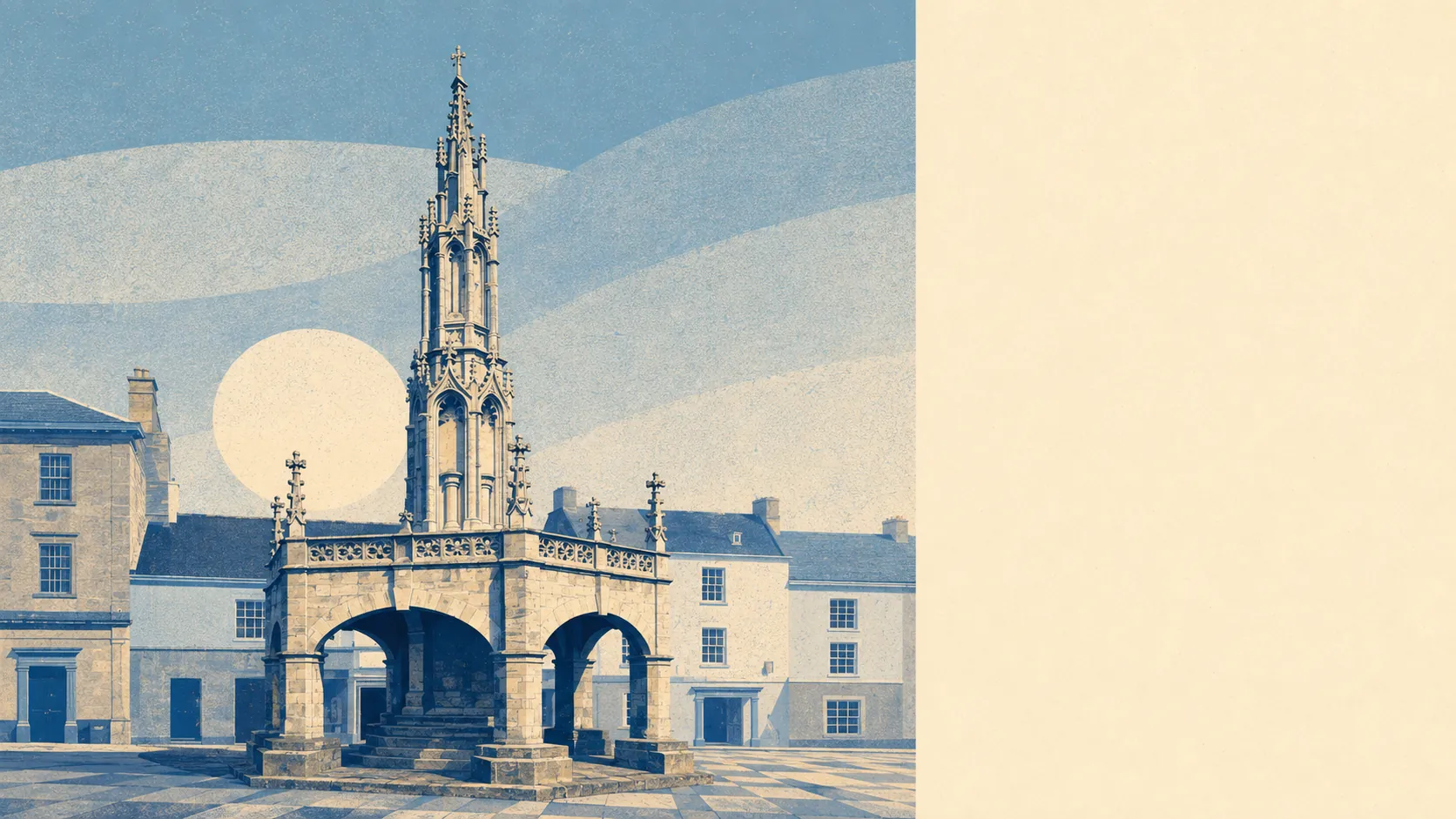
Which brings the catch. There are 216 listed buildings here, one at Grade I, ten at Grade II star and 205 at Grade II, plus a conservation area covering the old core along with Bowlish, Darshill and Charlton, and one entry on the Heritage at Risk register. Inside that boundary the Market Cross and the Merchants House are the neighbours, and external alterations go past a planning officer first. Outside it, in Tadley Acres or on the Hillmead side, the double glazing is between you and the installer.
Ownership sits at about 63%, the median age is 41, and household income before tax runs at about £52,700 for the financial year to March 2023. About 30% of households are one person living alone and about 19% are couples with children, while about 27% hold a degree and about 19% hold none. About 20% work from home, which in a town with no station is less a lifestyle choice than an infrastructure workaround. This page also covers Evercreech, the village to the south east, which shares the postcode district and most of the trade-offs.
It suits people who want a house and a garden inside a working town, who drive or work from home rather than commute by rail, and who want the Mendips as a weekly habit rather than a fortnight in July.
It does not suit anyone whose job needs a train, anyone who wants a period house and a free hand with it at the same time, or anyone who needs a hospital close by.
The most instructive local story concerns a piece of jewellery. An amulet was dug up near the Fosse Way, celebrated as some of the earliest evidence of Christianity in England, copied and presented to the Archbishop of Canterbury, then tested by Liverpool University in 2008, which found the silver dated from the nineteenth century or later. The arts complex had already been renamed The Amulet. It is now The Academy. The rest of the roll call runs to Herbert Foxwell the economist and Simon Browne the dissenting preacher, both born here, and Christopher Cazenove, who spent his childhood at Ham Manor in Bowlish and his adult life on screen. Best of the lot is John Kyte Collett, thrown off the local estates as a boy for trespassing, who grew up, bought land, and gave the town a park in 1906 so that nobody else would be.
Shepton Mallet is a good place to live and better than its own high street lets on. Its real strength is what surrounds it: green space at the end of nearly every street, water close by, and the Mendips instead of a seafront. Its weak spot is the freedom to alter a home, where 216 listed buildings and a conservation area over the old centre mean the prettiest housing comes with a planning officer attached. Buy on the edges and you get the countryside without the paperwork. Buy in the middle and you get the paperwork, the frontage, and a market cross that has stood in the square since long before anyone thought to consult about it.