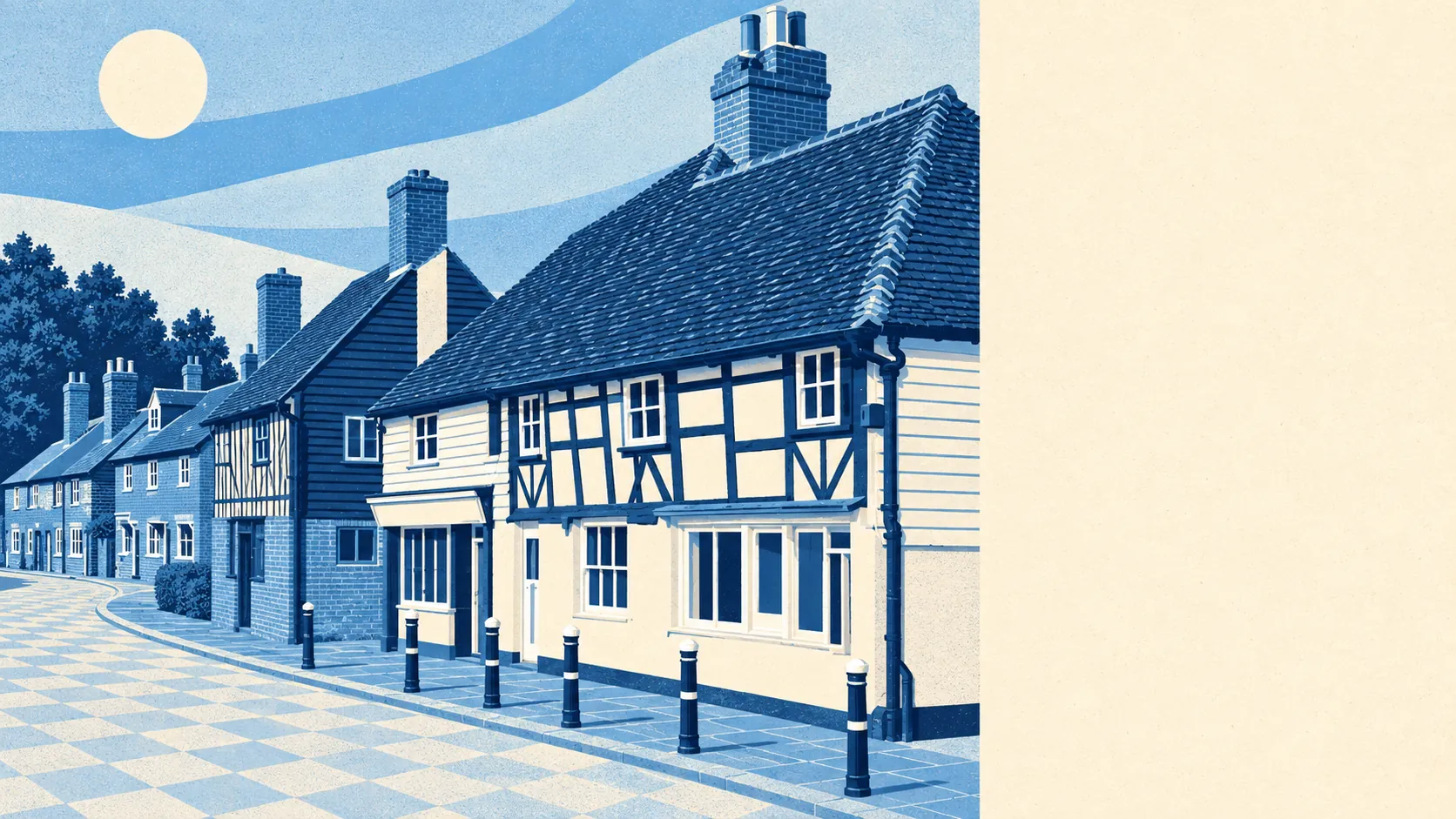
Robertsbridge is a good place to live once you've made your money somewhere else. Three in four households own their home. The typical resident is about fifty. The typical house sells for over half a million. It's a fine village to arrive in and a hard one to start out in.
Robertsbridge is mostly houses, and that stops being obvious once you look for a first rung. On the council-tax valuation list, which covers every home, 39% are detached, 22% semi-detached, 17% terraced and 13% bungalows. Flats make up 7%. Some 44% were built before 1930, so the old stock isn't confined to the High Street. The energy certificates are less flattering. Only 31% of certificated homes reach band C or better, 46% sit in band D and 24% are in E or worse. About 54% of homes are on mains gas and around 9% heat with electricity alone. In a pre-war cottage, that's the line on the listing the estate agent reads fastest.
The Land Registry recorded 23 sales in the year to March 2026, at a median of £530,000. The detached houses set that figure: 15 of the 23 sales were detached, at a median of £577,000. The four terraced sales came in around £270,000 and the three semis around £375,000. Samples that small tell you what happened, not what will happen. Council tax falls most often in band C, and only 11% of homes sit in bands A or B. The cheap end of the market is mostly theory here.
Rent is harder to pin down, because the published figure covers the whole district rather than the village. The typical private rent across the Rother area was about £1,160 a month as of April 2026. Robertsbridge's own streets may not match it, and with only about a quarter of households renting, a tenant here chooses from whatever the owners have decided to let go.
Crime is low and stays low. Robertsbridge's published rate was 51 crimes per 1,000 residents in the twelve months from June 2025 to May 2026, about 30% below the Rother average. In a village this size a handful of incidents can move the shares between categories, so treat the rate as a steady signal and the detailed mix as noise. Most people worried about safety here brought the worry with them.
The station is the headline and the car is the reality. Robertsbridge Rail Station sits on the line between Hastings and London, and Etchingham station is also nearby. At the 2021 census, though, only 3% of working residents took the train to work, 46% drove and 43% worked from home. The commuter line looks better in a brochure than it does in the census. Superfast broadband reaches 99% of premises, while gigabit reaches 13%. Every postcode gets 4G or 5G from at least one operator. There are ten bus stops, and the ones with timetable data average 19 weekday departures each, about one an hour at peak. Nobody moves here for the bus.
Flood risk needs a slow read. Of the village's postcodes, 23% carry a high rating on at least one flood indicator, surface water included. In the Environment Agency's river-and-sea flood zones, 11% of postcodes are in Zone 3, the highest-risk zone, and about 2% in Zone 2. The River Rother runs through the village. The Environment Agency has recorded nine flood events, the latest in October 2000, when the main river overtopped a channel with no raised defences. Check the exact address before you fall for the house. The surroundings are the reason people put up with everything else. The whole village sits inside the High Weald Area of Outstanding Natural Beauty. The average home is about 370 metres from public green space and around 220 metres from water. Here the countryside is the view from the end of your road, not a place you drive to.
Heritage comes with paperwork. Robertsbridge has 54 listed buildings, two at Grade II* and 52 at Grade II, including the Abbey ruins, Monk's Cottage and the former Seven Stars Inn. No conservation area is recorded around the village, so homes that aren't listed go through ordinary planning, with the landscape designation in the background. If you buy a listed one, new windows mean writing to the council first.
Most of the money is already in the houses. About 77% of households own their home, the median age is 50, and modelled gross household income averaged around £60,700 in the financial year to March 2023. The settled majority set the tone. The newcomers who do best here are the ones who arrive already sounding settled.
This page also covers the smaller places around the village: Bodiam, Brightling, Hurst Green, Mountfield and Staplecross. The same rules of countryside, car and cost apply there, only more so.
Robertsbridge suits buyers with equity from a sale elsewhere who want a proper village with a station they'll use now and then. Home workers who need superfast rather than gigabit broadband will be fine. So will anyone whose idea of a commute is the walk to the kitchen table. People who want walks from the front door, and who will check a flood map before they fall in love, will get the most out of it.
It suits first-time buyers badly, because flats are scarce and the cheaper council-tax bands barely exist. Anyone without a car will struggle once the hourly bus is the backup plan. Renters looking for choice won't find it either. People who want a listed cottage without the listed-building consent should look at a newer house.
The village has history, and not only in the stone. Richard I granted Robertsbridge a market charter in 1198, when the place was recorded as Pons Roberti. Barbara Bodichon, the educationalist and women's rights campaigner, lived here. So did the journalist Malcolm Muggeridge and the model Heather Mills, and the footballer Sam Jennings died here in 1944. No host would try to seat that lot at one dinner table.
Robertsbridge is a good place to live, and an expensive one to get into. Its real strength is the surroundings: the whole village is inside the High Weald, and green space and water are a short walk from most doors. The weak spot is value. At a median of well over half a million and with almost no cheap stock, the village makes you pay for the view before it lets you in. Anyone who can pay will find the village worth it.