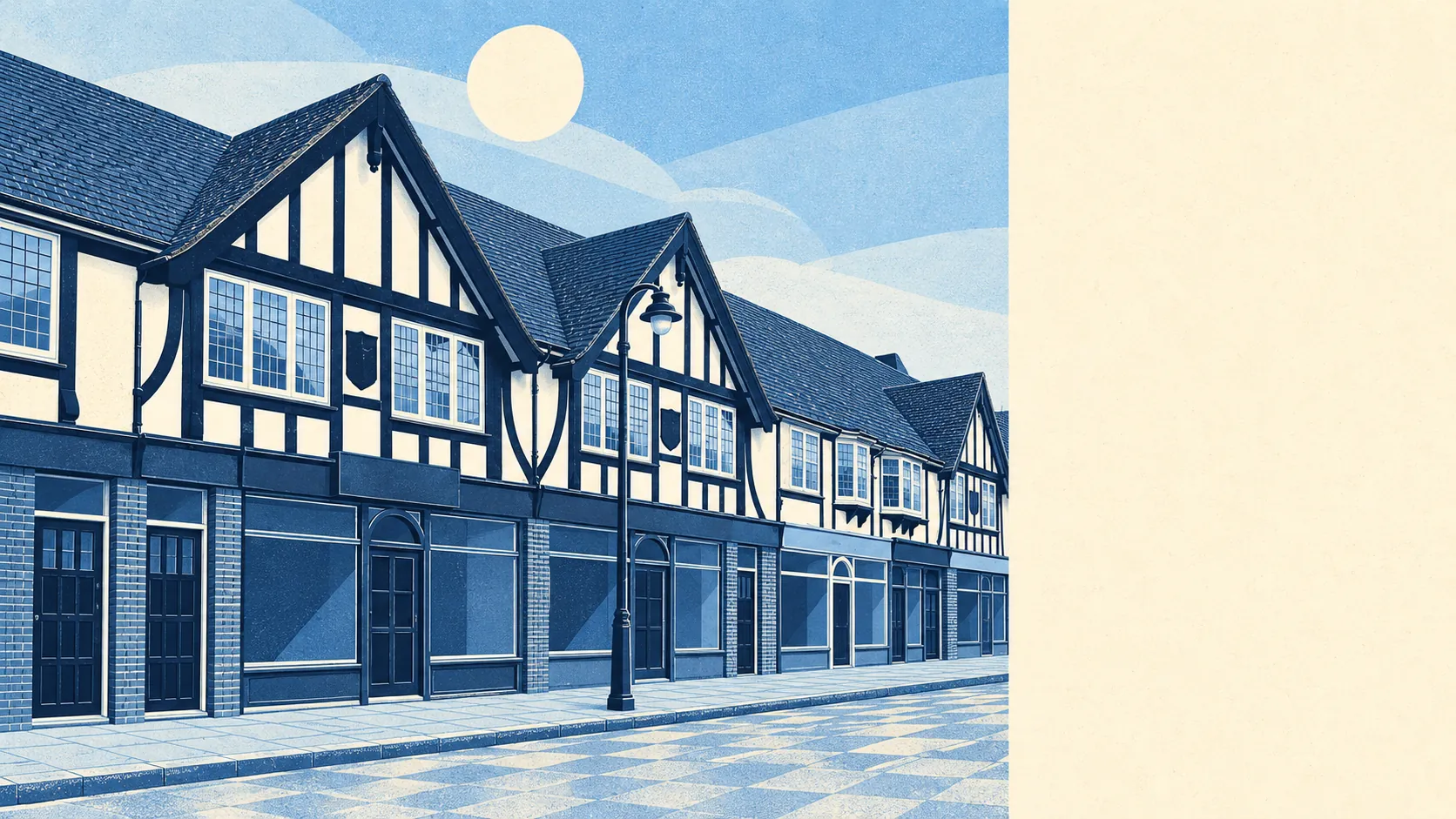
Radlett gives you neighbours who own their homes, earn well and stay put, and it charges close to a million pounds for the introduction. Three in four households own. The typical sale lands just under the million. Crime runs well below the rest of the borough. For anyone whose budget survives the first viewing, the welcome is warm.
The neighbourhood holds together because people commit to it. About 77% of households own their home, and the typical resident is 45. The Office for National Statistics models gross household income across the area at about £79,000 for the financial year to March 2023, averaged over its two middle-sized statistical areas. People here join things and stay in them: there's cricket on Cobden Hill, rugby at Tabard and a big floodlit tennis club. A town whose cricket club dates from 1884 and whose rugby club from 1951 has had a long time to learn everyone's name.
The money is the hard part. The Land Registry recorded 92 sales in the year to the end of May 2026, at a median of £985,000. Detached houses pull that up: 45 of them sold, at a median of £1,635,000. Semis went for about £775,000, the nine terraced houses for about £600,000 and flats for about £485,000. The most common council-tax band is G, and only about 6% of homes are in bands A or B. Hertsmere charges about £2,406 a year at Band D and £4,812 at Band H. In Radlett the cheap option is a flat at £485,000, and that takes some getting used to.
Renting doesn't get you in for less. Typical private rent across Hertsmere is about £1,800 a month, and that council-wide figure averages the whole borough, from small flats to large houses. About a quarter of Radlett's households rent, so the local choice is small to begin with.
The houses are big. On the council-tax valuation list, about 41% of dwellings are detached, 17% semi-detached, 11% terraced, 23% flats and 5% bungalows. Only about a fifth were built before 1930, so most of the town is inter-war and post-war, and just over half of households have four or more bedrooms. On the homes that hold an energy certificate, about half are rated A to C and 14% E or worse. Mains gas heats about 85% of homes. Four bedrooms is normal here, and so is paying to heat them all.
Hertfordshire Constabulary's published figures put Radlett at about 62 crimes per 1,000 residents in the year to May 2026, against about 91 per 1,000 across Hertsmere. The mix is more specific than the total. Burglary makes up about 9% of recorded crime here, against about 4% across England and Wales, and vehicle crime about 12% against 5%. Burglars and car thieves can read a council-tax band too.
Flood risk depends on which measure you use. About 9% of postcodes carry a high rating on at least one flood indicator, surface water included, and 12% a medium one. In the Environment Agency's river-and-sea flood zones the shares are much smaller: about 2% in zone 3 and 3% in zone 2. Eight flood events are on record, the latest in December 1992, when a main river overflowed its channel with no raised defences in the way.
Most front doors are close to open ground. The average home is about 270 metres from green space, with around 13 green spaces within a kilometre, and water of some kind is about 330 metres away. Since the 1950s the Green Belt has limited building here to infilling, and the same rule that keeps prices high also keeps the fields where they are.
Radlett Rail Station is the town's best-known asset, but at the 2021 Census only about 4% of working residents took the train to work. About 56% worked from home and 31% drove. Gigabit broadband reaches about 74% of premises and superfast about 99%. The 29 bus stops average about 29 weekday departures each, with fewer than two buses an hour at peak. The Victorian railway built modern Radlett, and the town has thanked it by mostly staying in.
Altering a period home means dealing with the council. There are 17 listed buildings, one at grade II* and 16 at grade II, and two conservation areas, Radlett North and Radlett South. Inside them, new windows, extensions and front-garden changes get looked at closely before anything is approved.
Primary schooling is strong. Across the three primaries in the district that report results, the average end-of-primary maths score was about 107, and Newberries Primary School and Fair Field Junior School are both local. Across Hertfordshire, Ofsted has graded 203 of 227 settings good or better, a county-wide figure that says nothing about any one school gate. Radlett has no mainstream secondary school, so children leave town at 11, mostly on dedicated buses. The Department for Transport's 2019 model put the public-transport trip to a secondary school at about 25 minutes. Every Radlett child gets a commute at 11, which is more than most of the working adults in town can say.
The town's history is noisier than its present. Handley Page opened an airfield north of the village in 1929 and built Halifax bombers there in the war. The Victor bomber prototype was flight-tested after the runway was extended in 1952, and a road named after it now runs beside a parcel depot. The airfield closed in 1970, and later residents brought a different kind of fame: Jeff Wayne of The War of the Worlds, Hank Marvin and Brian Bennett of the Shadows, Ted Childs, who produced The Sweeney and Inspector Morse, the actress Pam St. Clement and the EastEnders actress Lacey Turner. The bombers moved out and the television detectives moved in.
Radlett is right for a household with a large deposit, work that rarely needs an office, and children who won't mind the bus at 11, and it pays back people who like belonging to a club. First-time buyers and anyone hoping to stretch a modest budget should look elsewhere, because decades of infill-only building have kept the small, cheap homes few.
Radlett is better than average to live in. The neighbours are the reason to move here, and the price is the reason most people can't.