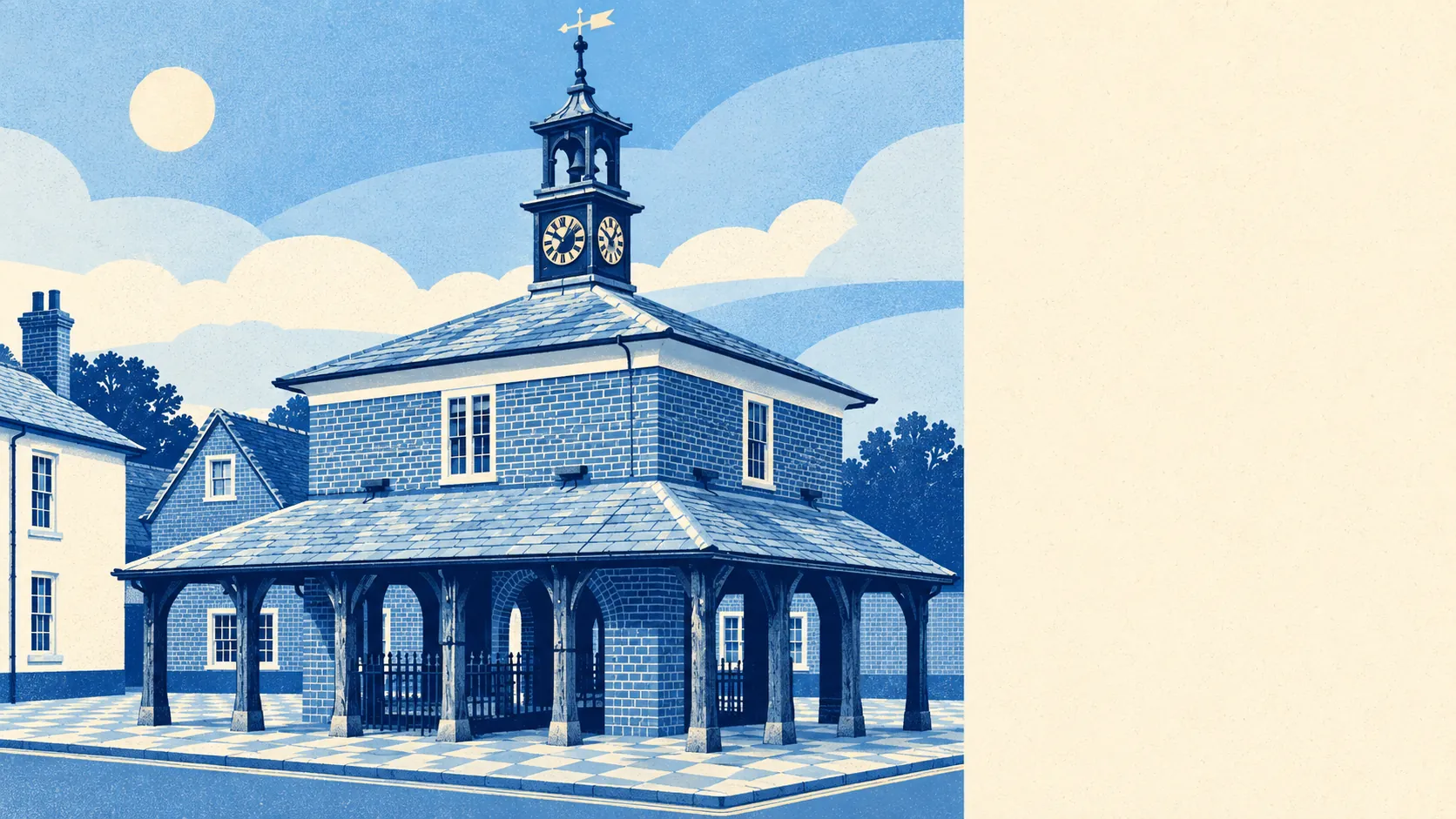
Princes Risborough is a proper working market town with the Chilterns starting at the end of the road, and for the right buyer that combination is hard to beat. Life here runs on the car, the home office and the hills, in roughly that order. It is right for people who want a town that functions on weekdays and countryside that takes over at weekends. Anyone hoping to buy an old cottage and rebuild it from the inside out has picked the wrong town.
Safety is the easy part of the case. Police figures for the year to May 2026 put Princes Risborough at about 44 recorded crimes per 1,000 residents, roughly a third below the Buckinghamshire average of about 65. Thames Valley Police, the force covering the town, charged about 9% of offences over the same period against a national rate of about 12%, though that is a force-wide number, not a local one. The low crime rate here comes from the town, and the charge rate comes from the force.
Heritage is where the town pushes back. There are 93 listed buildings in and around it, one at Grade I and six at Grade II*, and six conservation areas: Princes Risborough itself, Monks Risborough, Whiteleaf, Askett, Alscot and Horsenden. Inside those boundaries, new windows, dormers and extensions go through Buckinghamshire Council's planning process with a heritage officer reading over its shoulder, and a listed house needs consent for work inside as well as out. Seven scheduled monuments sit around the town as well. The barrows on Whiteleaf Hill have firmer planning protection than most kitchens here, and they have been waiting longer.
Homes sold through the Land Registry in the year to late May 2026 went for a typical £467,500 across 96 sales. Detached houses went for around £700,000, semis around £480,000, terraces around £405,000 and flats around £240,000. Band D is the most common council-tax band, and only about 6% of homes are in bands A or B, so cheap starter stock is thin on the ground. The ladder has rungs at the top and bottom and a long stretch of bare pole in between.
Renting is a small market, with about 12% of households renting privately. Buckinghamshire Council's area as a whole had a typical private rent of about £1,470 a month in April 2026, up 5% on the year, a county average that takes in High Wycombe and Aylesbury along with everywhere else.
The council-tax valuation list shows a town of houses: about 29% detached, 25% semi-detached, 14% terraced and 15% flats, with bungalows at 16%. Only about 15% of homes were built before 1930, and the energy certificates show a stock that is mostly post-war. About 55% of certificated homes are rated A to C, 35% D and 10% E or worse, and about 79% of homes are on mains gas. The old buildings are mostly on the high street and the shops have them. Nearly everyone else lives in the comfortable brick that came after.
About 73% of households own their home, the typical resident is 50, and the Office for National Statistics models median gross household income at about £72,000 for the financial year to March 2023, averaged across the wider area. People mostly move here once the deposit has stopped being the hard part.
Flood risk is modest. About 7% of postcodes are rated high on at least one flood indicator, surface water included, with 11% medium and 27% low. On the Environment Agency's river-and-sea flood zones the picture is calmer still: about 1% of postcodes are in zone 2 and none in zone 3. Whatever risk the town carries is mostly about where heavy rain goes, not a river.
The railway is the odd one out. Princes Risborough station, with Monks Risborough, Saunderton and Little Kimble close by, gives the area more rail than most market towns get, yet at the 2021 Census only about 2% of working residents took the train to work. About 45% worked from home and 42% drove. A town with its own junction has decided the best commute is no commute at all. Broadband backs that decision: superfast is available at 99% of premises and gigabit at about 66%. Buses are the weak link. Of the 30 stops with timetable data, the average had about three weekday departures and none had a weekend service. Without a car, Saturday is a walking day whether you planned one or not.
Which is less of a hardship than it sounds, because the walking is the best thing about the place. The nearest green space is about 180 metres from the average front door, with around 16 green spaces within a kilometre, water about 330 metres away and the National Cycle Network about 360 metres off. The edge of the Chilterns Area of Outstanding Natural Beauty brushes the town. Lacey Green and Speen are up in the hills themselves, while Longwick and Ilmer spread across the flatter ground towards the Oxfordshire border. Bledlow and the rest of Bledlow-cum-Saunderton, Great and Little Kimble cum Marsh and Monks Risborough complete the ring. A dog owner here will get more out of the postcode than almost anyone.
Princes Risborough is a better-than-average place to live, and the reasons sit on either side of the front door. Outside it, the hills, the green space and the low crime are there every morning without anyone having to drive to them. Inside it, the conservation areas and listed buildings mean the house you buy is fairly close to the house you will keep. It is right for people who work from home, own a car and want to walk out of the door straight into the Chilterns. Renovators with a sledgehammer and a vision, and anyone who needs a Sunday bus, should look elsewhere.