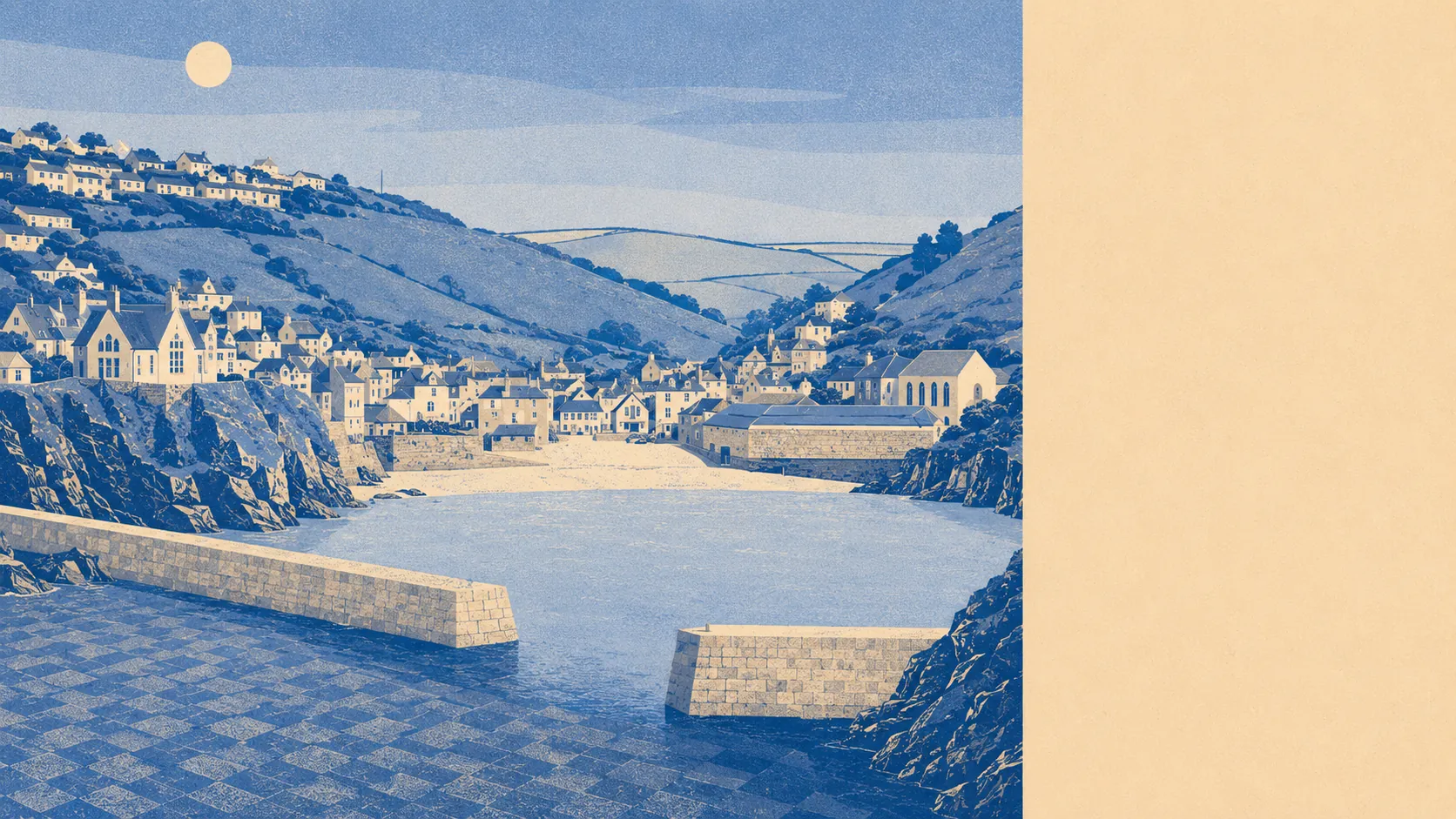
Port Isaac is a good place to live, and an even better place to own and let out. Two in three homes are owner-occupied. The typical resident is in their fifties. More than two hundred properties in the village are holiday lets. That is the bargain in one line: a village that works, funded largely by people who are leaving on Sunday.
The housing stock is not what the harbour photographs suggest. Across every dwelling on the council tax valuation list, about 33% are detached and around 25% are bungalows, ahead of the 19% that are terraced and the 16% that are semi-detached. Flats account for roughly 5%. About 44% of it was built before 1930, and the energy ratings show what that means in practice: around 58% of certificated homes sit at band E or worse, about 23% at band D, and only about 19% reach bands A to C. Just 6% are on mains gas. Close to a quarter run on electricity alone, and another 6% have no central heating at all. An old stone house above the Atlantic is a wonderful thing to look at and an expensive thing to warm, and the second fact arrives about three weeks after the first.
On price, the Land Registry recorded 11 sales in the year to March 2026, at a median of £345,000. Split by type, four terraced sales came in at a median of £329,000 and four detached at £500,000. Eleven transactions in twelve months is not a market so much as a queue, and the queue is what sets the price. Council tax lands mostly in band D, though about 32% of dwellings sit in bands A or B, which is the part of the village that never appears in the property pages.
Renting is harder to pin to the village itself. Typical private rent across the Cornwall area runs at about £1,000 a month as of April 2026, up around 5% over the year, and that is a council-area average rather than a Port Isaac figure. Locally, about 14% of households rent privately and about 19% rent socially. The long-term rental market here competes for the same buildings as the short-term one, and the short-term one pays weekly.
Safety is the standout. The recorded crime rate is about 41 offences per 1,000 people in the twelve months to May 2026, against roughly 74 across Cornwall as a whole, which puts the village around 45% below the wider council area. Worth knowing what happens next, though: Devon and Cornwall Police charged or summonsed about 8% of recorded offences over the same period, against about 12% nationally, and the force ranks last of the 42 in England and Wales on that measure. Very little happens. What does happen tends to stay unresolved.
Connectivity is the weak spot, and it is not close. Nobody commutes by train, because the line through Wadebridge shut in 1966 and never came back. About 52% of working residents drive, roughly 30% work from home, and about 12% walk. Half a percent take the bus, which is fair, given there are 8 stops and the five with published timetables average 22 weekday departures between them, all of them running at weekends too. A town centre is about 20 minutes by car and 56 by public transport. The nearest hospital is around 65 minutes in the car. Broadband is the consolation: every postcode can get superfast, though only about 3% can get gigabit. Mobile coverage reaches all postcodes on at least one operator and about 95% on all of them.
Water is the defining constraint. Every postcode sits within 500 metres of the coast, the median is about 125 metres, and the closest is 17 metres from the sea. On at least one flood indicator including surface water, about 24% of postcodes carry a high rating, about 21% medium and about 41% low. Inside the Environment Agency's river-and-sea flood zones the numbers are much smaller: roughly 3% of postcodes fall in zone 2 and none in zone 3. The two measures are answering different questions, and the surface-water one is the one that matters when a Cornish downpour meets a village built down a valley. The shoreline plan is hold the line across the twenty, fifty and hundred year horizons, while the nearest tide gauge at Devonport has recorded sea level rising about 2.35 millimetres a year. Compensations: green space averages roughly 350 metres away with two sites within a kilometre, and water is about 120 metres from the average front door, which is one way of describing the entire proposition.
Heritage is the other constraint. There are 102 listed buildings, all of them Grade II, and the whole village sits inside the Port Isaac conservation area. Roscarrock, Tresungers and the Church of St Endelienta are among the listed entries. In buying terms this means the windows, the render, the roof and the front door are matters for the council rather than for taste, and anyone planning to modernise should price consent and delay into the offer.
The character follows from all of it. Around 66% own their homes, the median age is 51, and modelled household income before tax averaged about £46,000 in the financial year to March 2023. Roughly 38% of households are one person living alone, and about 22% are a pensioner on their own. Against 423 households there are 222 holiday lets, 23 shops, three pubs and three restaurants, and 90 titles in the district are held by companies. Nearby St Endellion carries the parish church, and Port Quin along the coast is smaller again. The place is not hollow, but it is thinner in February than the summer suggests, and honest residents will tell you which months they actually like.
The name means port abounding in corn, which is the first sign that this village has changed its business model before. The Tudors dredged the harbour, the pilchards ran the economy until they stopped running, and tourism took over after the First World War. The place produced Edmund Henry Hambly, born here in 1914, an orthopaedic surgeon who spent his spare energy promoting the Cornish language, and it produced the Fisherman's Friends, singing shanties since 1995 to audiences well beyond the harbour wall. In 2016 the council told a local taxi firm to change how it displayed its name on grounds of good taste, which tells you as much about the modern village as any Ofsted table would.
It suits people who work from home or have finished working, who want water at the end of the street, who will happily drive for an hour when something goes wrong, and who read a quiet winter as the reward rather than the catch.
It does not suit anyone who needs a train, a hospital within reach of a bad night, a gigabit connection for work, cheap heating, or the freedom to put in the windows they actually want.
Port Isaac is average overall in the way that only a place of extremes can be. Its real strength is how little crime happens on its streets. The weak spot is transport and connectivity, which is not a fixable inconvenience but a fixed feature of living ten miles from anywhere with the sea on the fourth side. Come for the water, budget for the heating, and accept that the road out is the same length every day of the year.