Yes, provided you want a town rather than a view. Green space starts at the end of nearly every street. A terrace here costs less than a semi on the same hill. Half the homes sit in the two cheapest council tax bands. What will actually wear you down is not the students. It is the permission you need before you touch the front of your own house.
The housing is a proper mixed bag rather than a single period. On the council tax valuation list, which covers every dwelling rather than only the ones sold or certificated recently, terraces are the largest single type at about 28%, flats about 22%, bungalows about 20%, semis about 15% and detached about 13%. Roughly 22% of it went up before 1930, so the granite-and-slate stock is a real part of the town rather than a postcard of it. Energy performance splits about evenly: around 52% of certificated homes sit in bands A to C, 34% in band D, and about 14% at band E or worse. Two-thirds run on mains gas. About 12% are heated by electricity alone, which is a detail worth establishing at the viewing rather than in January, because an electric-only Victorian cottage is a different financial animal from the identical one next door with a boiler.
On price, the Land Registry's last twelve months to May 2026 put the typical sale at £277,500 across 98 transactions. The type matters more than the average does. Flats came in around £169,500 over 20 sales, terraces around £259,000 over 40, semis at £320,000 over 15, and detached houses at £415,000 over 23. So the gap between a terraced front door and a detached one here is the price of a flat, and the terraces are where most of the market actually happens. Council tax runs low: band B is the most common, and about 55% of dwellings sit in bands A or B.
Renting is harder to pin to the town itself. The published figure is the typical private rent across the Cornwall area, about £1,000 a month as of April 2026, and it is a county-wide number rather than Penryn's own. Treat it as the shape of the market, not a quote.
Crime is unremarkable in the way buyers want and estate agents never manage to say convincingly. The recorded rate over the year to May 2026 was about 71 crimes per thousand residents, which sits roughly 4% below the Cornwall average. Shoplifting makes up a larger share of the mix here than it does nationally, which is what a compact town centre with a student population produces. Worth knowing separately: Devon and Cornwall Police charged in about 8% of cases across the force over the same period, against about 12% nationally. That is a force-wide statistic rather than a Penryn one, but it is the force that would be turning up.
Connectivity is decent for west Cornwall and mediocre for anywhere else. Penryn Rail Station sits on the branch line, with Penmere, Falmouth Town, Falmouth Docks and Perranwell strung along the same route. About 2% of working residents take the train and about 3% the bus, while half drive and about 27% work from home, which tells you what people have concluded about the timetable. There are 60 bus stops in the area, averaging about 51 weekday departures each, and around 93% of them keep a weekend service. The nearest town centre is modelled at about 13 minutes by car and 27 by public transport. Broadband is better than the roads: gigabit service reaches about 61% of premises, superfast about 86%, and no premises fall below the universal service obligation. Around 95% of the area gets a signal from every mobile operator.
The surroundings are the strongest thing Penryn has going. Green space averages about 141 metres from a home, with roughly 20 sites within a kilometre, and water is closer still at about 163 metres. Flooding needs care, because two different measures circulate. On the postcode indicators, which include surface water, about 12% of postcodes carry a high rating on at least one. On the Environment Agency's river-and-sea mapping, about 7% of the area falls inside flood zone 3 and about 3% inside zone 2, rising to roughly 14% once the climate allowance is added. Six flood events are on the record, the most recent in 2014 and from the sea. Separately, the British Geological Survey places the whole area in the highest radon band, which means a test and, if needed, a fan, not a reason to walk away.
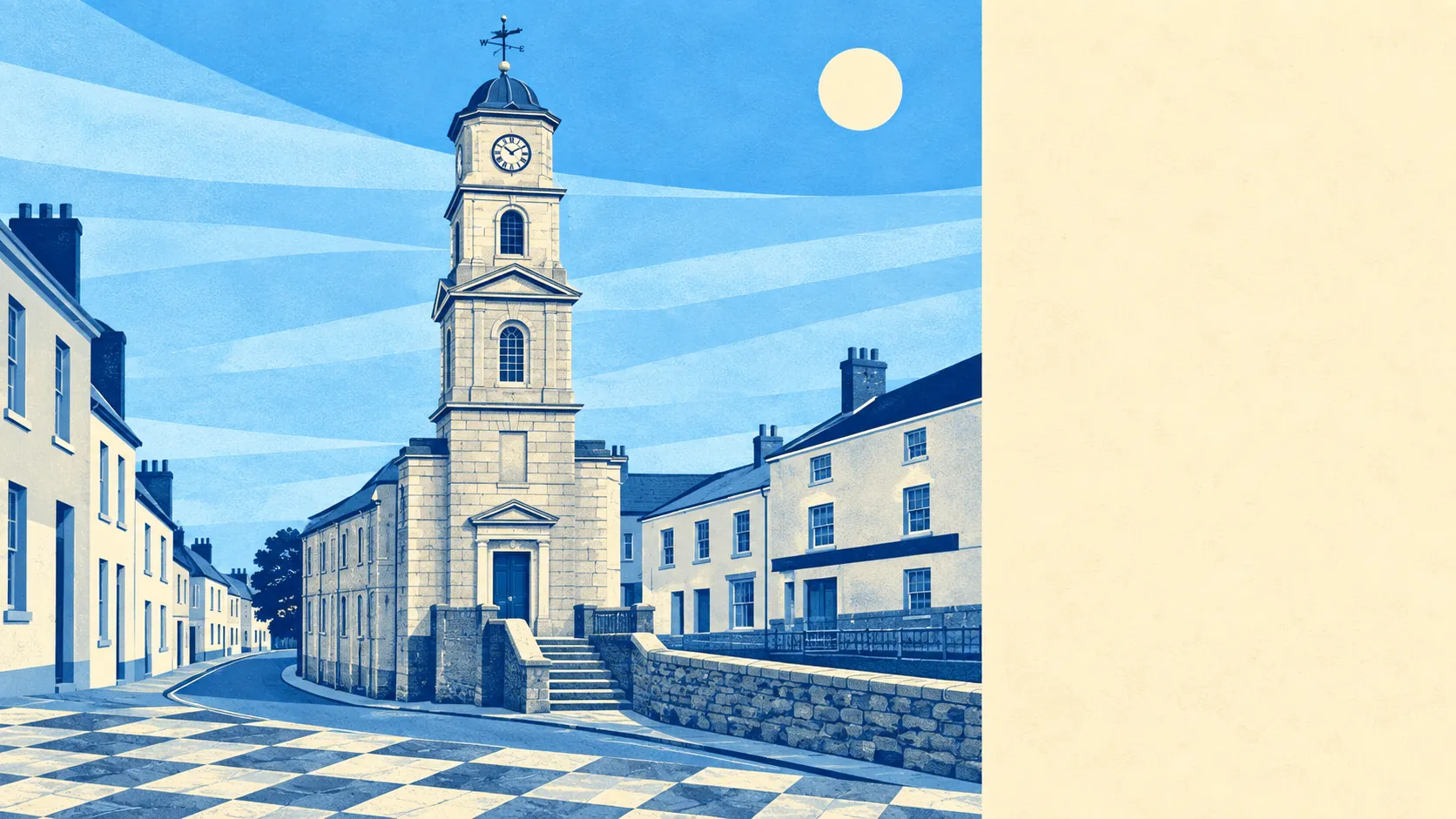
The heritage position is where the town takes something back off you. Penryn holds 215 listed buildings, 212 of them grade II and three at grade II star, plus a conservation area covering the historic streets and three scheduled monuments, among them what is left of Glasney College. That density is the tightest constraint on the page. It does not stop you buying. It does mean windows, doors, roofs, render and anything visible from the street become a conversation with the council rather than a weekend.
On character, about 59% of homes are owner-occupied and the median age is 31, though the second figure needs the campus attached to it. Of 11,772 residents, 1,638 live in halls and 10,134 in ordinary households, so the town reads younger on paper than it feels on a Tuesday morning. Household income, modelled gross for the financial year to March 2023, runs at about £50,600.
It suits people who want a working Cornish town with a rail stop, cheap council tax bands and countryside at the end of the road, and who are happy that the social centre of gravity sits down the hill in Falmouth. It suits a first buyer looking at terraces particularly well.
It does not suit anyone who wants to buy a period house and start reshaping it, or anyone whose commute depends on a train that goes somewhere fast. It also does not suit people who want a quiet street in September.
The town has form for producing people who left and then wrote about it. Peter Mundy, son of a Penryn pilchard trader, got as far as Asia, was among the first Europeans to taste tea, and came home to write one of the earliest travel guides in English. John Coode went further off-script and ended up governing Maryland. Glasney College, founded here in 1265 and demolished in 1548, was consequential enough that its dissolution helped set off the Prayer Book Rebellion the following year. Few towns this size have caused a rebellion and then gone quiet for five hundred years.
Penryn is a good place to live, and an awkward one to renovate. Its real strength is what sits around it: green space and water within a couple of minutes of the front door, and countryside that starts before the houses have finished. The weak spot is freedom, because the listed stock and the conservation area mean the town has opinions about your windows. Buy the one that already has the boiler and the double glazing, and you inherit the good half of that bargain.