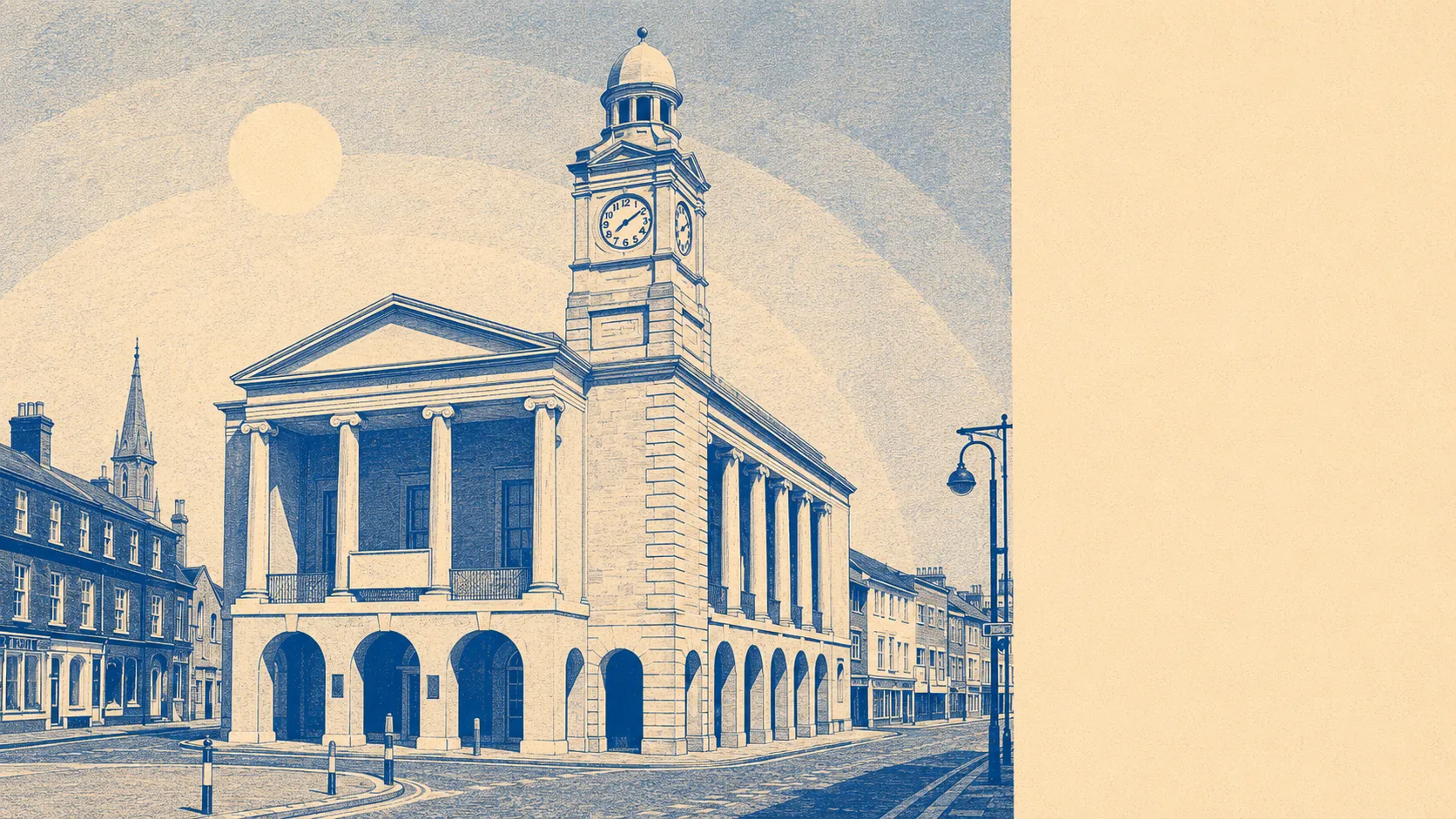
Newport is the Isle of Wight off-duty. Twenty-six thousand people. Every island bus ends up at Coppins Bridge. The hospital, the council, the shopping. The functional middle of an island that mostly sells postcards.
The housing is mostly houses. About two thirds of the stock. Flats are a quarter. Bungalows make up nearly one in ten. The dominant build period is post-war, the streets that went up between 1950 and 1982 when the island was catching up on slum clearance and the population was growing. About one in six homes pre-date 1930, fewer than a south-coast county town reader would expect. More than half the energy ratings sit in band A to C, roughly average for the region. About one in seven sit in band E or worse, which is the bit you check before you buy a pre-war semi off the Mall Road.
Sale prices are the cheapest of any reasonable south-coast county town. The typical sold price over the last twelve months was £220,000 across 327 transactions, which is what you pay in Portsmouth for a one-bed flat. Flats here go for about £120,000. Terraces around £205,000. Semis £242,500. Detached £310,000. Council tax sits mostly in bands A and B, which together cover nearly half the stock, with band B as the modal band. The cost-of-living calculation that makes Newport make sense is the one where the mortgage is small and the day-to-day bills are average. The calculation that breaks it is the one where you wanted to live in Cowes.
Rents are not separated out for Newport, so the figure to work with is the typical private rent across the Isle of Wight area, which sits at about £940 a month. That is closer to a Hampshire mainland number than a Portsmouth one. The island carries a premium over what its incomes would suggest, because more retired people than working ones are bidding up the housing, and because the Solent is between you and a longer commute. Newport is not the most expensive bit of the island. That is Cowes. Newport is the bit where the rent works out.
The crime figure is the conversation that has to happen. Newport's published crime rate is about 135 incidents per thousand residents per year, which sits roughly sixty-two percent above the Isle of Wight local-authority average. Most of that is concentrated in the town centre between Coppins Bridge and St Mary's Hospital, which is where every island bus eventually deposits everyone. The residential streets read very differently to the high street, but the headline number is the headline number, and it is the one that comes up when somebody mentions Newport to a Sandown landlord. Worth checking street-by-street instead of trusting the average.
Transport is buses and cars. The railway station closed in 1966 and the dual carriageway runs along the old track bed, which tells the reader something about the priorities of the era. About half of working residents drive to work and roughly one in five walk. About a quarter of households have no car at all, high for a south-coast town, reflecting the bus network and not a low-traffic ambition. There are 148 bus stops in town and route 1 from Cowes funnels in because Cowes has not had a train since the same 1966. Broadband is unexpectedly fine. Gigabit coverage reaches nearly nine in ten properties.
The environment is mostly green. The average property sits about 200 metres from a green space, with eighteen of them within a kilometre, the sort of figure rural towns produce and most urban centres do not get near. About 2.6 percent of the area is in the Isle of Wight Area of Outstanding Natural Beauty, which is meaningful for the bits around the edges. Flood risk is more concentrated than the average town. Roughly one in five postcodes carry at least some high flood risk, and one in six carry medium risk. Only one percent sits in the Environment Agency's Flood Zone 3, but the surface-water and tidal numbers are the ones a buyer should look up for their specific street, not the postcode average. Newport sits on the Medina at sea level. The Portsmouth tide gauge, the nearest with a long record, has been rising at about two millimetres a year since 1962. The maths does not care that you bought a Grade II terrace.
Heritage constraints sit in the middle of the range. There are 322 listed buildings, with five Grade I and seven Grade II starred, plus three scheduled ancient monuments including Carisbrooke Castle. There are zero formally-designated conservation areas inside the built-up boundary, unusual for a county town, meaning the planning regime for extensions and external alterations is less restrictive than the listed-building count would suggest. If you buy a listed property you sign up to the heritage paperwork. If you do not, you mostly do not.
Newport reads as a working town with retirement mixed in. About six in ten households own their home, below the south-of-England average but above the figure for any postal-district town next door to a London commute. The median age is 42, the kind of figure that splits between younger working families on the west of the town and older households settled around Carisbrooke and Pan. Median household income is about £47,500, competent rather than affluent and consistent with the public-sector and retail-services economy that the county-town role implies. Money that came from the council and the hospital, not the City.
Newport suits buyers who want an actual house on actual money, who do not need a station of their own, and who can live with the fact that the high street has more vape shops than independent bookshops. Families with school-age children who can find a good catchment, retirees who want the hospital nearby, and remote workers who care about the broadband and not the commute will all find what they need.
It is not for buyers who want yachting culture without paying for it, who think Sandown is the smart move, or who would rather live in Ryde because at least Ryde has the ferry.
The historical residents are mostly judges, daughters of kings and minor literary figures. Sir Thomas Fleming, born in the town in 1544, presided over the trial of Guy Fawkes, one of the better local CVs for a Tudor lawyer. Elizabeth Stuart, the second daughter of Charles I, died at Carisbrooke Castle aged fourteen in 1650 and is buried at St Thomas' Church, the kind of historical fact a tour guide will tell you and then you remember every time you walk past. Charlotte Anley wrote novels in the town in the 1820s. The Treaty of Newport was negotiated here in 1648 between Charles I and the parliamentary commissioners; Cromwell repudiated it after Preston, and Charles was executed shortly after. Not a quiet history for an admin town.
The verdict works out as average overall, which is fair for a place that has been the island's administrative middle for four hundred years. The strongest dimension is the surrounding area and green space, which scores at the top of the scale because two hundred metres to the nearest green space and the island's Area of Outstanding Natural Beauty on the doorstep is a quality of life most south-coast towns cannot claim. The weakest is the published crime rate. Cheaper than Cowes. More functional than Sandown. Less smug than Ventnor. The crime rate, roughly sixty-two percent above the island average, is the conversation you have to have first.