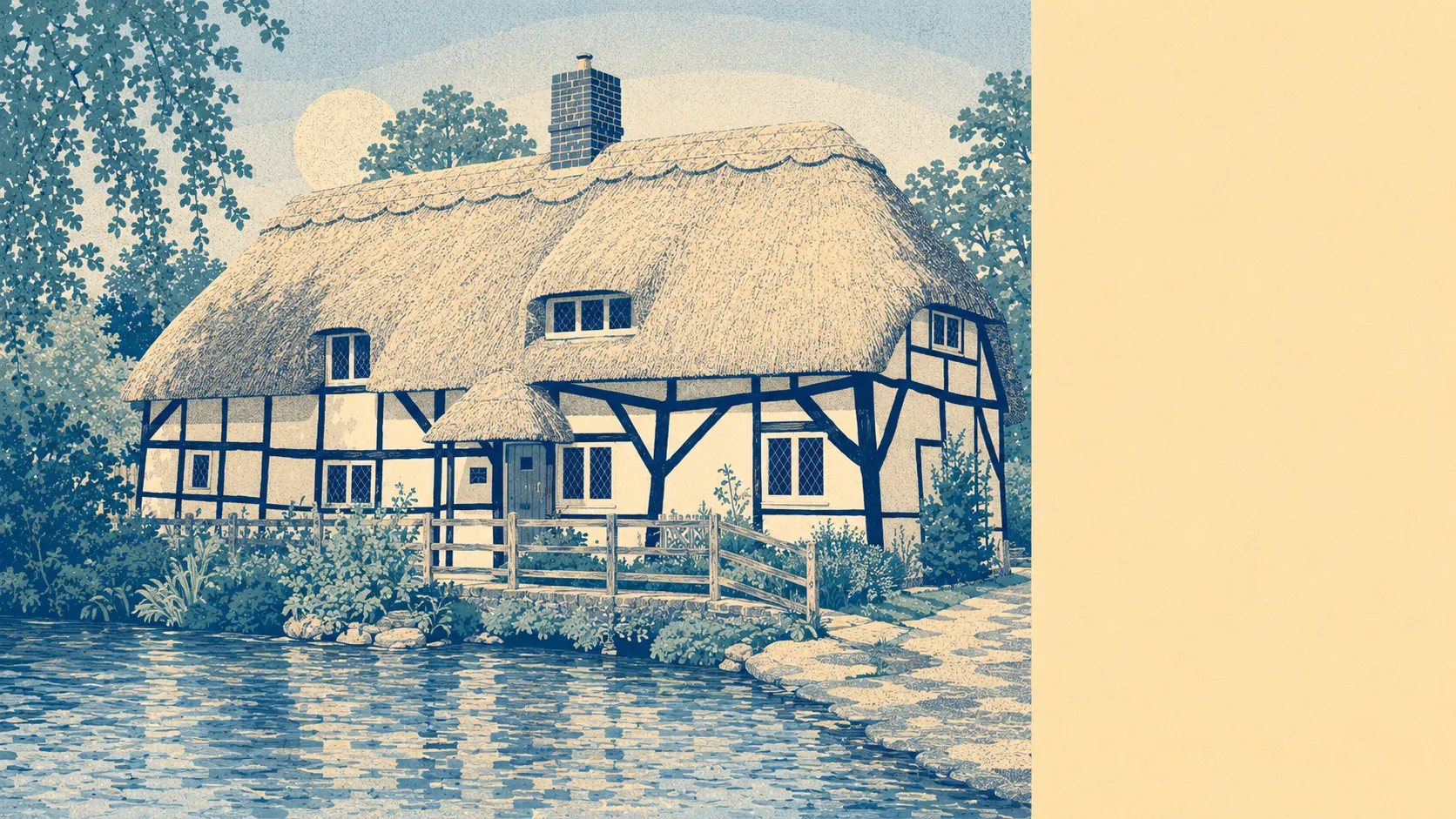
New Alresford is a Georgian market town that quietly priced out everyone under fifty. The typical home sold for around half a million pounds last year. Roughly seven in ten households own the place they live in. The median resident is 52. This isn't young Hampshire, it's settled Hampshire, with a heritage railway that doesn't go anywhere you need to be.
The housing is houses, which sounds obvious until you compare it to anywhere near a city. More than six in ten homes here are houses and fewer than one in five are flats, with a solid run of bungalows filling the gap, which already tells you who's buying. Most of the stock went up between the 1950s and the early 1980s, so the Georgian frontages the town trades on sit in front of a lot of plainly ordinary post-war building. On energy, about half the homes reach band C or better, getting on for four in ten sit at band D, and roughly one in nine come in at band E or worse. The older and prettier the house, the colder the hallway.
The typical home changed hands for about £505,000 over the past year, off around seventy sales. The spread is the usual Hampshire ladder. A detached house runs to roughly £610,000, a semi around £470,000, a terrace about £427,500, and a flat closer to £240,000, which is the only way into the town under a quarter of a million. Council tax puts most homes in band C, and only about one in six sit in the cheaper band A or B bracket, so the low-tax end of the market is thin on the ground.
Renting is a minority sport here, about a quarter of homes, split between private and social. The typical private rent across the Winchester area runs at about £1,500 a month, up nearly four percent over the year. That's a district figure covering the whole of Winchester rather than the town alone, so read it as a guide to the sort of neighbourhood you're moving into, not a quote for the street.
On crime the town does what genteel market towns do. The published rate is around 31 recorded crimes per thousand people a year, roughly 52 percent below the wider Winchester district average. That's the published figure, not a sum you get by dividing the crime count by the people who live here, and it puts Alresford among the calmer places in an already calm district. Nothing here is going to keep you up at night except possibly your own heating bill.
Connectivity is the weak spot, and it isn't close. Almost nobody commutes by train, for the good reason that the only line is the Watercress Line, a heritage railway that runs to Alton for the pleasure of it rather than for the nine o'clock meeting. Getting on for half the working population drives, and a similar share works from home, which is how a town with no real station functions at all. Broadband takes the edge off: near enough every home can get superfast, and about half can get gigabit, so the work-from-home half aren't doing it on a dial tone.
For surroundings the town scores well. Green space is rarely more than a couple of minutes off, with something like a dozen parks or open spaces within a kilometre of the average front door, and Alresford Pond and its watercress beds sit right on the northern edge. Flood risk is real but contained: roughly eight percent of postcodes carry some high surface-water risk and about one in five carry a low risk, which is worth checking street by street rather than assuming, because the river and the pond don't spread it evenly.
Then there's the heritage overhead, which is the price of all those Georgian frontages. The town carries around 133 listed buildings, four of them at the higher grade two star, plus a conservation area covering New Alresford itself and a scheduled monument at the medieval Alresford Bridge. Buy one of the pretty ones and the conservation rules will have opinions about your windows, your front door and the colour of your render. Character comes with a planning officer attached.
The character of the place follows from the numbers. About seven in ten homes are owner-occupied, the median age is 52, and the typical household income is a little over £63,000, comfortably above the national middle. This is a town of settled owners rather than churn, the sort of place people arrive and stay, and the age profile tells you they mostly arrive having already done the city part of their lives.
It suits a particular buyer. If you want a walkable Georgian town with good green space, low crime and a garden, and you either work from home or don't mind driving to everything, Alresford gives you exactly that with no surprises.
It doesn't suit you if your life runs on a train. Anyone commuting daily to London, or even to Winchester by rail, will spend the first fortnight discovering that the station on the map is a steam attraction, and the second fortnight weighing up the drive into Winchester and the parking at the other end. Young renters and first-time buyers will also find the ladder starts high and the cheap rungs are mostly missing.
The town has form for producing and keeping interesting people. Mary Russell Mitford, the novelist and dramatist, lived at 27 Broad Street until she was ten. The cricket commentator John Arlott made Alresford home for twenty years from 1961, which is about as good a character reference as an English market town can ask for. And both Alexa Chung and Russell Howard passed through Perins School, a range of alumni most towns this size would struggle to match.
Add it up and Alresford lands above average, a comfortable three and a half out of five. Its strongest card by a distance is the community and the settled, low-crime, well-owned feel of the place, which scores full marks. Its weakest, also by a distance, is getting out of it without a car. So the honest verdict is this: if the trade on offer is a lovely Georgian town in exchange for a life built around your own driveway, and that sounds like a good deal, Alresford is one of the best versions of it in Hampshire. If it doesn't, you already know where the station isn't.