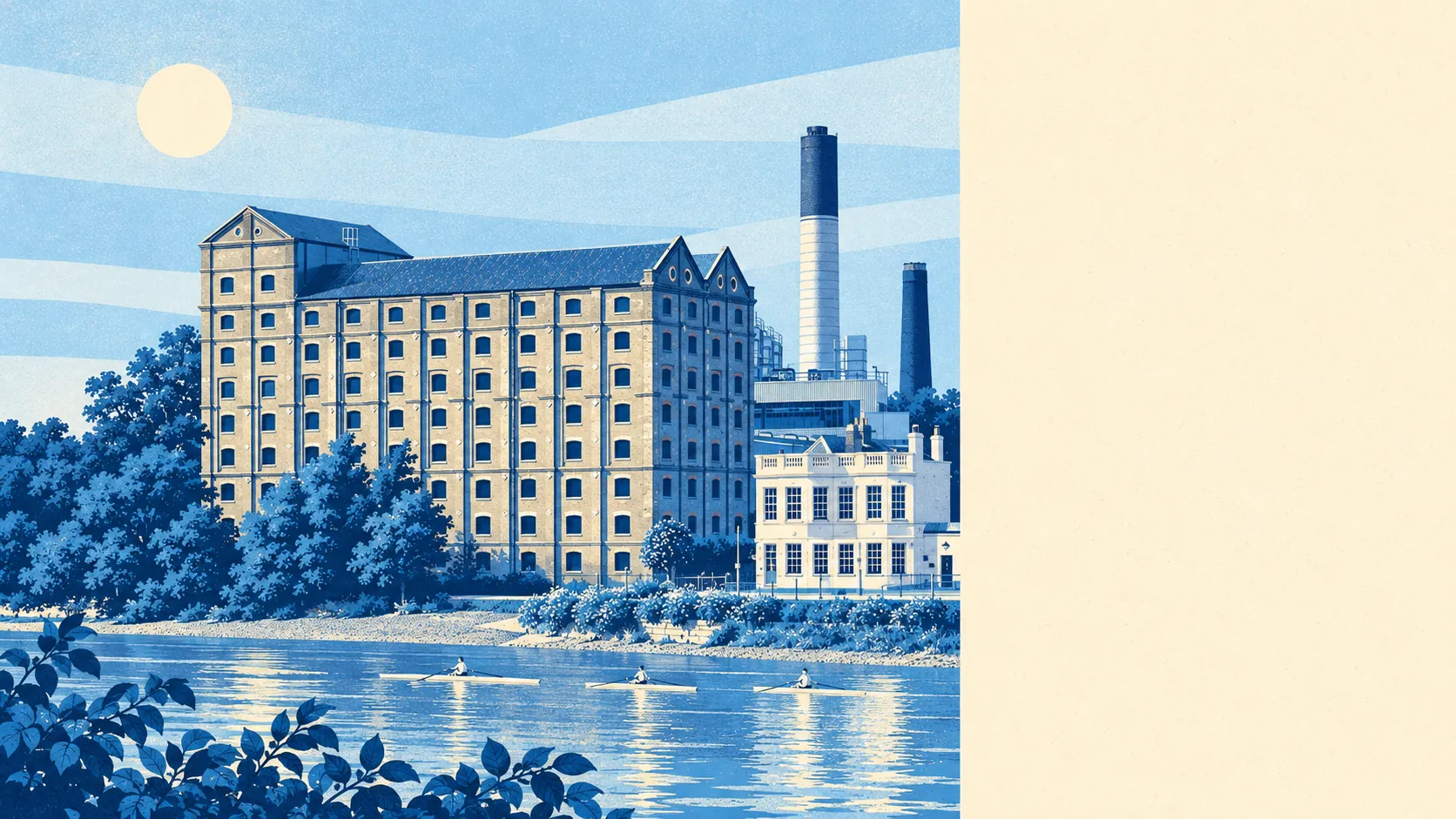
The area around Mortlake is mostly green and wet, in the good sense. A park is a couple of minutes from almost every front door. The Thames runs along one edge and Richmond Park lies just to the south. The high street mixes shops and offices, with only a few pubs. For a district this densely built, the outdoor space is remarkable.
Across the area, the average home is about 160 metres from public green space, and there are about 44 green spaces within a kilometre. That is a park, a common or a playing field within a short walk of the door, and dozens more within a longer one. Living this close to Richmond Park means a long walk is easy to fit into a normal week.
Water is nearly as close. The average home is about 400 metres from blue space, with about 49 bodies of water within a kilometre, from the Thames to the ponds and streams around it. Since 1845 the Oxford and Cambridge Boat Race has finished here, at a stone just downstream of Chiswick Bridge, and most people who walk the towpath pass it without noticing.
Cycling routes are less good. The nearest stretch of the National Cycle Network is about 1.1 kilometres away on average, and only about 4% of postcodes are close to it. Riders mostly rely on the river paths and the park roads.
The valuation list for the area records 627 rateable premises. The largest groups are 242 shops and 168 offices, followed by 29 restaurants and 8 pubs. These are premises on the council's rating list, so some may be empty or used for something else. Even so, the pattern is clear: Mortlake has far more shops and offices than places to drink.
Fine-particle air pollution across Richmond upon Thames averaged about 8.3 micrograms per cubic metre in 2024. That is a figure for the whole borough, and the main roads through Mortlake will run higher than the quieter streets near the park.
The surroundings are among the best-known in south-west London. Kew is to the west and Barnes to the east, and Richmond Park borders the southern edge. East Sheen supplies most of the restaurants and convenience shopping along the Upper Richmond Road. Nearby conservation areas include Kew Gardens, the Royal Botanic Gardens and Old Deer Park, so the district is surrounded by protected open land. It has more royal parks and listed gardens next door than any normal suburb would expect.
Private gardens are modest. Across the area there is about 47,300 square metres of private garden for every 1,000 residents, which fits a district of Edwardian terraces and flats more than detached houses on big plots. With Richmond Park so close, a small back garden matters less than it would elsewhere.
Food hygiene is strong. Of the 119 rated food premises, about 71% hold the top five-star score, and only about 3% are rated poor. A meal out in Mortlake is very likely to come from a clean kitchen.
None of the area falls inside a protected landscape. There is no area of outstanding natural beauty, no site of special scientific interest and no ancient woodland. Mortlake's green space is parks, commons and river, which is what you would expect for a London suburb.
The surroundings are one of Mortlake's real strengths, with parks, the river and Richmond Park all within easy reach of almost every home. Few places this close to central London offer as much outdoor space.