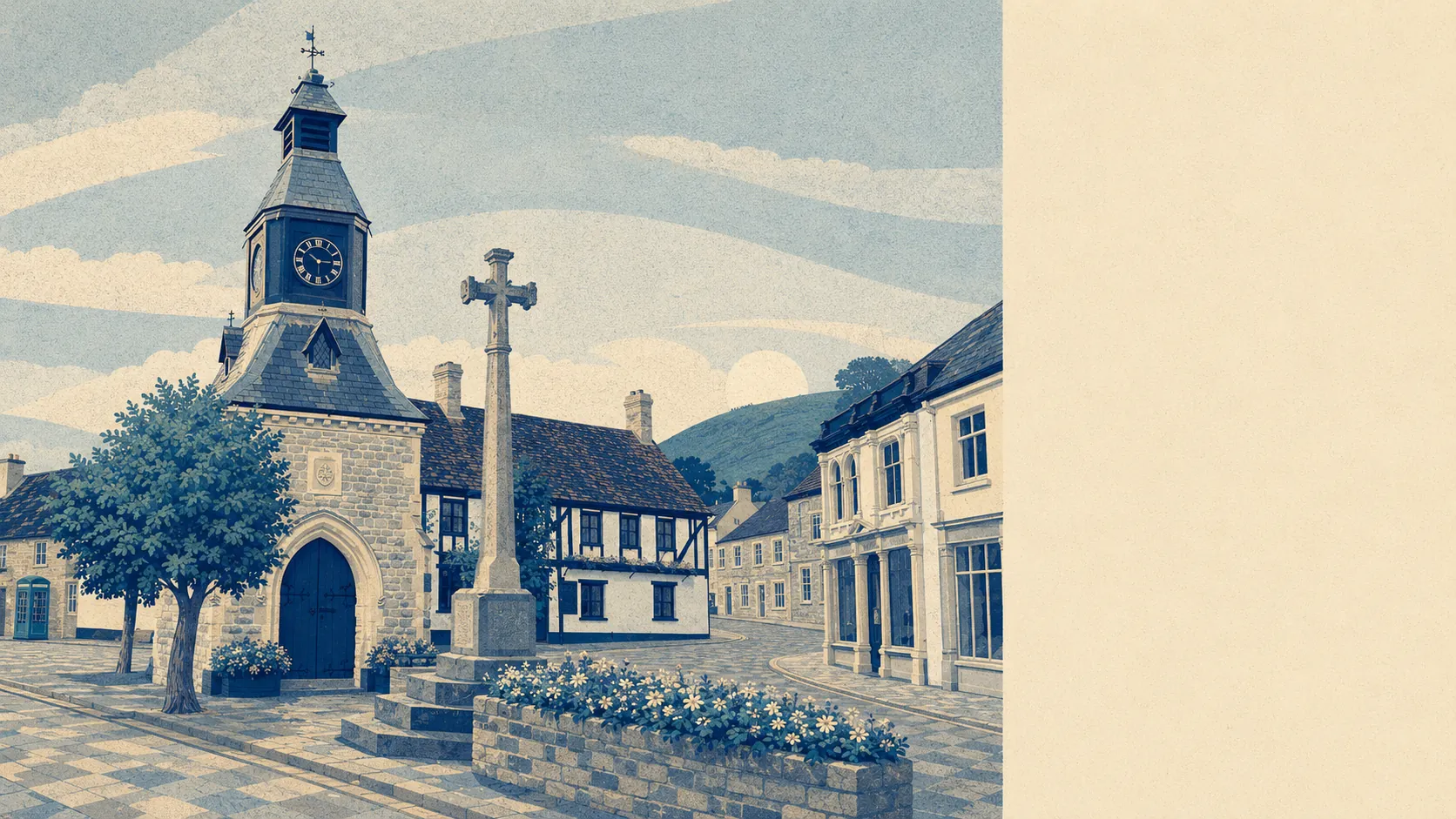
The setting is the best thing about Mere by a distance. Green space starts roughly 170 metres from the average front door. Water is closer still. Around eleven separate green spaces sit within a kilometre of a typical postcode. This is not a town with countryside nearby, it is a town the countryside has agreed to let stay.
The green space access figures are the sort that most places quietly envy. About 11 green spaces within a kilometre, at an average distance of roughly 166 metres, means the walk to grass is shorter than the walk to most people's cars. That number does the work that a hundred words of scenery writing cannot.
Water is nearer again, at an average of about 197 metres, with roughly 47 blue spaces within a kilometre. Streams, ponds and watercourses are threaded through this part of the county thickly enough that the count stops being impressive and starts being simply what the geography is. The town's own name may come from a mere, an old word for a pond or small lake, which suggests the water got here first and has never entirely left.
Cycling is the weak link in the outdoor picture. The National Cycle Network sits an average of about 2.2 kilometres away, and no postcodes in the town count as close to it. There is no ancient woodland recorded within the area at all. For walking, the ground is generous. For a family wanting to put children on bikes and reach a traffic-free route without loading the car first, it is not.
Air quality for the council area was measured at about 6 micrograms of fine particles per cubic metre in 2024. That is a Wiltshire-wide figure rather than a reading taken on the high street, and it is offered as context rather than as a claim about anyone's lungs.
Just under 1% of the area falls inside the Cranborne Chase and West Wiltshire Downs area of outstanding natural beauty. That is a sliver rather than a blanket, and it matters mainly for anyone buying on that edge, where the designation carries planning weight. There is no site of special scientific interest recorded within the area.
The character comes from what surrounds the town rather than from anything the town has built recently. Whitesheet Hill sits on the northwestern parish boundary carrying an Iron Age hill fort and a Neolithic causewayed camp. Long Hill above the town holds bowl barrows, and Mere Down to the north carries medieval strip lynchets, which are the terraced marks of ploughing that stopped several centuries ago and never grew out. The Earl of Cornwall put a castle on the hill in the middle of the thirteenth century, it was abandoned in the fourteenth, and only earthworks remain. Stourhead House lies within reach, with its Palladian Bridge, its Temple of Apollo and its Temple of Flora, plus the Bristol High Cross that was carted out of a city and rebuilt in a garden. The hamlets around the parish, Barrow Street, Burton, Charnage, Limpers Hill, Rook Street and Southbrook, are the kind of places where the name is older than anything standing in it.
Private outdoor space is the part nobody measures and everybody wants. Gardens here run to roughly 309,000 square metres per 1,000 residents, which is the figure that actually tells you whether homes have their own outdoor room rather than just a park to share. In Mere they do, comfortably.
On the commercial side, the local valuation list carries 86 rateable premises across the town, which is what a market town of this size looks like when you count the units rather than the shopfronts. Across the wider postal district the total runs to 214 shop premises, 115 offices, 33 pubs, 12 restaurants and 24 holiday lets. These are premises on a rating list rather than businesses currently trading, so treat them as the shape of the local economy rather than a directory of open doors.
Of the 15 food premises with a published hygiene rating, about 87% hold the top score and none sit at the bottom of the scale. Eating out here is a small field with a good record.
The surroundings are the single strongest thing Mere has going for it, and it is not close. Green space at the door, water nearer than the shops, and several thousand years of earthworks on the hills for anyone who fancies a walk with a bit of prehistory attached.