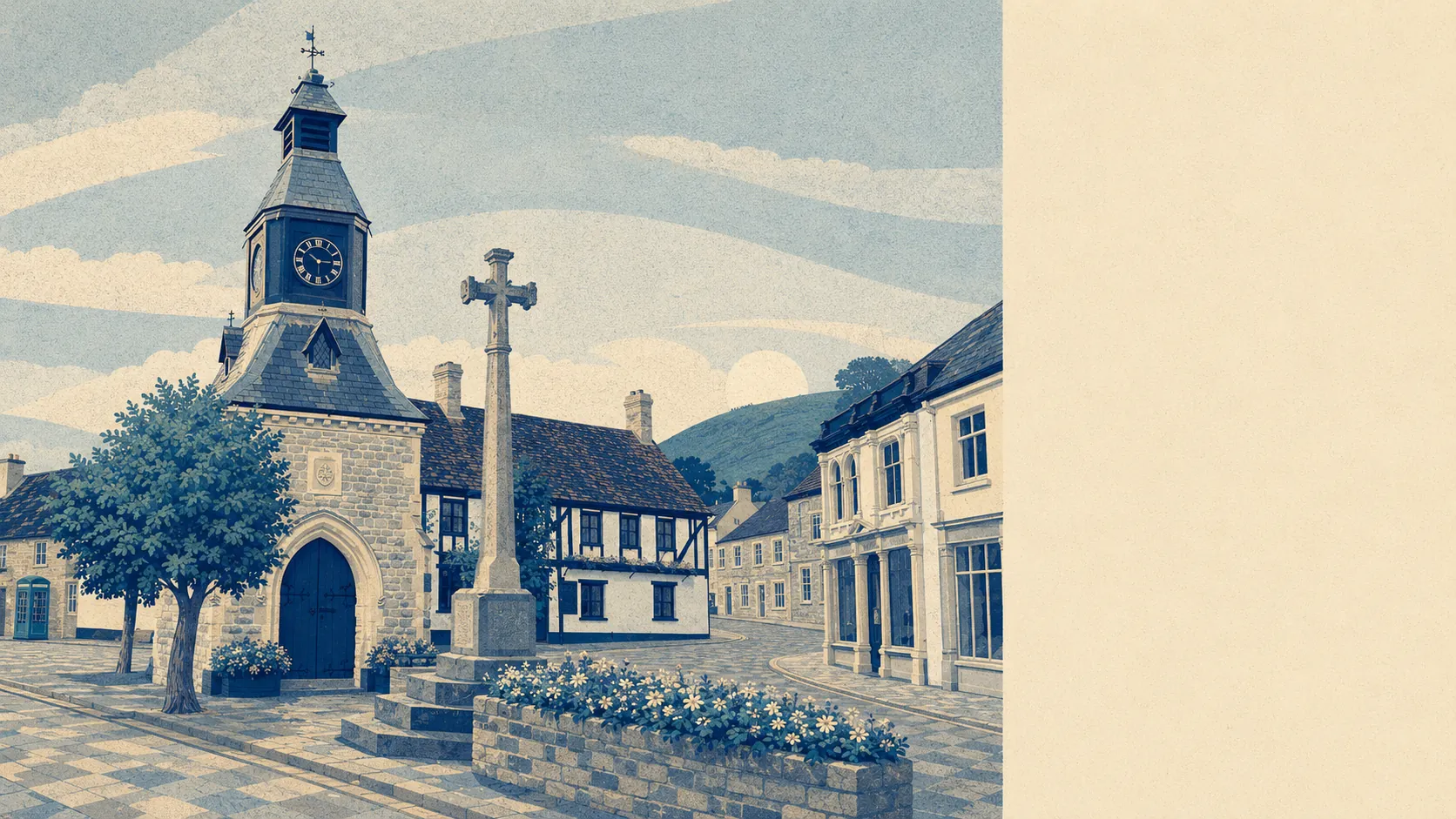
Mere is a good place to live if you have already made peace with the car. Almost nobody commutes by train. Two-thirds of people drive to work. More than a quarter work from home and never leave the postcode at all. The green space starts about a hundred and fifty metres from most front doors, which is either the whole point of the place or a poor substitute for a railway station, depending on how you feel about the main road.
The housing is old and mostly detached from the idea that anyone might want a flat. On the council-tax valuation list, which covers every dwelling rather than just the ones certificated since 2008, about 27% are detached, 25% semi-detached, 19% terraced and 20% bungalows. Flats account for about 8%, so if a maisonette above a shop is what you are after, this is not the town. Around 37% of the stock was built before 1930, and the energy certificates back that up: about a third sit at band D and roughly 14% at band E or worse, against 53% reaching band C or better. Nearly three-quarters run on mains gas, with about 6% on electric-only heating. That last group is the one to check before the viewing rather than after, because an electric-only Victorian cottage in a valley bottom is a bill, not a quirk.
The Land Registry's last twelve months to May 2026 put the typical sale at £360,000 across 27 transactions. The split by type is stark: detached homes came in around £458,500 on 14 sales, semi-detached about £262,500 on three, and terraces around £240,000 on eight. That is not a market with a smooth middle. That is two markets sharing a high street. Council tax runs modal band C, with about 32% of dwellings in bands A and B, so the town is not the Wiltshire postcode where everyone is quietly paying band F and pretending it is fine.
Renting is harder to pin to Mere itself. The typical private rent across the Wiltshire area is about £1,060 a month, which is a local-authority average rather than the town's own figure, and Wiltshire is a big place with Salisbury at one end of it. Treat it as the shape of the thing, not the price of the thing.
Wiltshire Police recorded a crime rate of about 61 per thousand over the twelve months to May 2026, which sits roughly 2% below the Wiltshire average. That is a published rate, not something arrived at by dividing incidents by residents. What it means in practice is that Mere is neither the safe outlier the estate agent implies nor the hidden problem the internet occasionally invents. It is an ordinary Wiltshire market town, statistically indistinguishable from the county it sits in.
Connectivity is where the town stops being charming and starts being a decision. There is no station in Mere. Gillingham in Dorset is the rail option, and about 0.4% of working residents actually use a train to get anywhere, which tells you how workable that is in daily practice. Around 0.3% take a bus. The sixteen bus stops in the area average about seven scheduled weekday departures each, with about 60% of them getting any weekend service at all. The Department for Transport's 2019 modelling puts a town centre at roughly 16 minutes by car and about 48 minutes on public transport, and those public transport figures age badly as routes get withdrawn. Broadband is the redeeming feature: superfast reaches every premise, gigabit reaches about 40%, and no postcode falls below the universal service obligation. The town is better wired than it is served by anything on rails.
Flooding needs its labels kept straight, because two different measures both appear on this site. On the postcode indicators, which include surface water and other sources, about 19% of Mere's postcodes carry a high flag on at least one measure and about 15% a medium one. The Environment Agency's river-and-sea flood zones are a narrower thing entirely: about 3% of the area sits in zone 3 and about 1% in zone 2, rising to around 5% under the climate-adjusted extent. The Environment Agency's risk mapping for rivers and sea lists 28 properties at high risk. Get the specific address checked, because the town's name may derive from a mere, and the ground has opinions about water that the deeds will not mention. Against that, green space is the strongest thing here: an average of about 166 metres to the nearest green space, with roughly 11 within a kilometre, and water even closer at about 197 metres. Just under 1% of the area falls inside the Cranborne Chase and West Wiltshire Downs National Landscape.
There are 77 listed buildings in the area, two of them Grade I and three Grade II star, plus a conservation area covering Mere itself and two scheduled monuments. If you buy inside that boundary, your windows are a planning matter, and the answer on double glazing may not be the one you want. Buy outside it and the constraint largely evaporates.
About 69% of homes are owner-occupied and the typical resident is 55. Median household income was around £52,000 in the financial year to March 2023. That combination produces the atmosphere accurately: settled, unhurried, and not especially interested in whether you approve.
It suits people who want space, quiet and a view, who work from home or have already accepted a car-dependent commute, and who understand that a market town of this size trades convenience for calm. It suits retirees and downsizers particularly well.
It does not suit anyone who needs a train, anyone under thirty who wants somewhere open after nine, or anyone buying a listed cottage on the assumption that they will "sort the heating out later". Mere will be honest with those people eventually. It just prefers to do it slowly.
The town has form for producing people who then leave. Harrison Birtwistle, the composer, came from here, as did the diplomat Rowland Sperling. There is also Lot Long, a thatcher, whose photograph ended up on the cover of Led Zeppelin's fourth album, which remains the most unlikely route to global visibility any Wiltshire tradesman has managed. The Earl of Cornwall built a castle on the hill in the thirteenth century and it was abandoned within a hundred years, leaving earthworks that are now the best short walk in town.
The real strength here is the setting: green space and water within a couple of minutes of the front door, protected landscape on the doorstep, and countryside that does not need any marketing. The weak spot is getting anywhere. No station, thin bus provision, and a public transport network that assumes you were going to drive anyway. Mere is a good place to live for people whose lives fit inside it, and an expensive lesson for anyone who thought they could commute out of it.