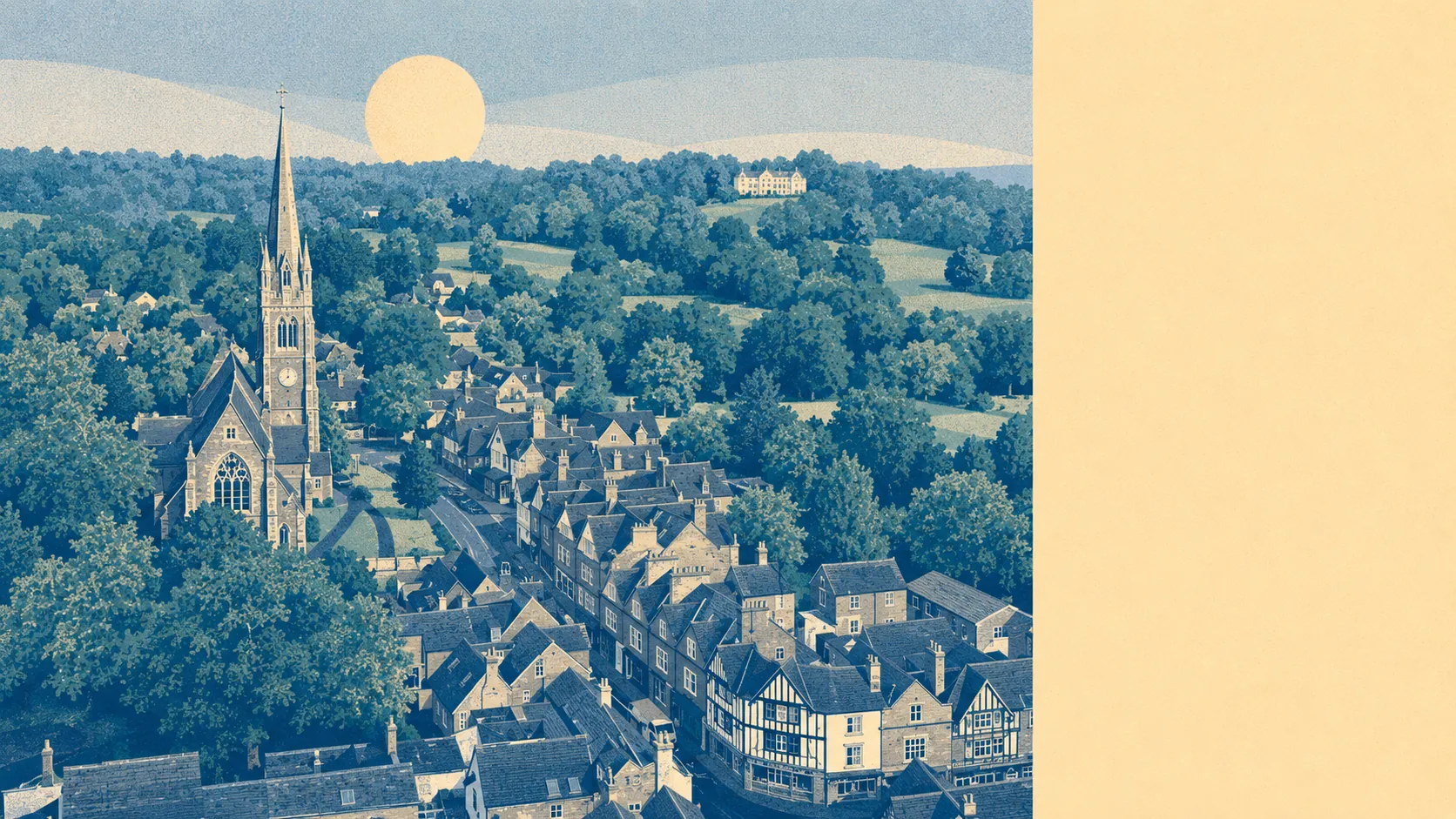
Lyndhurst is the capital of a forest. The median age is 54. Roughly three quarters of households own their home. Half of them keep two cars or more. This isn't a commuter town doing an impression of the countryside. It's the countryside, with a council office and a traffic problem.
The stock is mostly houses, about six in ten of them, with flats making up nearly three in ten and a scattering of bungalows. It skews old: a third of it went up before 1930, and post-war building is the single biggest chunk. That age shows in the energy ratings. Nearly four in ten homes sit at band D, and more than a fifth land at band E or worse, which is the New Forest way of saying you will spend a portion of every winter feeding an old house that was never built to hold heat. Under four in ten reach band C or better. Old forest villages don't do double glazing quietly.
A typical sale over the last year came in around £424,000, off fifty transactions, which is not many and tells you how rarely anything here changes hands. What you get for the money depends entirely on what you're buying. A detached house runs to about £656,000. A semi is closer to £440,000. Terraces sit around £345,000, and flats come in near £168,000, which is the only door into the village a normal deposit can open. Council tax leans heavy too: the most common band is E, and fewer than two in ten homes fall in the cheap bands A or B. This is not where you come to save money.
Renting is thin on the ground and priced accordingly. Across the wider New Forest area, a typical private rent runs at about £1,240 a month. Lyndhurst itself, with three quarters of households owning and little coming up to let, is not a renter's town. If you want in and you won't buy, you wait, and you pay whatever the forest decides.
The published crime rate is about 67 recorded crimes per thousand people a year, which sits roughly 15% above the New Forest average. That reads worse than it feels. A tourist honeypot pulls in far more bodies than its three thousand residents, and the count logs the day-trippers' bad afternoons alongside the locals'. For a village this size the practical reality is quiet, but the figure is the figure, and it is above the local average rather than below it.
Lyndhurst has no railway station of its own. The nearest are Ashurst New Forest, Beaulieu Road and Brockenhurst, all a drive away, and it shows in the commute: barely one in two hundred residents gets to work by train. The town centre is about twenty minutes off by public transport or under ten by car. Broadband is better than the rural setting would suggest, with gigabit available to just over half of postcodes and superfast reaching nearly all of them. You can work from home here, and given the trains, plenty of people do.
Green space is the whole point. Woodland and heath start on average just over a hundred metres from the front door, and the typical postcode has around fourteen patches of it within a kilometre. That's the deal for the forest wrapping the village. The other side of living in a low-lying forest is water: about one in six postcodes carries a high surface-water flood risk, so the specific street matters, and it pays to check which side of the drainage you're buying on before the survey does it for you.
The village carries thirty-three listed buildings, one of them Grade I and two Grade II-starred, along with two conservation areas at Swan Green and Lyndhurst itself. That heritage is lovely to look at and a real constraint to live in. Inside a conservation area or a listed building, the windows, the render, the extensions and the paint stop being your decision and start being a conversation with the planners. Buy the character, inherit the paperwork.
The profile is settled and comfortable. About three quarters own their homes, the median resident is 54, and the typical household income sits around £59,000. This is a village of people who arrived, stayed, and stopped moving, which is pleasant if you're one of them and slow going if you're trying to become one.
This page also covers the smaller settlements that sit under Lyndhurst's wing, the hamlets of Bramshaw and Minstead out among the trees to the north, both quieter and even more forest than the village they answer to.
It suits downsizers, retirees, remote workers and anyone whose daily life runs on the forest rather than the motorway. If you want a period house with woodland on the doorstep and you can absorb the price, the heating bills and the planning rules, this is close to ideal.
It suits nobody who needs a train every morning, wants a cheap way in, or expects a house they can knock about however they like. The commuter, the first-time buyer and the extension-planner all have easier lives somewhere with fewer trees and fewer rules.
For a small place it has gathered some genuine names. Arthur Phillip, the naval officer who led the First Fleet to Australia, is remembered here. Alice Liddell, the girl who inspired Alice in Wonderland, lived out her married years in the village as Alice Hargreaves. Arthur Conan Doyle, not content with inventing Sherlock Holmes, tried his hand at architecture on the old Lyndhurst Park Hotel, and the building stood as his only surviving effort right up until it was demolished and replaced with housing. Brusher Mills worked these woods as the New Forest's professional snake catcher, back when catching snakes was a career.
So, good place to live? Middling on the scorecard, and honest about why. It rates average overall, and the split underneath is stark. The surroundings are as good as they get, forest on the doorstep, green space everywhere, top marks. The value is where it stings, with prices high, stock old and costly to run, and a market that rarely opens the door. Lyndhurst is worth it if the forest is the reason you're coming. If you're doing sums, the forest will win and the sums won't.