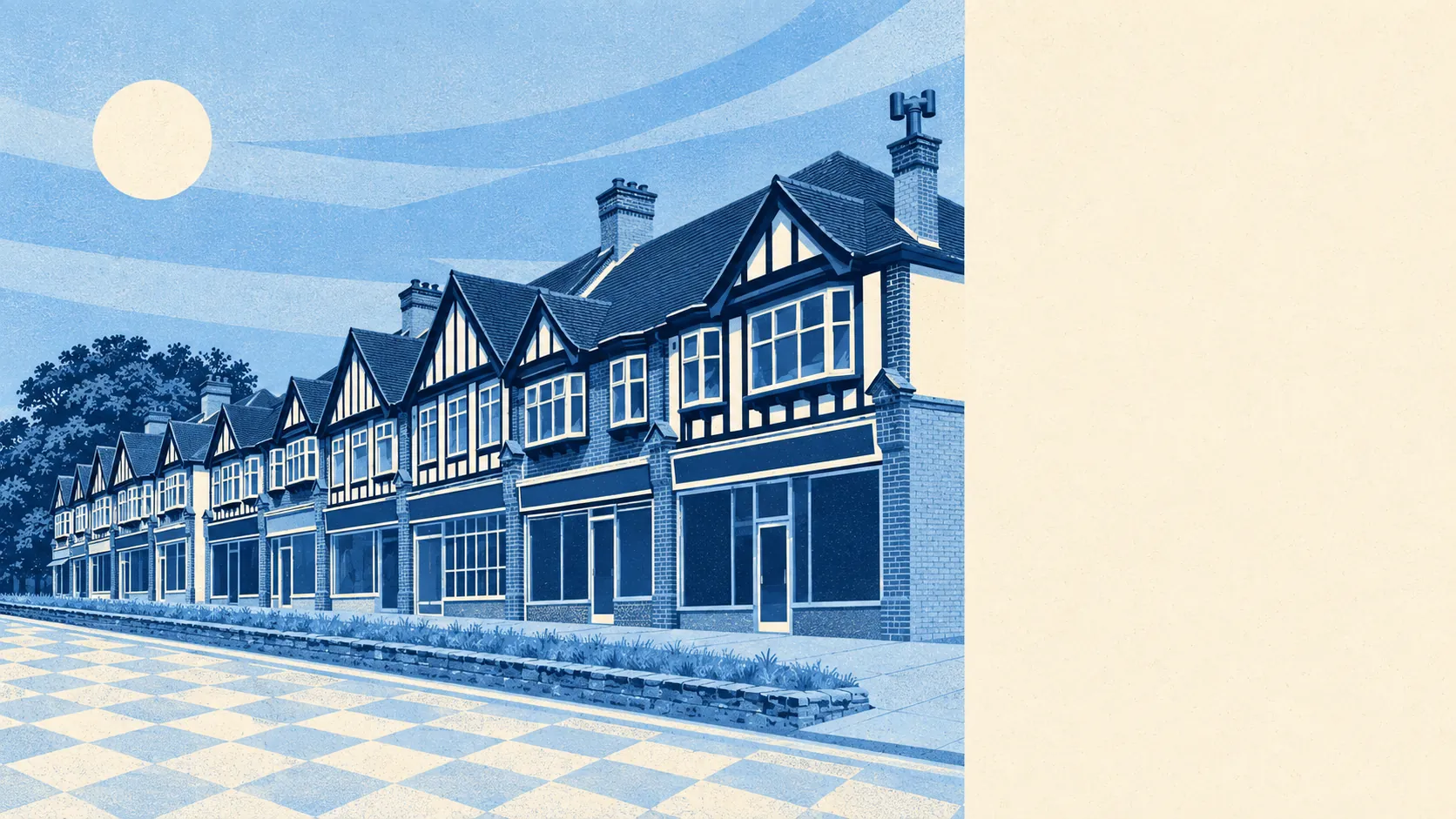
Yes, provided you've already made the money rather than planning to make it here. Over eight in ten own their home. More than half work from the kitchen table. The typical sale edges towards a million. Limpsfield is where people end up, and it isn't somewhere they save up for.
The housing is detached and mostly old. On the council-tax valuation list, 51% of dwellings are detached, about 16% semi-detached, 11% terraced, 14% flats and 6% bungalows, and about 45% were built before 1930. Old walls cost money to heat, and the energy certificates show it. About 34% of certificated homes reach band C or better, 41% sit in band D, and a quarter are rated E or worse. About 81% of homes are on mains gas and only 3% rely on electric-only heating, so the running-cost shock comes from draughty Edwardian bay windows and not from the tariff. Buyers who fall for the inglenook tend to meet the heating bill in their first January.
The Land Registry recorded 27 sales in the year to March 2026, and the median price was about £895,000. Detached houses make up most of that: 17 sold, at a median of £1,200,000. The other types sold too rarely to mean much. Three semis went for a median of about £490,000, four terraces for about £479,000, and three flats for £710,000, so treat those as anecdotes and not as a market. Council tax follows the same pattern. The most common band is G, and only about 5% of homes sit in bands A or B. Anyone hoping for a cheap way in will find the valuation list politely unhelpful.
The typical private rent across the Tandridge area was about £1,610 a month in April 2026, up 3% on the year. That's a district-wide average, and it includes a lot of housing that looks nothing like a four-bedroom detached house under the North Downs. For a Limpsfield house, expect more.
Crime is low. The published rate for the year to May 2026 was about 43 per 1,000 residents, roughly 39% below the Tandridge average. The totals are small enough that a handful of incidents shifts the mix by several points, so nobody should read much into which category came top. The rate itself is the useful number. The worst local drama in centuries remains a Domesday entry listing the village's nests of hawks.
For schools, Ofsted has graded 147 of 159 inspected settings across Surrey good or better, 30 of them outstanding. Within the postcode district, the one primary with published results averaged 106 in Key Stage 2 maths, and the one secondary had an Attainment 8 score of about 45. That's respectable, and it won't impress the buyer who moved here for league tables. Limpsfield CofE Infant School sits in the village. Hurst Green Infant School, Holland Junior School and St Mary's CofE Primary School are nearby, and Oxted School is the local secondary. The Department for Transport modelled the walk to the nearest primary at about 15 minutes and to the nearest secondary at about 22 minutes. Limpsfield Grange School, a special-needs school for girls, is also in the parish.
Oxted and Hurst Green stations are both close, but at the 2021 census only about 5% of working residents commuted by train and 57% worked from home. About 29% drove. The buses are thin: 19 stops, averaging 23 weekday departures each and fewer than two an hour at peak, so a bus pass here is mostly a gesture. Gigabit broadband reaches about 79% of premises and superfast about 96%, which matters more than the timetable for a village that mostly commutes by laptop. The modelled journey to the nearest hospital was about 30 minutes by car and about an hour by public transport in 2019. The M25 runs to the north, close enough to use and far enough away not to hear.
Flooding is mostly a surface-water story. About 12% of postcodes have at least one high-risk flood indicator, including surface water, but only about 1% fall in the Environment Agency's river-and-sea flood zone 2 and none in zone 3. The only recorded flood on file is from 1968, when an ordinary watercourse overflowed. Green space is close by: the nearest is about 255 metres away on average, with around 11 within a kilometre. Limpsfield Common is National Trust land, Staffhurst Wood fills with bluebells every spring, and a sliver of the Surrey Hills Area of Outstanding Natural Beauty falls within the area. Nobody here lacks somewhere to walk the dog. Some people moved here mainly for the dog.
Before you plan an extension, look at the heritage count: 43 listed buildings, two of them Grade I, five Grade II* and 36 Grade II. Two conservation areas fall within the area, Limpsfield itself and Station Road West, Oxted. Old Court Cottage, once the Abbot of Battle's manorial court, and the Church of St Peter are the Grade I pair. In the historic core, new windows, extensions and anything visible from the lane go through the planning office. That office has seen eight centuries of timber framing and won't hurry for your kitchen island.
About 84% of households own their home, the median age is about 49, and modelled gross household income averaged about £84,000 in the year to March 2023. Nearly 60% of homes have four or more bedrooms. It's a settled village of people who stopped moving house because they couldn't think of anywhere better to go.
It suits established buyers who want a detached house, somewhere to walk and a train station they rarely need, and who have the equity to pay for all three. It also suits families who value short walks to infant schools and don't mind a secondary judged on ordinary results.
It doesn't suit first-time buyers, anyone who wants a street with some bustle after seven, or anyone who needs a bus that turns up often. For them, the trade is Oxted: its town centre and the more varied housing around it, in exchange for giving up the common on the doorstep. That's an honest swap in either direction.
The churchyard at St Peter's holds Frederick Delius, his wife Jelka and, a few yards away, Sir Thomas Beecham, who spent his career promoting Delius's music. The clarinettist Jack Brymer is buried there too. The High Street's Manor House was probably never a manor house. It ran as a school from 1897 to 1969, and its former pupils include the writer Gillian Tindall, the Special Operations Executive agent Diana Rowden and Mary Soames, Churchill's daughter. Even the village's grand names turn out to be more modest up close.
Limpsfield is a good place to live if you can afford it, and most people can't. Its real strength is the community: settled, comfortable, safe and surrounded by common land. The weak spot is price and value, with a million-pound median, band G council tax and a heating bill to match. Buy here to stay put, because the village never planned on going anywhere either.