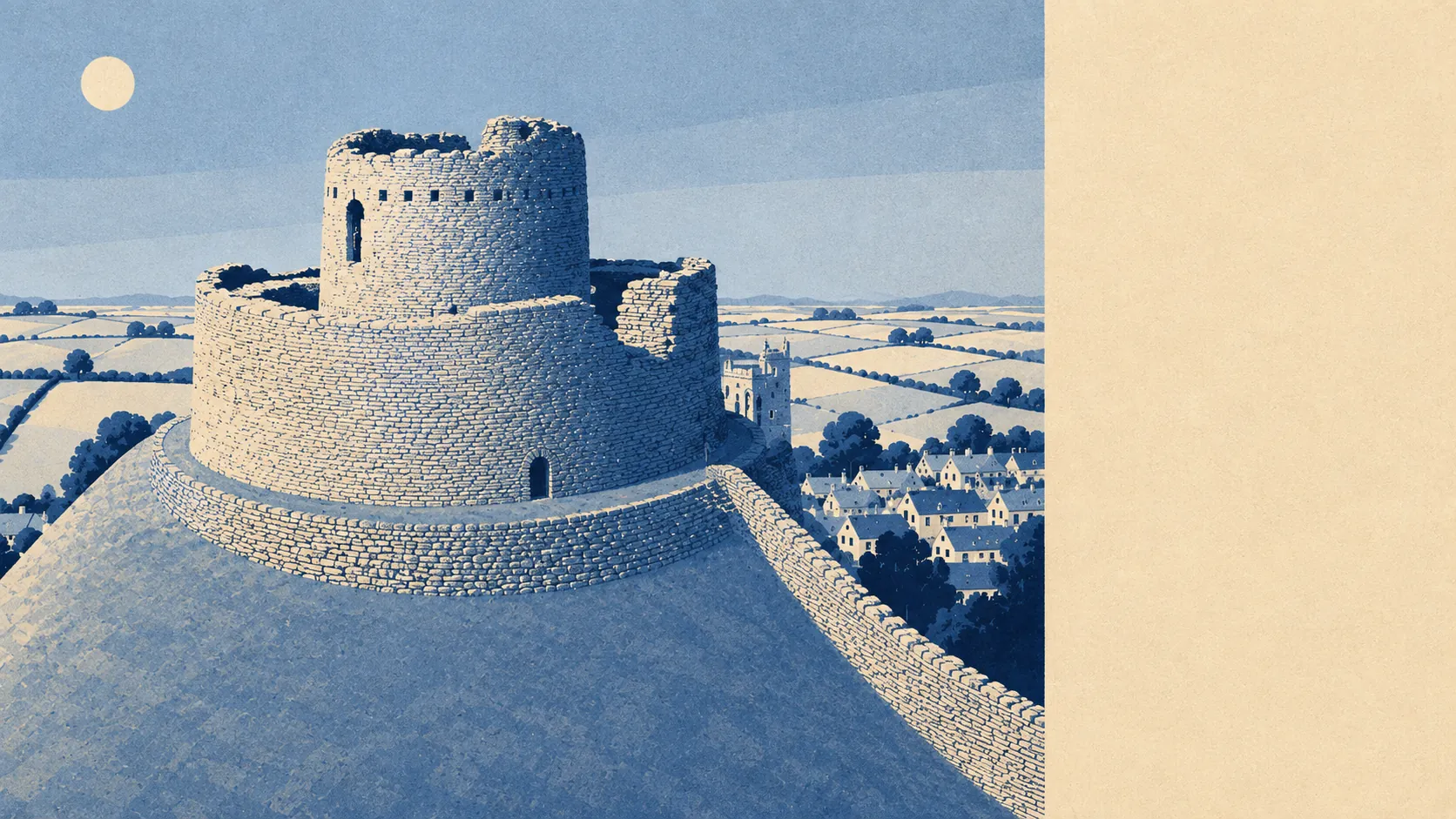
Launceston is a good place to live, and it took the town roughly nine hundred years to stop arguing with itself about its own name. It sits a mile from Devon and makes almost nothing of it. The ground is steep enough to turn a trip to the shops into cardio. Most people own their homes, the typical resident is in their mid-forties, and nobody here is waiting for the place to turn into somewhere else. This is a town that settled its business a long time ago and would rather you did not make a scene about it.
The housing stock is unusually even. Taking the council tax valuation list, which covers every dwelling rather than only what has sold or been certificated recently, terraces make up about 27% of the stock, detached houses 19%, semis and flats about 18% each, and bungalows 16%. Around 27% went up before 1930, which in Launceston means stone, thick walls and awkward angles, because the town climbs from the River Kensey up to the castle and the buildings climbed with it. Energy certificates put about 54% of certificated property in bands A to C, 29% in band D and 17% in band E or worse. Roughly 61% run on mains gas. About 18% are heated by electricity alone, which in a pre-1930 stone house is the difference between a nice viewing in June and a genuinely instructive January.
The Land Registry recorded 87 sales in the year to May 2026 at a median of £200,000, and that median is holding four separate markets in one hand. Flats came in around £111,000, terraces at £170,000, semi-detached houses about £251,000, detached houses at £375,000. Council tax lands where those prices suggest it would: band A is the most common band, and about 54% of dwellings sit in band A or B. Buying here is one of the few remaining places in the county where the number on the listing does not require a second reading.
Renting is only measured across the whole Cornwall area rather than Launceston on its own, so it is a regional typical rather than the street outside. On that basis the Office for National Statistics puts typical private rent at about £1,000 a month as of April 2026, up about 5% over the year, with one-bedroom places around £690, two-bedrooms about £880 and three-bedrooms roughly £1,080.
Recorded crime for the area runs at about 76 crimes per 1,000 people over the twelve months to May 2026, against about 74 across Cornwall as a whole. That is roughly 3% above the county rate, which is to say Launceston is an ordinary Cornish town with ordinary Cornish trouble. Anyone selling you a story about a place gone to the dogs, or a place where nothing ever happens, is describing their own mood rather than the town.
About 61% of working residents drive to work and roughly 17% work from home. Trains do not feature, because the town has not been on the national railway network since the North Cornwall line closed in 1966, and what runs today is the Launceston Steam Railway, which is a pleasant afternoon and not a commute. Buses do more than their reputation: 56 stops in the area, an average of about 43 scheduled weekday departures per stop, and weekend service at every one of them. The Department for Transport's 2019 modelling puts the town centre about 8 minutes away by car and 18 on foot, a food shop about 7 minutes, and the nearest hospital about 53 minutes by car, which is the figure that quietly shapes how people feel about getting older here. Broadband is better than the geography deserves, with gigabit reaching about 78% of premises, superfast about 90%, and mobile coverage from every operator across about 95% of the area.
Flooding is real and contained, and it depends which measure you use. On the postcode indicators, which include surface water and flag a postcode if any single indicator fires, about 7% carry a high rating, 10% medium and 27% low. Inside the river and sea flood zones proper, about 3% of postcodes fall in Flood Zone 3 and 1% in Zone 2, with about 1% touched by a historic flood outline. Four flood events are on record, the last in December 1979, when the channel could not take what arrived. The steep ground is the whole explanation: the risk sits at the bottom, near the Kensey, and most of the town is above it. Green space is the compensation, with the average postcode about 140 metres from open ground, roughly 18 green spaces within a kilometre, and water about 400 metres away. Every postcode falls in the upper radon bands, topping out at the highest there is, which means a test and a fan under the floor rather than a reason to leave.
There are 218 listed buildings, seven of them Grade I and fourteen Grade II star, one conservation area over the town, and seven scheduled monuments including the castle's motte, bailey and shell keep and the South Gate still standing across the road. Two listed buildings sit on the Heritage at Risk register. Dockacre House and Lawrence House are the postcard. The practical version is that changing your windows or extending anywhere near the conservation boundary means consent, and consent means months.
About 56% of homes are owned, the median age is 45, and typical household income was around £44,400 gross in the financial year to March 2023. This is a town of settled households rather than a dormitory that empties at seven. It serves as the main shopping centre for a large stretch of east Cornwall and west Devon, which is also what Lezant, South Petherwin, Treneglos and Withnoe are doing here: they sit in the fields around it and come in for everything a village cannot do.
It suits people who want a stone terrace, a doctor's surgery and a food shop inside ten minutes by car, and gigabit broadband instead of a station. It suits anyone whose life runs on a car and a view.
It does not suit anyone who needs a train, anyone who expects a hospital nearby, or anyone whose plan opens with knocking the back off something listed.
For a town this size, the export record is absurd. Philip Gidley King left and ended up governing New South Wales. James Ruse left considerably less voluntarily, convicted of burglary at 23, transported with the First Fleet, and farming at the other end of the planet not long after. Launceston in Tasmania took the name. Cuthbert Mayne was executed here in 1577 and the town has carried the memorials ever since. Mary Ann Davenport played Shakespeare, Roger Moore sat in classrooms at Launceston College, and the town mentions this with genuinely impressive restraint.
Launceston is better than its passing traffic assumes. Its real strength is what surrounds it: open ground almost at the door, water minutes away, and countryside that begins where the last street stops. The weak spot is the freedom to alter a home, because a town with this much of it listed and a conservation area over the middle does not hand out permission in a hurry. Buy here for the town and the ground it stands on. Buy here for a blank canvas and the planning office will explain, courteously, at length.