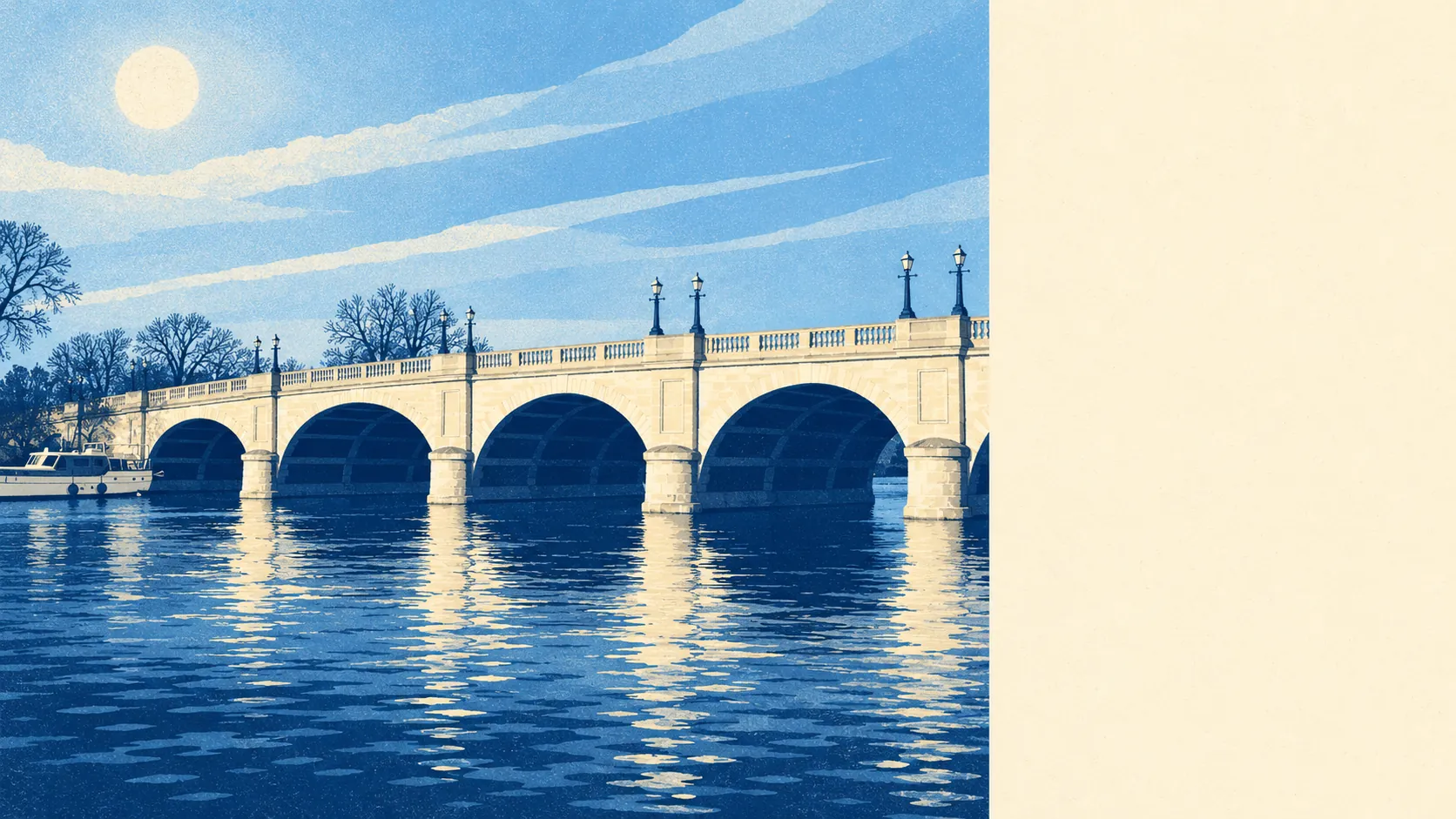
Greener and wetter than a shopping town has any right to be. A patch of green space is a couple of minutes from most front doors. Dozens more lie within a kilometre. The Thames is barely further away. The Bentall Centre is what people drive to Kingston for, and the river is why the ones who live there stay.
The typical home in Kingston is about 130 metres from the nearest public green space, with about 24 green spaces inside a kilometre. Within reach are Canbury Gardens on the riverbank, Bushy Park and Hampton Court Park across the bridge, and Richmond Park to the north. For a place this dense, nobody is short of somewhere to walk the dog.
Water is closer still to hand. The nearest river, pond or other blue space averages about 290 metres from a Kingston home, and about 48 of them lie within a kilometre. The Thames does most of the work, with the Hogsmill joining it near the old market. Kingston Rowing Club has been on the river at Canbury Gardens since 1858, and Kingston Regatta takes over the water just above the bridge for a weekend in early July.
The nearest stretch of the National Cycle Network is about 730 metres from a typical home, and about 48% of postcodes count as close to it. The Thames Down Link footpath starts here and heads south towards Box Hill, which is the official route for anyone who has had enough of the shops.
The high street is what you would expect of a town that draws shoppers from miles around. The rating list counts 412 shops, 302 offices, 70 restaurants and 20 pubs. The Rose Theatre opened by the riverside in 2008, the Charter Quay development finished off the riverside walk, and the Druid's Head was one of the first taverns anywhere to make syllabub in the 18th century, so the town has been feeding visitors something sweet for a long time.
Fine-particle air pollution across the Royal Borough of Kingston upon Thames averaged about 8.3 micrograms per cubic metre in 2024. That is a borough-wide figure, so the busiest road in town and the quietest park share the same number.
The feel is a riverside market town that grew a big retail centre and a university without losing the river. The Old Town keeps its market and its listed buildings, the riverfront has bars and a theatre, and a few minutes in almost any direction the parks take over. Hampton Wick, across the bridge, is quieter again, with Bushy Park on one side and the Thames on the other.
Private outdoor space is more limited. Kingston has about 41,000 square metres of private garden for every 1,000 residents, which in a town where about 65% of homes are flats means many people rely on the parks instead of a lawn of their own. For any flat, ask whether the garden in the photos is private, shared or the communal strip by the bins.
The council's rating list counts 1,268 non-domestic premises in Kingston, with shops and offices well ahead of every other kind. Those are premises on the valuation list, so they include empty units and do not confirm that any particular business is trading.
Food hygiene inspectors have rated 324 premises here, and about 73% hold the top score of five. About 3% sit at the low end of the scale. For a town this busy with places to eat, the kitchens are mostly in order.
No area of outstanding natural beauty, site of special scientific interest or ancient woodland overlaps Kingston. The green space here is parkland, gardens and river meadow, made for people to use, and the protected countryside starts further out.
The surroundings are one of Kingston's real strengths, with royal parks, riverbank and green space closer to the average front door than in most towns its size. The town centre is busy; five minutes from it, the place turns into a river walk.