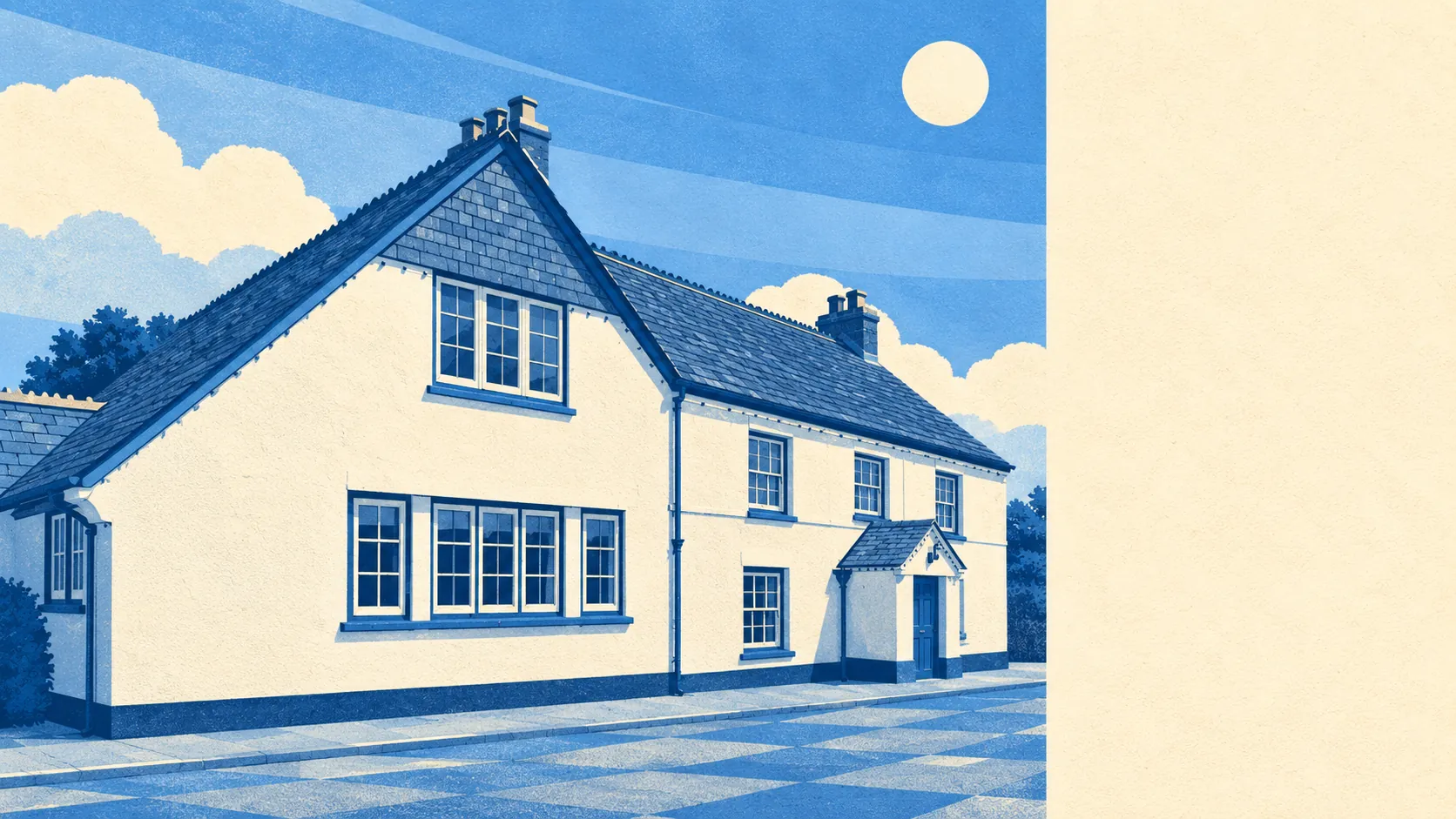
Yes, if your version of Cornwall has a garden in it rather than a sea view. Two-thirds of households own outright or on a mortgage. The bungalow is a serious local architectural movement. Almost nobody takes the train anywhere, because the car does everything. This is Cornwall as a place people actually live in on a Tuesday in February, and it is priced like somewhere that knows it.
The housing is the first thing to understand, because it explains most of the rest. On the council tax valuation list, semi-detached houses account for about 26% of dwellings, terraces about 22%, detached about 21%, and bungalows about 17%, with flats at roughly 4%. That is a stock built for families and for people who have stopped wanting stairs, and very little of it built for anyone who wants a balcony. About a third of it went up before 1930, which in this part of Cornwall means solid stone walls and the heating bills that come with them. Energy certificates for the area put about 34% of certificated homes in bands A to C, 29% in band D, and 36% in band E or worse. Only about 20% of households are on mains gas, and about 24% run on electricity alone. A granite-walled cottage heated entirely by electricity is a specific financial experience, and it is one worth establishing before the second viewing rather than after the first winter.
On price, the Land Registry recorded 68 sales in the twelve months to May 2026, at a median of £252,000. The split by type is wide and worth reading properly: detached homes came in at a median of £375,000 across 22 sales, semi-detached at about £234,000 across 22, and terraces at £220,000 across 21. Three flats sold in the whole year, at a median of £115,000, which is less a market than an anecdote. Council tax sits low, with band B the most common and about 67% of dwellings in bands A or B combined. Cornwall is not a cheap county to buy into, and this is one of the parts of it where an ordinary salary still reaches a house with a drive.
Renting is harder to pin to the village itself. The Office for National Statistics puts the typical private rent across the Cornwall area at about £1,000 a month, which is a county-wide figure covering everything from harbour flats to farm cottages. Treat it as the surrounding market rather than the local street.
On safety, the recorded crime rate for the area was about 61 offences per 1,000 residents in the year to May 2026, roughly 18% below the Cornwall average. That is a published rate, not a back-of-envelope calculation, and it puts this area in the quieter half of a county that is already quiet. The main risk to your evening here is the drive home.
Schools are the strongest thing on the page after the surroundings. Across Cornwall, Ofsted has graded 120 settings, of which 95 are good or better and three are outstanding. Across the eleven schools sitting in these postcode districts, the average key stage two maths score is about 104, which is above the national benchmark of 100. Indian Queens Primary School and Roche Community Primary School are the nearest options, with Summercourt Academy and St Columb Major Academy also in range, and Brannel School taking secondary-age children. The Department for Transport's modelling puts a primary school about seven minutes away by car and thirteen on foot, and a secondary about eighteen minutes by car. On public transport that secondary trip stretches to roughly 38 minutes, which is the number that decides whether your teenager gets the bus or you become the bus.
Connectivity is the weakest of the practical dimensions and the one people misjudge. About 67% of working residents drive to work and about 17% work from home. Under 1% commute by train, despite St Columb Road Rail Station and Roche Rail Station both sitting on the branch line, and Quintrell Downs and Bugle being reachable. There are 129 bus stops in the area, averaging about 24 scheduled weekday departures each, and about 87% of them see some weekend service, which is better than rural Cornwall's reputation suggests. The nearest town centre is about 22 minutes by car and about 42 by public transport, a gap that tells you everything about how the place is organised. Broadband is genuinely good: about 91% of premises can get superfast, about 58% can get gigabit, and under 1% fall below the universal service minimum. You can work from a stone cottage here without fighting the connection.
The environmental picture needs its two measures kept apart. On the postcode-level indicators, which include surface water, about 19% of postcodes carry a high rating on at least one flood measure and about 13% a medium one. On the Environment Agency's river-and-sea flood zones, the exposure is far smaller, with about 1% of the area in zone 3 and under 1% in zone 2. Two flood events are on the record, the most recent in 1980 and caused by local drainage rather than a river. Green space is the consolation and then some: the average postcode sits roughly 370 metres from open green space with about seven such spaces within a kilometre, and water about 910 metres away. No national landscape or site of special scientific interest overlaps the area, which means the green here is working green rather than protected green.
Heritage constraints are light. There are 75 listed buildings across the area, one of them grade one and four grade two star, with the remaining 70 at grade two, and no conservation areas falling inside the boundary at all. Unless you buy one of the listed few, nobody is going to write to you about your windows. That is a rarer freedom in Cornwall than buyers expect.
The character follows from all of it. About 66% of households own their home, the median resident is 42, and typical household income across the area was around £43,000 in the financial year to March 2023. This is a settled, working, mortgage-paying place where people expect to stay a while.
It suits families who want a garden, a driveway and a primary school inside a ten-minute drive, and who are happy to trade a coastal postcode for a house with room in it. It suits remote workers who need reliable broadband and do not need a station. It suits anyone whose budget breaks the moment a sea view enters the equation.
It does not suit people without a car, because the twenty-minute car trip to town becomes a forty-minute public transport expedition and stays that way. It does not suit buyers who want period charm with modern running costs, because the older stock here is often heated by electricity alone. And it does not suit anyone who moved to Cornwall for the water, because the water is a drive away and always will be.
The real strength here is the setting and the ease of getting into it: green space close on every side, schools that hold up, and constraints light enough to let you change your own house. The weak spot is water underfoot rather than water on the horizon, with surface-water risk touching a meaningful share of postcodes even though the river-and-sea zones barely register. Check the drainage on the specific address, then buy the garden.