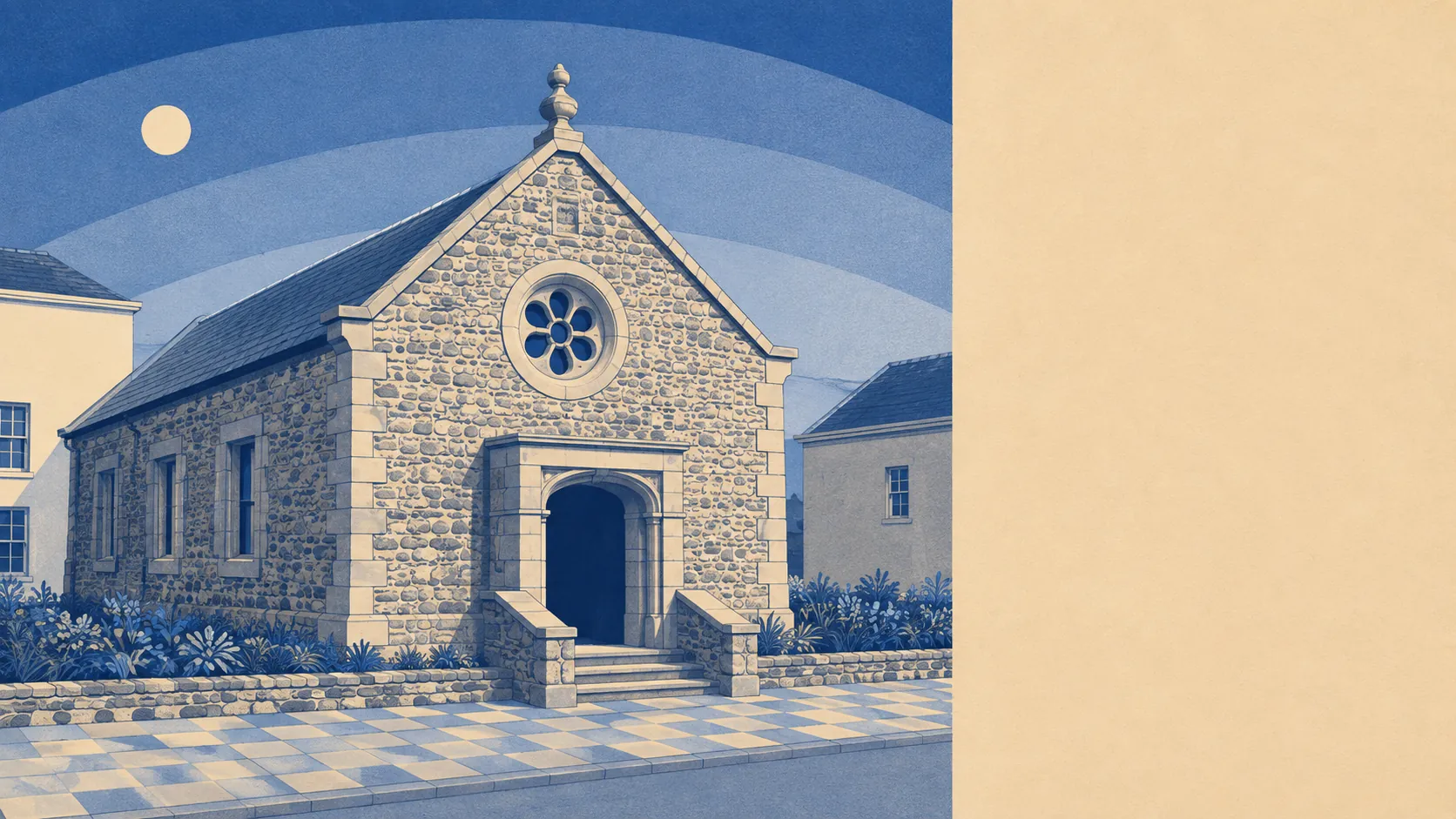
Honiton is Devon for people who have stopped auditioning. The median resident is fifty. Two in three own their home. Almost every address can get gigabit broadband, and open ground starts a couple of streets from most front doors. This is not a town on the way up, and it is not sliding anywhere either. It arrived, unpacked, and stopped checking what the neighbours paid.
The housing is unshowy and it is mostly houses. Across every dwelling on the council tax valuation list, terraces account for about 24%, semis 23%, detached houses 20% and bungalows 19%, with flats at about 12%. Bungalows at nearly a fifth of the stock tell you who has been buying here for the last forty years. Only about 17% of dwellings went up before 1930, so the Georgian High Street is the shop window rather than the housing story. Three bedrooms is the standard unit at about 39% of households, two bedrooms at 35%. Three quarters of homes run on mains gas and about 11% are heated by electricity alone, which is the figure to check before the viewing rather than after completion, because electric-only heating in an older house is a running cost you inherit with the keys. On energy certificates, about 56% of the stock sits in bands A to C, 36% in band D and 8% at band E or worse.
The Land Registry's last twelve months, to May 2026, put the typical Honiton sale at about £259,000 across 198 transactions. Broken down by type: flats around £128,000, terraces around £212,000, semis £282,000, detached houses £391,000. Council tax sits low, with band B the most common and about 41% of dwellings in bands A or B, and a band D bill in this area running to around £2,600 a year. Nothing in that spread needs the word aspirational attached to it, which is a mercy.
Renting is measured across the whole district rather than the town alone. Typical private rent across the East Devon area is about £970 a month as of April 2026, up 7% over the year. By size across the same area, that is roughly £690 for a one-bedroom, £900 for two and £1,120 for three. Treat those as the district's shape, not a quote for a specific street.
Recorded crime runs at about 53 offences per thousand people over the twelve months to May 2026, roughly 7% above the East Devon average of about 50. That is the published rate for the area rather than a count divided by residents. Violence and sexual offences make up about 48% of recorded crime against 35% nationally, a statutory grouping wide enough to include common assault without injury, so read it as a mix rather than a warning. The number worth more attention belongs to the force rather than the town: Devon and Cornwall Police charge about 8% of recorded crimes against 12% nationally, and rank last of the 42 forces on that measure. The low rate is the good news. What happens after the thing that did happen is the other half of the sentence.
Honiton Rail Station sits on the West of England Main Line with South Western Railway services to London Waterloo and Exeter St Davids, and about 1% of working residents actually commute by train. Around 56% drive and 22% work from home, which is the modern version of a good commute. There are 69 bus stops in and around the town, averaging 28 scheduled weekday departures each, with 86% seeing a weekend service. Broadband is the standout: gigabit capability reaches about 97% of premises, superfast reaches all of them, and nothing sits below the universal service obligation. Mobile coverage from every operator reaches about 97% of the area. Modelled journey times from 2019 put the town centre 9 minutes away by car and a doctor's surgery about the same, with the nearest hospital 30 minutes by car or 74 minutes on public transport. That last one is the figure to sit with.
Water is the honest weakness. About 12% of postcodes carry a high flag on at least one flood indicator, including surface water, with a further 12% at medium and 24% at low. On the narrower measure, the Environment Agency's river and sea flood zones cover about 2% of postcodes in zone 3 and 5% in zone 2, rising to about 8% once climate allowance is added. Roughly 6% sit inside a historic flood outline, and 33 flood events have been recorded here, the most recent in 1968 when a main river exceeded its channel capacity. The River Otter is the reason for both the risk and the view. Green space is the compensation and it is unusually good: the average postcode is about 143 metres from open space with roughly 22 green spaces within a kilometre, and water about 243 metres away. Around 2% of the area falls inside the East Devon and Blackdown Hills protected areas. Two costs against that: road noise reaches every postcode at levels around 65 decibels or higher, topping out near 75, and about 10% of postcodes fall in the higher radon bands.
There are 112 listed buildings in and around the town, six of them grade two star and the rest grade two, a conservation area covering Honiton itself and another at Gittisham. Marwood House dates from 1619, the Manor House began as a coaching inn, and Honiton Garage goes back to about 1700, which may be the most Devon sentence in the county. Two listed buildings sit on the Heritage at Risk register. In practice, buying inside the conservation area or a listed building turns windows, doors, panels and anything visible from the street into a conversation with the planning department rather than a decision. Fair trade for the High Street looking the way it does, and a trade some buyers discover only after pricing the double glazing.
About 68% of homes are owner occupied, the median age is 50, and typical household income is about £48,700 gross, on the financial year to March 2023. A third of households are one person and about 19% are a pensioner living alone, while unemployment sits near 2%. It is a town that is quiet on a Tuesday and knows who lives three doors down. This page also covers Dunkeswell and Feniton, the latter of which comes with its own railway station.
It suits remote workers who want gigabit broadband, a detached house at a Devon price and countryside at the end of the road. It suits downsizers, given how much of the stock is bungalows. It suits families willing to work with two primaries and one secondary with a sixth form, Honiton Community College, rather than a menu of options.
It does not suit anyone who needs frequent trains, a hospital nearby, or a night out that runs past the point where the town has gone to bed. It does not suit buyers who want a period house and no planning conversations. And it does not suit anyone who buys on the low ground without reading the flood mapping first.
For an inland market town, Honiton produced a striking amount of uniform: Admiral Samuel Graves, Brigadier-General John Prideaux, and Captain George Blagdon Westcott, who served in the American War of Independence and the French Revolutionary Wars. Ozias Humphry stayed indoors painting portrait miniatures, which from here looks like the better career.
Honiton is a good place to live, and its real strength is what surrounds it: green space at the end of most streets, protected hills on two sides, water minutes from the door. The weak spot is water in the wrong place, with roughly one postcode in eight flagged high on at least one flood measure, which makes the address matter more than the town. Get that right and everything else here is quietly in your favour. Get it wrong and the River Otter will remind you, on its own schedule, in its own time.