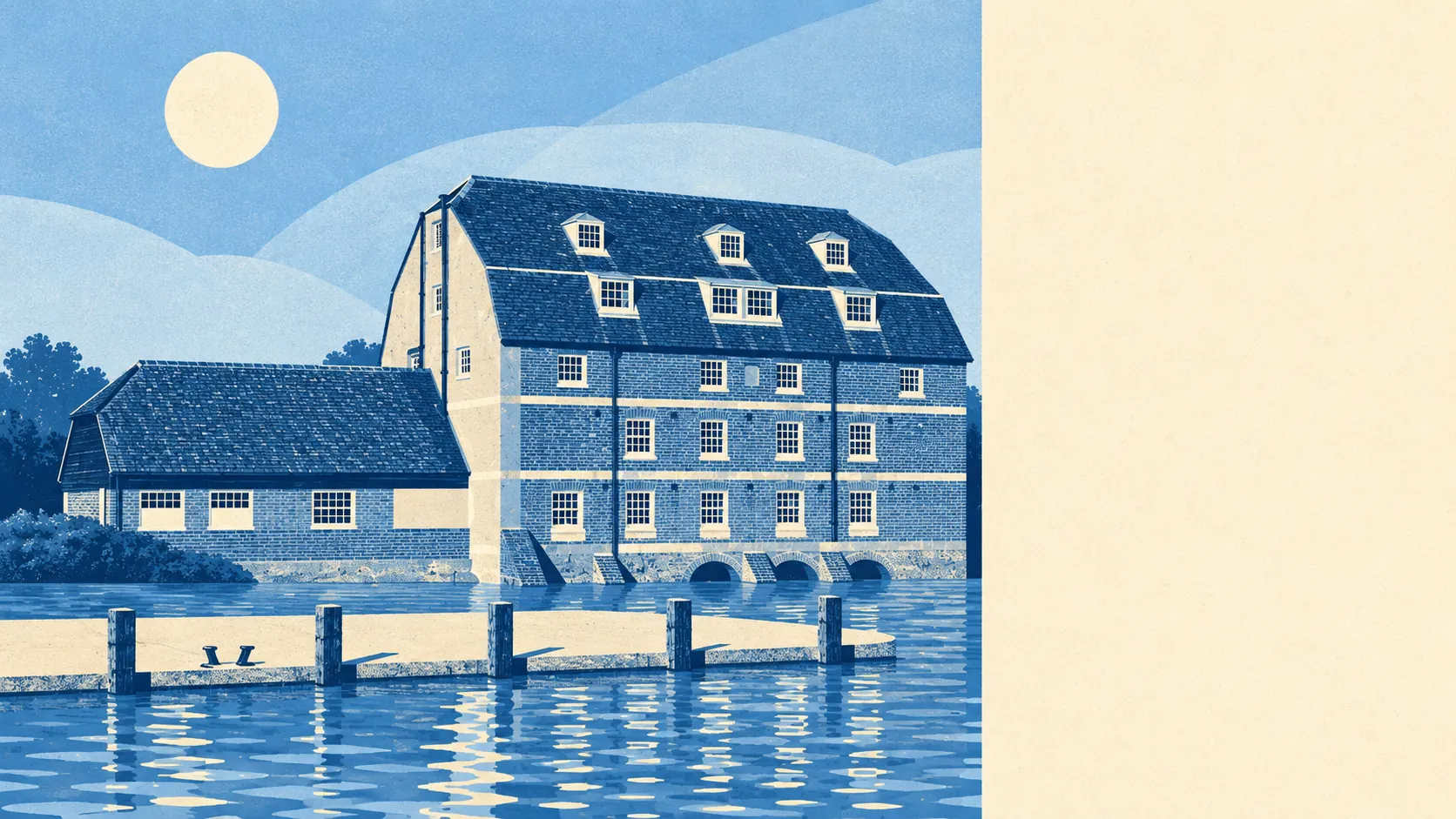
In Holbury you reach grass before you reach a shop. Green space is a couple of minutes' walk from most front doors. Water is closer than most visitors expect. The heath beyond the village is dotted with ancient burial mounds. The view includes a refinery, but the walks mostly don't.
The average home in Holbury is about 150 metres from the nearest public green space, and there are about 14 green spaces within a kilometre. Nobody needs to drive to a park. Parents will find the dog and the children can be walked on the same trip.
Water is about 450 metres away on average, with about 18 bodies of water within a kilometre, counting creeks, ponds and the shoreline. In a village people know for an industrial skyline, that's the part of the local geography that rarely makes it into the description.
Cyclists have less to work with. The National Cycle Network is about 4.2 kilometres away on average, and no postcodes are counted as close to it. Anyone who wants traffic-free cycling will be driving the bike to it first. There's no ancient woodland inside the area.
The premises records list 215 shop units, 11 pubs and 9 restaurants. That's a working village with the everyday basics rather than a destination high street. A Saturday out here means the heath or the shore, not a round of independent shops.
Fine-particle air pollution across the local council area averaged about 6 micrograms per cubic metre in 2024. That's a district-wide figure, not a reading for any one street, and it matters mainly to anyone assuming the refinery must make the whole district smoggy.
The surrounding names are the real draw. Calshot, with its 16th-century artillery castle, is close by, as are Ashlett Creek and Exbury, both conservation areas. The moated site west of Holbury Manor has been recognised as a scheduled monument. Out on Beaulieu Heath, a round barrow cemetery and scattered bowl barrows, including one in Fawley Inclosure, show people were burying their dead here long before anyone thought of a refinery. Cadland House has a registered historic park and garden. The history within reach is older and more varied than the village's reputation suggests.
Private gardens are generous: about 153,000 square metres of garden for every 1,000 residents, all of it private outdoor space. With so many bungalows and post-war houses on decent plots, most homes here come with a real garden rather than a paved yard.
The business rating list counts premises differently from the records above, and it holds 201 in total. Shop premises are the largest group at 47, followed by workshop and industrial premises at 38 and offices at 31, with warehouses and stores making up much of the rest. These are rateable premises on a valuation list, not a count of businesses currently open. The mix looks like a village that works as well as sleeps.
Of the 23 food premises with a hygiene rating, about 78% hold the top score and none sit at the bottom. The choice of places to eat is limited, but none of them is on the list you'd want to avoid.
No protected-landscape designation overlaps Holbury itself. There's no area of outstanding natural beauty, no site of special scientific interest and no ancient woodland inside the area. The protected landscape starts beyond the village edge, and the village itself doesn't come with conservation paperwork.
The surroundings are Holbury's best feature. Grass, water and ancient heath all sit within easy reach, and the refinery on the skyline doesn't take any of that away.