The area around Hastings is the strongest argument for living in it. There's a park at the end of most streets. The sea is a short walk from much of the town. Two hills frame the centre, each with its own cliff railway. The town gets the headlines, but the ground it sits on is what makes people stay.
Green space is almost impossible to avoid. The average home is roughly 150 metres from the nearest green space, with about 26 green spaces within a kilometre. Alexandra Park and St Leonard's Gardens are the formal end of it. The West Hill and East Hill are the wilder end, and much of the rest is squeezed into the gaps between terraces.
Water is close too. The nearest open water is about 300 metres away on average, with about 31 bodies of water within a kilometre, sea included. In a seaside town that sounds obvious. It stops being obvious when you notice how far back from the front the terraces climb.
The National Cycle Network passes through town, about 1,400 metres from the average home, with around 32% of postcodes close to it. There's no ancient woodland mapped within the area itself, so the old woods are a trip out of town rather than a stroll from the doorstep.
The rating list of premises counts 1,022 shops, 83 pubs and 103 restaurants, which is what the streets are made of. Shops outnumber everything else by a distance, which is what a town centre built around a shopping centre and a long seafront produces. A pub count in the eighties means nobody walks far for a pint.
Fine-particle air pollution across Hastings borough averaged about 7 micrograms per cubic metre in 2024. That's a council-wide figure, not a reading from any particular street.
The High Weald Area of Outstanding Natural Beauty overlaps about 1% of the area, along the northern edge where the town gives way to countryside. No site of special scientific interest overlaps the town and there's no ancient woodland inside it. The protected landscape starts where the houses stop, which is a fair description of a town squeezed between the sea and the Weald.
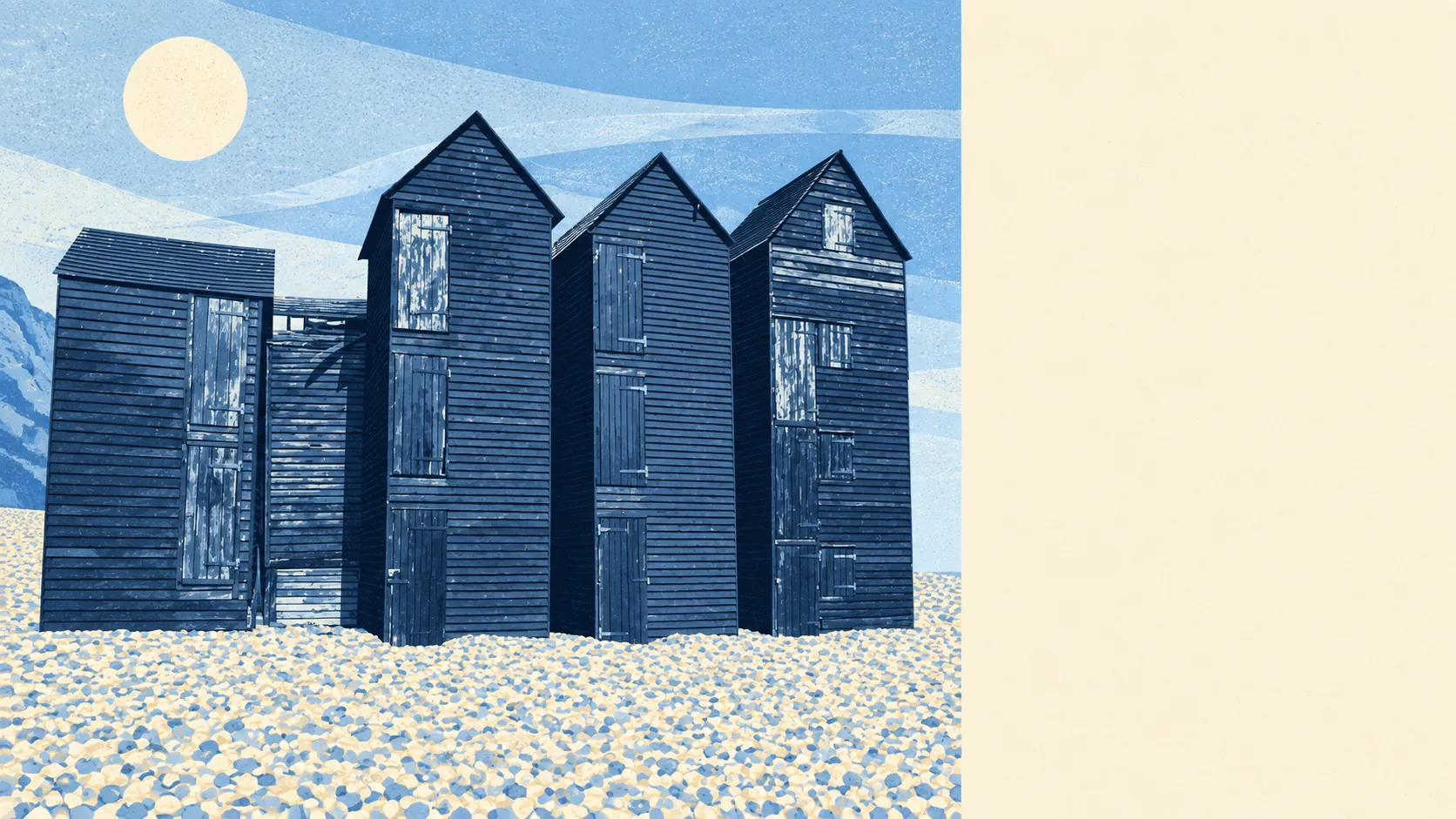
The character comes from the terrain. The Old Town sits in a valley between the two hills, with the fishing boats hauled up on the beach at the Stade and the tall black net huts beside them. Rock-a-Nore runs out east under the cliffs, and a miniature railway runs along the beach to Marine Parade. Westwards, St Leonards-on-Sea started as a separate planned town and still feels like one. East of it all, Fairlight and Pett give way to clifftop and marsh. Few towns this size fit a castle ruin, a working beach, a pier and two funicular railways into a walk you can do before lunch.
Private gardens are more generous than the terraced streets suggest: about 100,000 square metres of garden per 1,000 residents across the town's neighbourhoods. Plenty of homes have a proper patch of their own, and the flats that don't have a park round the corner.
The valuation list counts 3,565 rateable premises, including 595 offices and 188 holiday lets alongside the shops, pubs and restaurants. These are premises on the list, not a count of businesses open today. The holiday lets are a reminder that the town still gets rented by the week every summer.
Of the 707 food premises with a hygiene rating, about 90% hold the top score and about 2% sit at the bottom. Eating out here is mostly a question of taste, not of risk.
The surroundings are one of Hastings' real strengths. Parks, sea, hills and countryside all sit within a short walk of most front doors, and few towns of this price can say the same.