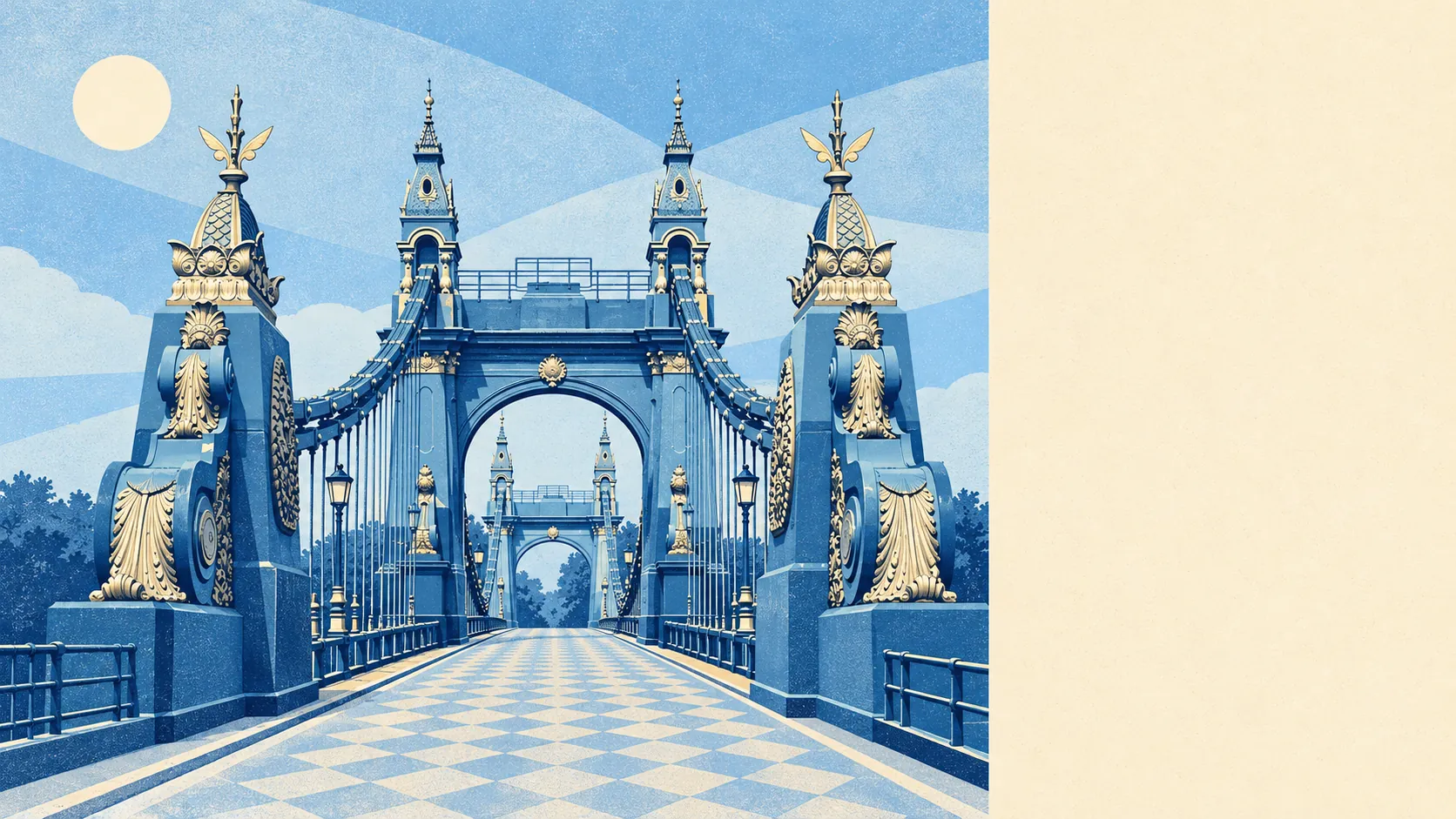
The area around Hammersmith is better than its traffic suggests. Green space is a couple of minutes from almost any front door. The Thames is a short walk further. King Street has the shops, pubs and restaurants of a proper town centre. There is no protected countryside anywhere, and the area doesn't need it.
The typical Hammersmith home is about 130 metres from public green space, with around 37 green spaces within a kilometre. In a district this crowded that is an unusual amount of grass. St Peter's Square is a listed garden square, and Bishop's Park and Wandsworth Park are in easy reach along the river.
Water is close as well. The nearest river or open water is about 425 metres away on average, and roughly 38 stretches of it lie within a kilometre. Most of that is the Thames, so the riverside walk past Upper Mall and Hammersmith Terrace is part of most residents' week whether they planned it or not.
For cycling, the nearest National Cycle Network route is about 1.9 kilometres away on average, and no postcode in Hammersmith is close to one. The area has no ancient woodland either.
The high street works as one. Hammersmith has about 446 shops, 44 pubs and 94 restaurants. King Street has a second shopping centre, Livat Hammersmith, as well as the town hall and the Lyric Theatre, and the Broadway at the other end adds the main shopping centre and the bus station. For anything bigger, Chiswick, Fulham and Kensington are all neighbours.
Fine particle pollution across Hammersmith and Fulham averaged about 9.1 micrograms per cubic metre in 2024, a borough-wide reading that can't separate a riverside garden from a flat beside the flyover.
The character changes within a few streets. Near the Broadway and the gyratory it is busy, loud and full of offices and buses. Towards the river it is older and calmer, with listed Georgian houses, the old riverside pubs and the rowing crowd on the water. Six conservation areas surround the district, from Bedford Park to Castelnau across the river, so the nicer streets tend to be the protected ones.
Private gardens are scarcer. Hammersmith has about 17,700 square metres of private garden for every thousand residents, and most of that belongs to the terraced houses, since about three in four homes here are flats. For many residents the park is the garden. If a flat advertises "use of garden", read the lease to see whether that means your own patch or a shared lawn the whole building can use.
The council's rating list shows how much of Hammersmith is given over to work. Of 2,717 rateable premises, the largest category by far is 1,246 offices, followed by 444 shops. These are premises on the list, which doesn't mean every one is currently trading. The district used to make things: lamps at the Osram factory on Brook Green, and furniture at Waring & Gillow's works in Cambridge Grove, which switched to building aircraft in both world wars. These days it mostly produces meetings.
The Food Standards Agency rates 416 food premises in Hammersmith. About 87% have the top hygiene score and fewer than 1% are rated poor.
None of the area is covered by a protected landscape designation. There is no area of outstanding natural beauty, no site of special scientific interest and no ancient woodland. It is an inner London district with parks, squares and a river, and it does well with what it has.
What surrounds Hammersmith is one of its real strengths. Few addresses this central have this much green space and river within a short walk.