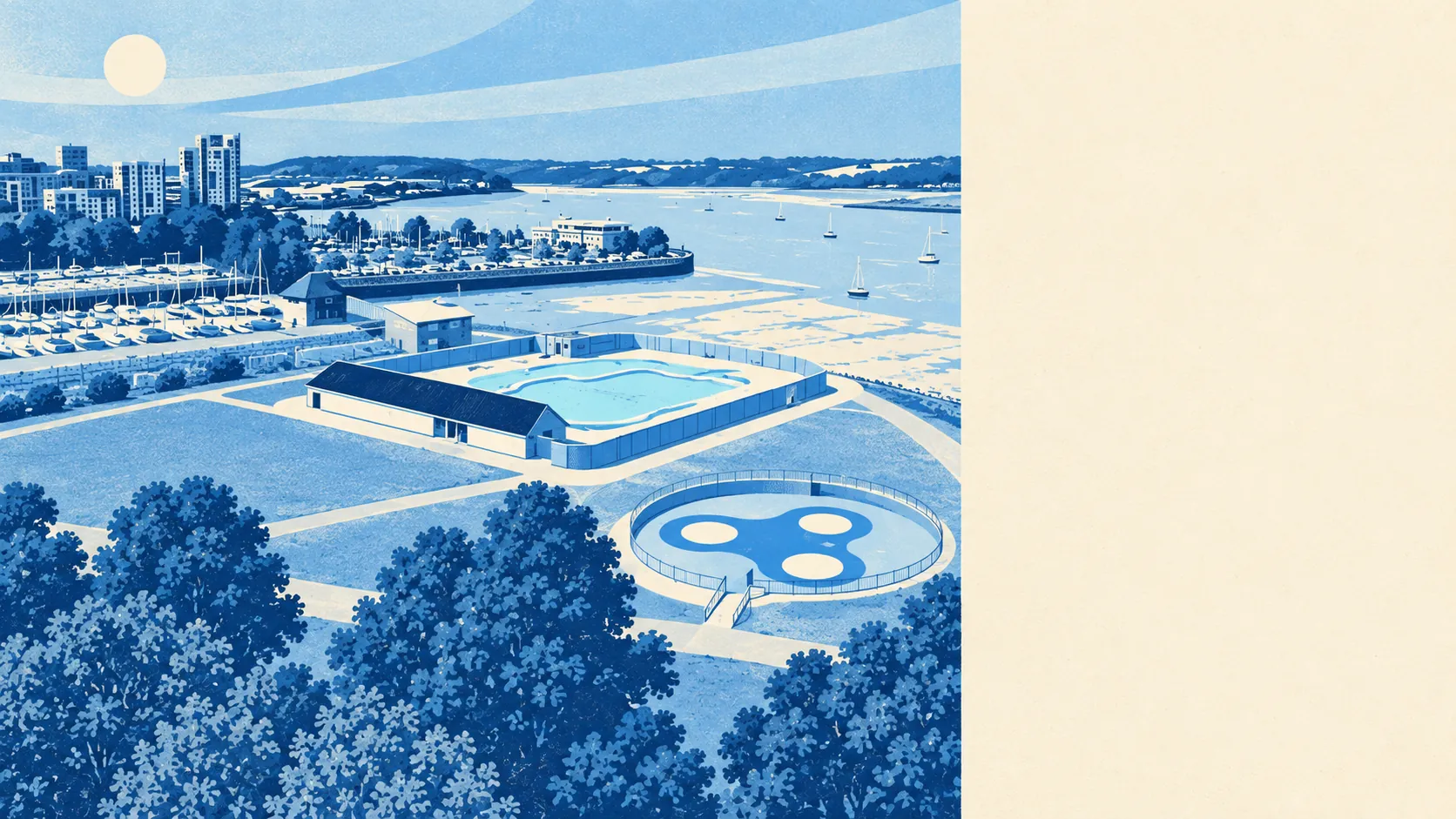
The area around Gillingham is greener than its terraces suggest. A park is a couple of minutes from most front doors. Twenty-odd green spaces sit within a short walk. The water is a bit further off. The town looks built-up from the High Street and green from the back gate.
The average home is about 155 metres from its nearest green space, with about 21 green spaces within a kilometre. That's a town where the dog chooses the park, not the owner. The Great Lines Heritage Park and the Lower Lines Park are the big ones, open ground kept clear for centuries so gunners had something to aim across. The same open land now gets used for football and Sunday walks.
Water takes more effort. The average home is about 1,150 metres from the nearest blue space, with about 13 stretches of water within a kilometre. Gillingham Marina and the Medway shoreline are the obvious draws, and for most residents they're a short trip, not the view from the bedroom.
The National Cycle Network is about 1,350 metres away on average, and about 25% of postcodes sit close to a route. There's no ancient woodland within the area. For that, you head south, towards the Capstone valley beyond Hempstead and the countryside past the motorway.
The premises data counts 1,222 shops, 80 pubs and 111 restaurants. That's a working town's High Street, with its Saturday and Monday market, not a boutique parade. Nobody moves here to be near an artisan cheese shop, and nobody pretends otherwise.
Fine-particle air pollution across the Medway council area averaged about 7.7 micrograms per cubic metre in 2024. That's a council-wide figure, not a reading from any particular street.
The character comes from the place's working history. Brompton Lines and the old dockyard defences run along one edge. Gillingham Green and Gillingham Park hold the older village cores, and Lower Rainham and Lower Twydall keep a quieter edge to the east. Gillingham Business Park sits outside the centre, doing the job the dockyard used to do. It's a town built for work that has turned its old defences into parks.
Private gardens matter as much as public ones. The area has about 74,000 square metres of garden per 1,000 residents, so behind the terraces there's real outdoor space, not just a yard. Plenty of homes have room for a shed and an ongoing argument about the shed.
On the business rating list there are 1,841 rateable premises. After shops, the biggest groups are offices, with 206, and warehouses, with 98. These are premises on the valuation list, not a count of businesses open today. Still, they point to a town that goes to work locally as well as commuting out.
For eating out, 540 food premises carry a hygiene rating, about 75% of them at the top score of five, and about 3% at the low end. Three-quarters at the top is a decent showing for a town where the takeaway is part of the weekly routine.
No protected landscape overlaps the area: no Area of Outstanding Natural Beauty, no Site of Special Scientific Interest and no ancient woodland. The Kent Downs is the nearest named one. That's a plain statement about what Gillingham is, a town, and it leaves the protected countryside for the drive out.
The surroundings are one of Gillingham's real strengths. Parks are almost on the doorstep, gardens sit behind the terraces, and the water is a short trip away.