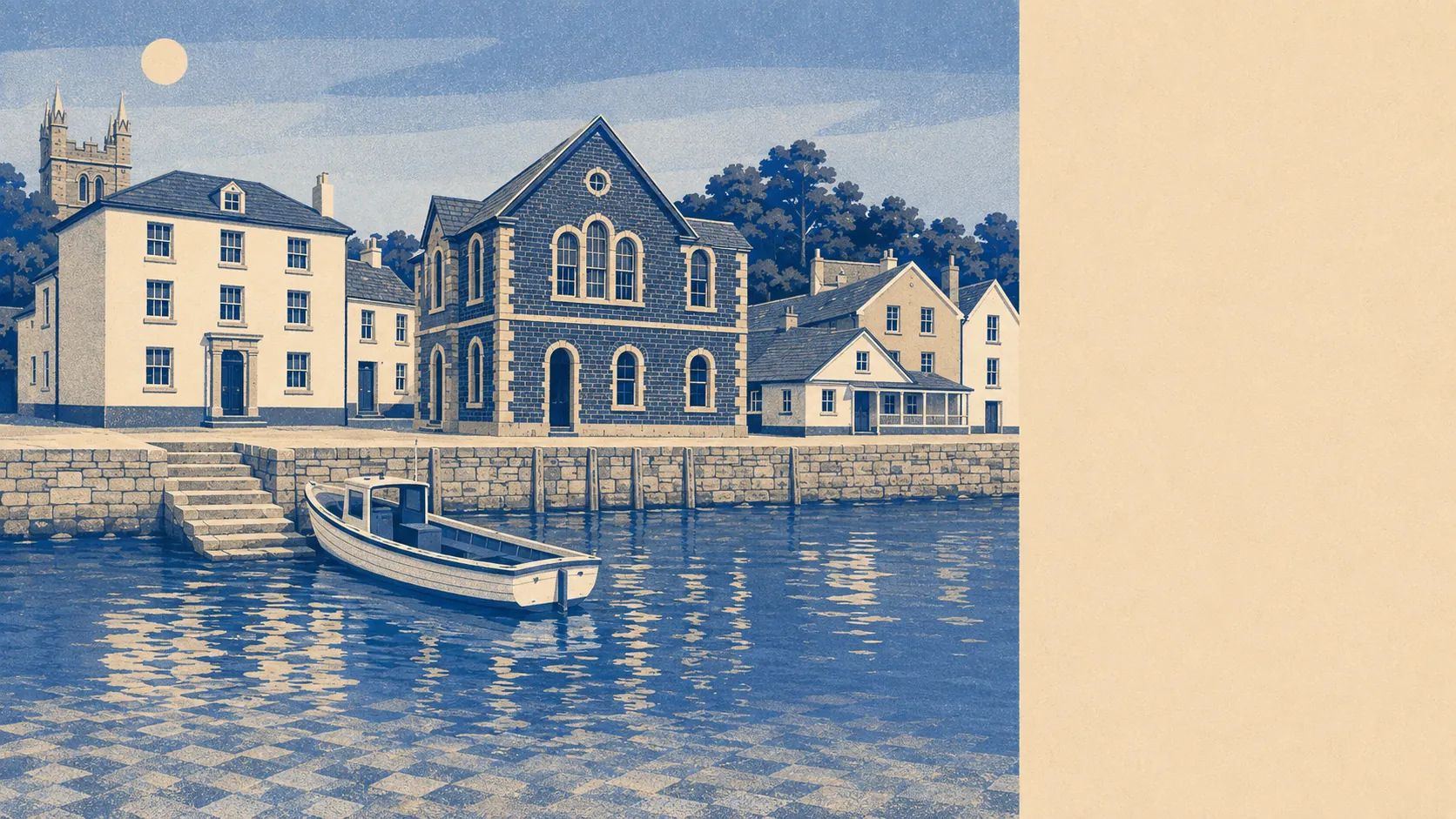
Yes, if you can live somewhere the water is the point and the parking never will be. About seven in ten own their homes. The typical resident is well past fifty. The estuary is closer to most front doors than the nearest bus stop. Fowey is not a town that is trying to become anything, and that is the whole offer.
The housing stock is a mixture rather than a type. On the council-tax valuation list, which covers every dwelling in the area rather than only the ones with a recent energy certificate, about 27% are detached, 25% terraced, 17% bungalows, 16% flats and 14% semi-detached. Roughly 38% were built before 1930, which is the fact doing the most work here: this is a town of old walls, small rooms and window frames somebody has opinions about. Around 70% run on mains gas, and about 11% are on electric-only heating, which is the figure to establish before the viewing rather than after the first winter quarter. On energy certificates, half the stock sits in bands A to C, about 32% in band D, and roughly 18% in band E or worse. Old harbour towns do not hand out good energy ratings, and Fowey has not made an exception.
Sale prices reflect a place people choose rather than commute to. The Land Registry's last twelve months put the median sale at £450,000 across 35 sales. Detached houses ran to a median of about £552,000, terraces around £390,000, flats about £340,000 and semi-detached around £310,000. Council tax lands most commonly in band C, and about 27% of dwellings sit in bands A or B, so the bill picture is gentler than the sale prices imply. That gap between what a house costs and what the council thinks it is worth is the oldest story in Cornish property, and Fowey tells it clearly.
Renting is harder to pin to the town itself. The typical private rent across the Cornwall area is about £1,000 a month, up around 5% over the year. That is a county-wide figure covering everything from Bodmin to the coast, so treat it as the shape of the market rather than the price of a Fowey flat with a view of the water. Anything with an estuary in the window will be asking for more than the county typical, and the people advertising it know exactly what they have.
On safety, the published rate is about 48 recorded crimes per thousand people over the twelve months to May 2026, about 35% below the Cornwall average. The strongest thing you can say about a small town's crime numbers is that they are small enough for a single bad weekend to move them, and that is true here. But the direction is consistent and the comparison is with a local authority that includes some genuinely busy places. Devon and Cornwall Police charge in about 8% of cases against a national rate of about 12%, which is a force-level statistic rather than a Fowey one, and worth knowing before anyone forms a view about what reporting something achieves.
Connectivity is where the honesty is required. Fowey station closed to passengers in 1965 and the line now carries china clay rather than commuters, so the nearest passenger service is Par Rail Station, and only around 1% of residents commute by train. Roughly 44% drive to work and about 32% work from home, which in a town this size is less a lifestyle choice than a structural one. There are 46 bus stops in the area, and the 23 with published timetables average around 54 weekday services each, every one of them running at weekends too. The car journey to a main town centre is about 25 minutes; by public transport it is closer to 44. Broadband is better than the geography suggests: superfast reaches about 95% of premises, gigabit about 45%, and only a fraction of a percent sit below the universal service obligation. At least one mobile operator gives 4G or 5G coverage to about 100% of the area, and all operators to about 95%.
Water is both the attraction and the constraint. On the postcode indicators, which count postcodes flagged on at least one flood measure including surface water, about 22% carry a high flag and 14% a medium one. On the Environment Agency's river-and-sea zone mapping, which is a narrower and stricter measure, about 7% of the area sits in flood zone 3 and 1% in zone 2, rising to around 21% under the climate-adjusted zone. Seven flood events are on record, the most recent in January 2014, caused by the sea overtopping defences. The shoreline management policy across every postcode here is hold the line. Against that, green space is genuinely excellent: the average postcode is around 89 metres from open green space with about 12 patches within a kilometre, and water is about 242 metres away. Radon sits in the highest band across the whole area, which means testing and, where needed, mitigation, both of which are routine and neither of which is a reason to walk away.
Heritage is not decoration here, it is planning policy. There are 118 listed buildings in the area, including two at grade one and nine at grade two star, four scheduled monuments, and three conservation areas covering Fowey, Bodinnick and Polruan. If you buy inside one, your window replacements, your render, your solar panels and quite possibly your front door become a conversation with the council rather than a decision. People who find that romantic love it. People who wanted double glazing by March find out the hard way.
The character follows from all of it. Around 71% own their homes, the median age is 55, and typical household income sits near £44,600 for the financial year to March 2023. This page also covers Bodinnick across the water and Golant up the river, both of which are quieter again and both of which make Fowey itself look positively metropolitan. Fowey has form for interesting residents: Kenneth Grahame and Mabel Lucie Attwell both had their connections to the place, Mary Bryant was born here in 1765 before being transported to New South Wales and becoming one of the first to escape it, and the Fowey Gallants were licensed privateers, which is a polite word for what they actually did.
Fowey suits people whose lives do not depend on a station, a driveway or a Tuesday-night choice of restaurants. If you are buying for retirement, for a boat, or because you have finally admitted you want to live somewhere with weather in it, this works. If you have school-age children and two commutes, look hard at the car journey times before you fall for the harbour.
Fowey is a good place to live, and its real strength is the surroundings: green space at the end of the street, water at the end of that, and a landscape that has been worth looking at for a thousand years. The weak spot is flood risk, which the mapping is honest about and which varies enormously street by street, so the address matters more than the town does. Buy uphill, check the specific postcode, and the rest of it is the version of Cornwall people are trying to buy when they buy Cornwall.