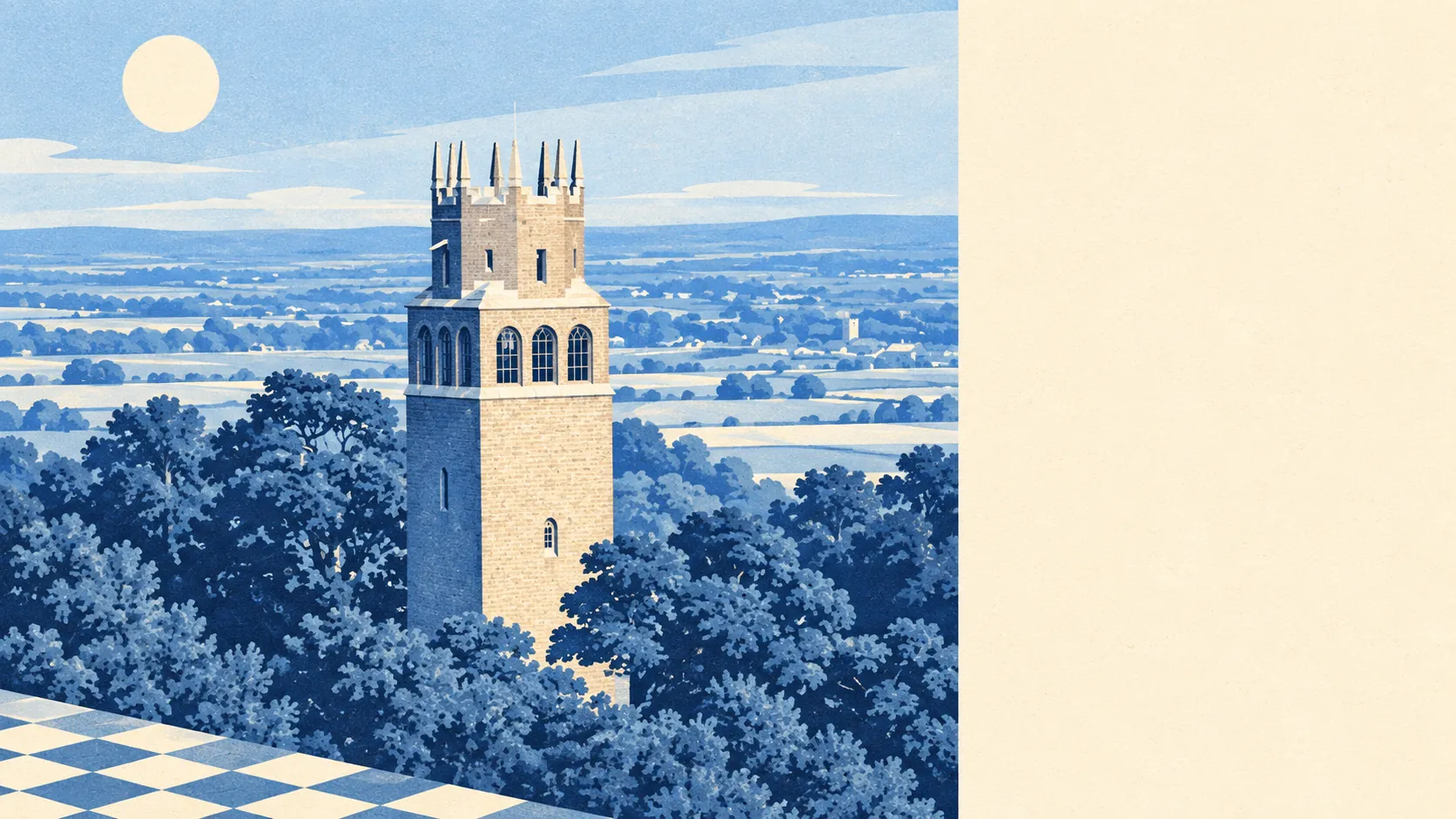
Faringdon is a market town that drives to work. About six in ten own their home. Half the commuters go by car and a third don't commute at all. The train is a rumour. The Tuesday market is the only thing left that comes to you.
The housing is an honest spread, not a postcard. Every home on the council-tax list is counted here: detached houses and terraces make up about 28% each, semis 20%, flats 19% and bungalows 6%. Only 19% were built before 1930, so the old stone around the Old Town Hall is the shop window and most of the town behind it is post-war and later. That helps with the bills. Of the homes with an energy certificate, 71% are rated A to C, 24% sit at D and 5% at E or worse. About 78% of homes are on mains gas and 10% rely on electric heating alone, which is the question to ask at the viewing and not after the first winter. The frontage the listing photographs is rarely the one you end up heating.
Prices are fair for the south of Oxfordshire and nobody's idea of a bargain. The Land Registry recorded 111 sales in the year to May 2026, with a median of about £321,000. Terraces went for around £296,000, semis about £330,000 and detached houses about £443,000. Flats, at roughly £175,000, are the cheapest way in by a distance. Band C is the most common council-tax band, and only 19% of homes sit in bands A or B, so the cheap-to-run starter house is thinner on the ground than the flat prices suggest.
There is no rent figure for Faringdon on its own. The typical private rent across the Vale of White Horse area is about £1,330 a month, from the Office for National Statistics' rent index as of April 2026. That average covers Faringdon, Wantage and a great many villages, so treat it as a rough guide and check live listings street by street. Letting agents will quote whichever end of it suits the listing.
Safety is the weak spot. Police records put crime at about 73 per 1,000 residents in the year to May 2026, roughly 25% above the Vale of White Horse average. Shoplifting accounts for about 13% of recorded crime, against about 8% nationally, which says more about a working high street than about the residential streets. Across the whole Thames Valley Police area, about 9% of cases ended in a charge over the same year, against about 12% nationally. That is a force figure, not a Faringdon one, but it is the force you get.
Schools are steady. Primary schools in the area average about 104 on the Key Stage 2 maths score across six schools, and Faringdon Community College, the only secondary in the postcode district, records an Attainment 8 score of about 44. Across Oxfordshire, Ofsted has graded 108 of 121 inspected settings good or outstanding. Primaries in and around town include Folly View Primary and The Elms Primary School. With one secondary, the catchment arms race that eats weekends in bigger towns has nowhere to go.
Connectivity depends entirely on whether you own a car. Under 1% of working residents commute by train and about 49% drive. The bus is better than its reputation: the town has 49 bus stops, and those with timetable data average about 67 weekday departures and three an hour at peak, with 91% running at weekends. The S6 links Swindon and Oxford. Modelled figures from 2019 put the nearest hospital about 28 minutes away by car and 78 minutes by public transport, which is a long afternoon with a sprained ankle. Broadband is where the town makes up ground: superfast reaches every premises, gigabit about 80%, and about 95% of the area gets 4G or 5G from every operator. For the 36% who work from home, the commute is the landing.
The surroundings are the best thing about the place. The Environment Agency's river-and-sea flood zones cover none of the town. Surface water is a different matter: about 15% of postcodes are flagged high risk on at least one flood indicator, including surface water, so check the exact address. Green space sits about 120 metres from the average home, with around 21 green spaces within a kilometre and water about 430 metres away. The villages that ring the town, Great Coxwell, Little Coxwell, Littleworth, Fernham and Shellingford close in, Buckland, Longcot, Stanford in the Vale, Uffington and Watchfield further out, give you the countryside without the drive to reach it. Uffington brings the White Horse with it.
Heritage comes with paperwork. There are 125 listed buildings, including two at Grade I and two at Grade II*, plus 121 at Grade II, and the town centre sits inside the Faringdon conservation area. If the house you love is on the market place, the sash window you hate is probably staying.
The town itself is settled rather than sleepy. About 8,600 people live here, about 62% own their home and the median resident is 40. Household income averaged about £66,000 gross in the financial year to March 2023, on the Office for National Statistics' modelled estimate. That is a comfortable town of families and mid-career owners, not a retirement lounge.
Faringdon suits households with a car, a job that is at least partly remote, and a liking for fields within walking distance. Families who want one decent secondary and no catchment drama will find it straightforward, and buyers priced out of Oxford get a town with a working centre rather than a dormitory estate.
It does not suit anyone who needs a train, a hospital nearby or a quiet high street after dark. If your week depends on a rail commute, the arithmetic points somewhere with a station, and that is a fair trade, not a failure.
The town has a habit of outlasting its founders. King John set up an abbey here in 1202 and the monks left for Beaulieu in 1203, which is an early example of the town's instinct for turnover. The market granted in 1218 has held on better than the monks did. The poet laureate Henry James Pye inherited Faringdon House from his father, and the Spanish writer Arturo Barea spent his exile here and is buried in the town. People come for one reason and stay for the long version.
Faringdon is a good place to live if the car is already on the drive. Its real strength is the surrounding area and green space, with open country and the White Horse villages on the doorstep. The weak spot is safety, with crime running a quarter above the rest of the Vale. Buy the view and lock the car.