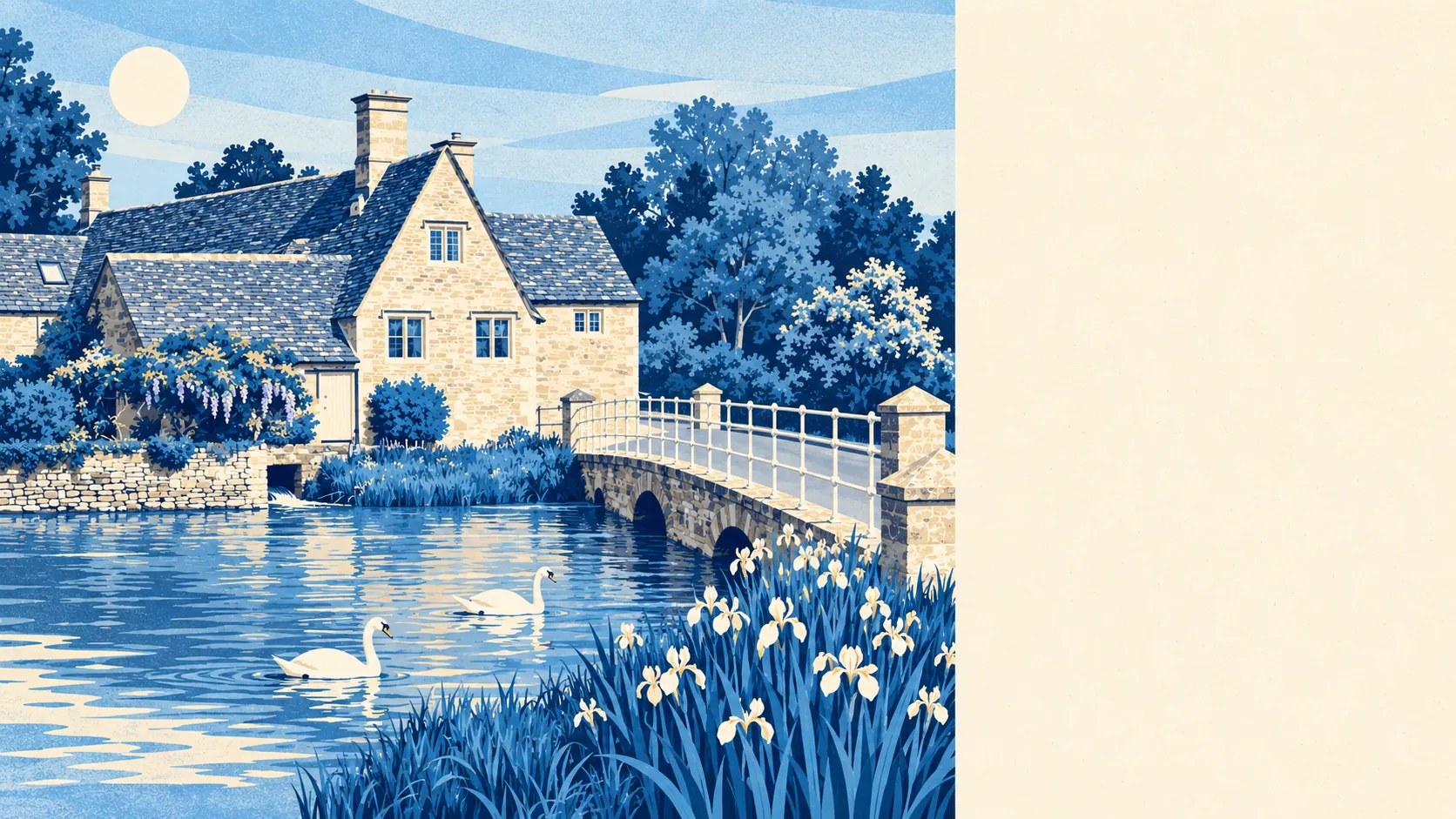
Fairford is a small market town that gets most things right and charges full Cotswold money for it. It runs on the River Coln, a medieval wool church and the car, and the fields start where the streets stop. It works best for families and home workers who drive. It works least well for anyone trying to buy their first home on one salary.
The safety picture is good. Gloucestershire Constabulary's published rate for the town is about 27 crimes per 1,000 residents in the year to May 2026, about a third below the Cotswold district average of about 40. Fairford's best-known brush with the police came in 2003, when coaches of protesters heading for the air base were stopped and searched at Lechlade and sent back to London. Even the trouble struggled to get here.
Prices are where the town is hardest on buyers. The Land Registry recorded 53 sales in the year to April 2026, at a typical price of about £436,000. The type of house decides almost everything. Detached homes went for around £650,000, semis about £400,000 and terraces about £328,000. Only three flats sold, at around £205,000, which is too few to tell you anything. Council tax is gentler: band C is the most common, and about 23% of homes are in the two cheapest bands. The purchase price hurts a lot more than the annual bill does.
Renting offers no back door. Private rent across the Cotswold council area typically ran to about £1,260 a month in April 2026, and Fairford pays that district average whether it fits the town or not.
The housing is more mixed than the stone-cottage image suggests. On the council-tax list about 35% of homes are detached, 24% semi-detached, 23% terraced and 11% bungalows, and flats make up about 5%. Only about 22% were built before 1930. The energy certificates show post-war building as the biggest single era, and 59% of certified homes are rated A to C. About 74% of homes heat with mains gas. The postcards are taken at the church end of town, though the typical mortgage is on something built a good while later.
About 69% of households own their home and the typical resident is 46. The Office for National Statistics models gross household income for the area at about £58,700 in the financial year to March 2023. Most people here are past the renting stage and some way short of retiring, and the town has been arranged to suit them.
The river is both the town's best asset and its main risk. On the Environment Agency's river-and-sea mapping, about 7% of the area falls in the highest-risk flood zone and about 2% in the middle zone. A broader measure counts postcodes on at least one flood indicator, surface water included, and about 12% of postcodes are rated high on it. In July 2007 heavy rain flooded homes on Milton Street and London Street. Most of the town is on dry ground. The streets nearest the Coln are a separate question for buyers.
The railway to Oxford closed in 1962 and nothing replaced it. Buses run to Cirencester and Lechlade, but the town's 24 stops average about four weekday departures each, and almost nobody gets to work by train. About half of workers drive and about 36% work from home. The Department for Transport's 2019 modelling puts the nearest town centre about 23 minutes away by car and 56 by public transport, and the bus figure has probably only got worse since. Gigabit broadband reaches about 83% of premises. More than half of households run two or more cars, and the rest mostly work from home.
There are 119 listed buildings, including the Grade I Church of St Mary the Virgin, four at Grade II* and 114 at Grade II, plus the Fairford conservation area. If you buy one of the older houses, any change to the windows, roof or front door goes through the council first.
Fairford keeps its own secondary, Farmor's School, which recorded an average Attainment 8 score of about 49. Fairford Church of England Primary School is in town, and Meysey Hampton and Hatherop have their own Church of England primaries close by. The six primaries in the district average about 106 in end-of-primary maths. Across Gloucestershire, Ofsted grades 136 of its 156 graded settings good or better, though that is a county-wide figure. Families with children of both ages don't need to leave town for school.
The surroundings are where Fairford is strongest. The average home is about 160 metres from public green space and about 390 metres from water, and the Cotswold Water Park is nearby. This page also covers Hatherop, Coln St Aldwyns, Meysey Hampton and Aldsworth, where the stone villages and farmland carry on. The town's notable names include the American-born painter Edwin Austin Abbey, the writer Paul Cornell and the mountaineer Kenton Cool, who found bigger hills than these somewhere along the way.
Fairford is better than average, and the gap between what it does well and what it charges is easy to see. You get green space and water a few minutes' walk from the front door, low crime and a secondary school in town. You pay for it in the house price. It is right for a family with two cars or a job done from home, and with the budget for a semi at around £400,000. First-time buyers stretching a single income, and anyone who wants to live without a car, should look at a bigger town with a station.