Eltham never got the Tube, and has spent the time since proving it could manage without one. At rush hour the average bus stop sees about thirteen buses, fibre-fast broadband reaches almost every door, and nearly four in ten workers skip the commute altogether. For a buyer, that means a south-east London suburb where the car is optional, which is rarer than the semis make it look.
Three stations do the rail work: Eltham, Mottingham and New Eltham, with trains heading for Charing Cross, Cannon Street and Victoria. The two suburban lines run at or beyond capacity in the morning peak, so the seat is a privilege and standing is the normal fare. The 2021 Census found about 11% of working residents commuting by train, 8% by bus and 29% by car, while 37% worked from home. The bus network carries more of the load than people credit. There are 280 stops, and the 262 with timetable data average 221 departures each weekday, with about 97% still served at weekends. Gigabit broadband reaches about 94% of premises and superfast reaches all of them. The Department for Transport's modelled journey times, which date from 2019, put the nearest town centre about 16 minutes away by public transport and a GP about 11. Car and walking times hold up well over the years. Bus timings age faster.
Police.uk records about 90 crimes per 1,000 people in Eltham over the year to May 2026, roughly 24% below the average for the Royal Borough of Greenwich. Violent and sexual offences make up 29% of local crime against 35% nationally. Vehicle crime makes up 10% against 5%, so the car that so many households can do without is also the thing most worth locking.
The Land Registry's last twelve months, to May 2026, put the typical sale at about £475,000. Flats went for around £303,000, terraces about £480,000, semis about £615,000, and the 23 detached houses that sold fetched about £700,000. Band C is the most common council-tax band, and only about 14% of homes sit in bands A or B. The Land Registry's price index shows values essentially unchanged over the year. Renting means paying the Royal Borough of Greenwich's typical private rent of about £1,950 a month as of April 2026, a borough-wide average that covers far more than these streets.
The council-tax valuation list shows a stock split almost evenly three ways: about 34% terraced, 31% semi-detached and 30% flats. Detached houses are about 3% and bungalows about 2%. Only about 19% of homes were built before 1930, and the energy certificates show interwar building as the biggest single era. On efficiency, about 42% of certificated homes rate A to C, 44% rate D and 14% rate E or worse. About 80% heat with mains gas. This is a suburb built to a plan and then filled with loft conversions.
Flood risk is where Eltham does worst, and the source surprises people. The town centre sits on a plateau. In the Environment Agency's river-and-sea flood zones, only about 0.2% of postcodes fall in the highest zone, and the last recorded flood from a main river was in 1968. Measured as postcodes on at least one flood indicator, surface water included, about 22% carry a high rating. The threat is rain with nowhere to go, and a plateau doesn't stop that.
Ofsted has graded 37 of 40 local settings good or better, 11 of them outstanding. The area's primaries average about 107 in end-of-primary maths, against a national expected standard of 100. Its four secondaries, which include Eltham Hill School, Harris Academy Greenwich and St Thomas More Catholic Comprehensive School, average an Attainment 8 score of about 53. Parents here tend to argue about which good school to pick. That's a better argument than the one most London boroughs offer.
About 57% of households own their home and the typical resident is 39. Modelled gross household income came to about £76,000 in the financial year to March 2023. Social renting accounts for about 27% of households, so Eltham is a mixed suburb with plenty of neighbours who never had to deal with a mortgage broker.
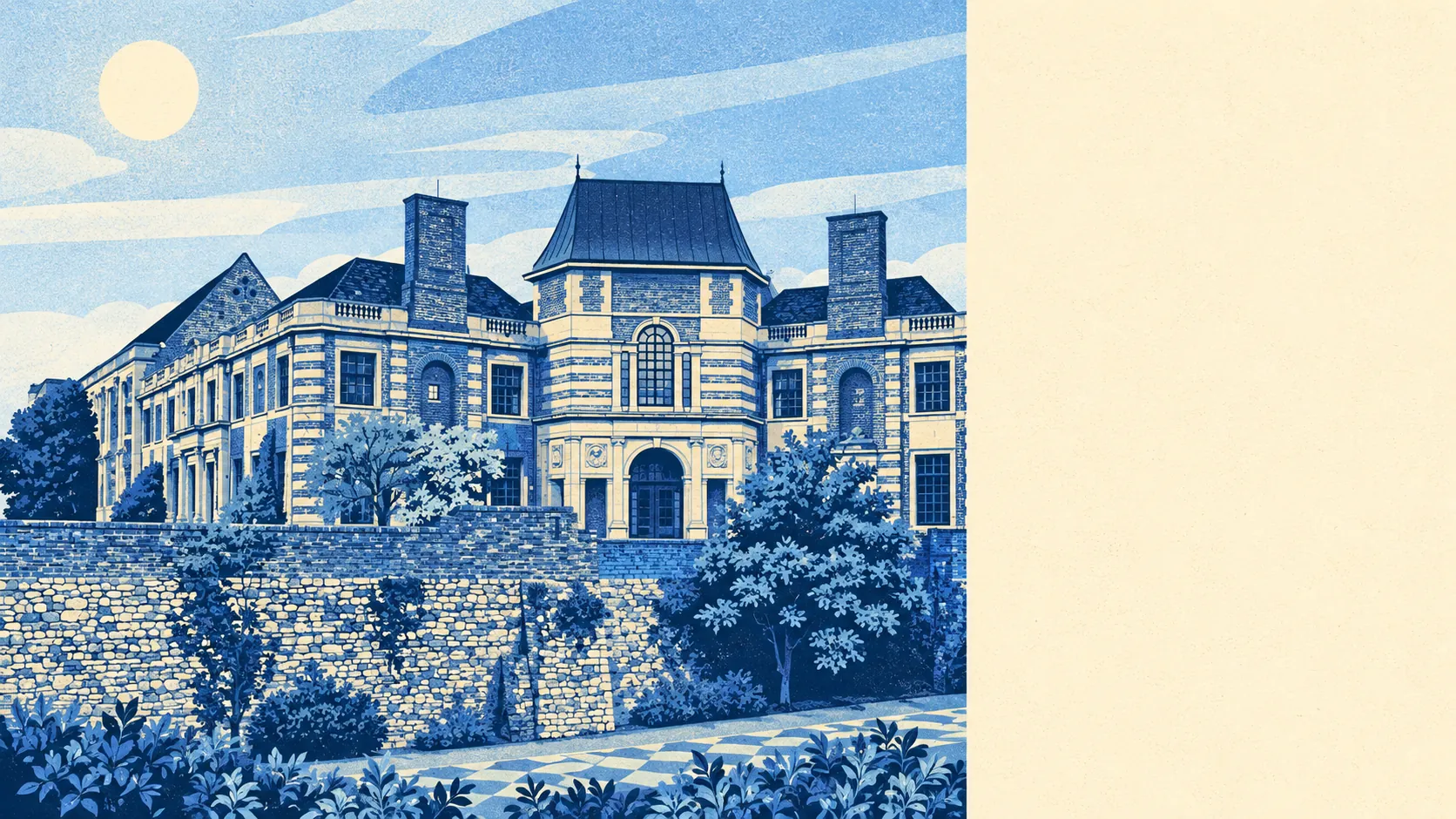
There are 75 listed buildings, six of them Grade I, and just one conservation area, Willersley Avenue and Braundton Avenue. Most owners can extend without a heritage officer reading over their shoulder. The palace takes most of the grandeur. Henry III held a public Christmas there in 1270, and Edward II often stayed. Hubert Bland, a co-founder of the Fabian Society, lived at Well Hall House, as did the watchmaker John Arnold. A precision timekeeper and a believer in very gradual change shared an address, which is a fair summary of how Eltham approaches progress.
Green space is about 140 metres from the average front door. Avery Hill, Sutcliffe Park, The Tarn, Well Hall Pleasaunce and Horn Park all hold Green Flag status, and the River Quaggy runs along the south-west edge. Water of some kind is within about 500 metres on average. The parks came before the people who now walk in them, and nobody is about to build on them.
Eltham is right for buyers who want a semi with a garden, a choice of good schools and a commute that works without a car, and that includes the quieter streets of New Eltham and Mottingham. It is wrong for anyone who needs the Tube at the end of the road, or who plans to buy low on the plateau and assume the rain will drain somewhere else.
What a buyer gets here is the luxury of not organising life around a car: buses that keep coming, three stations, and broadband good enough to stay home. Eltham is an above-average place to live, and much of that comes from how easily you can leave it every morning and come home every evening.