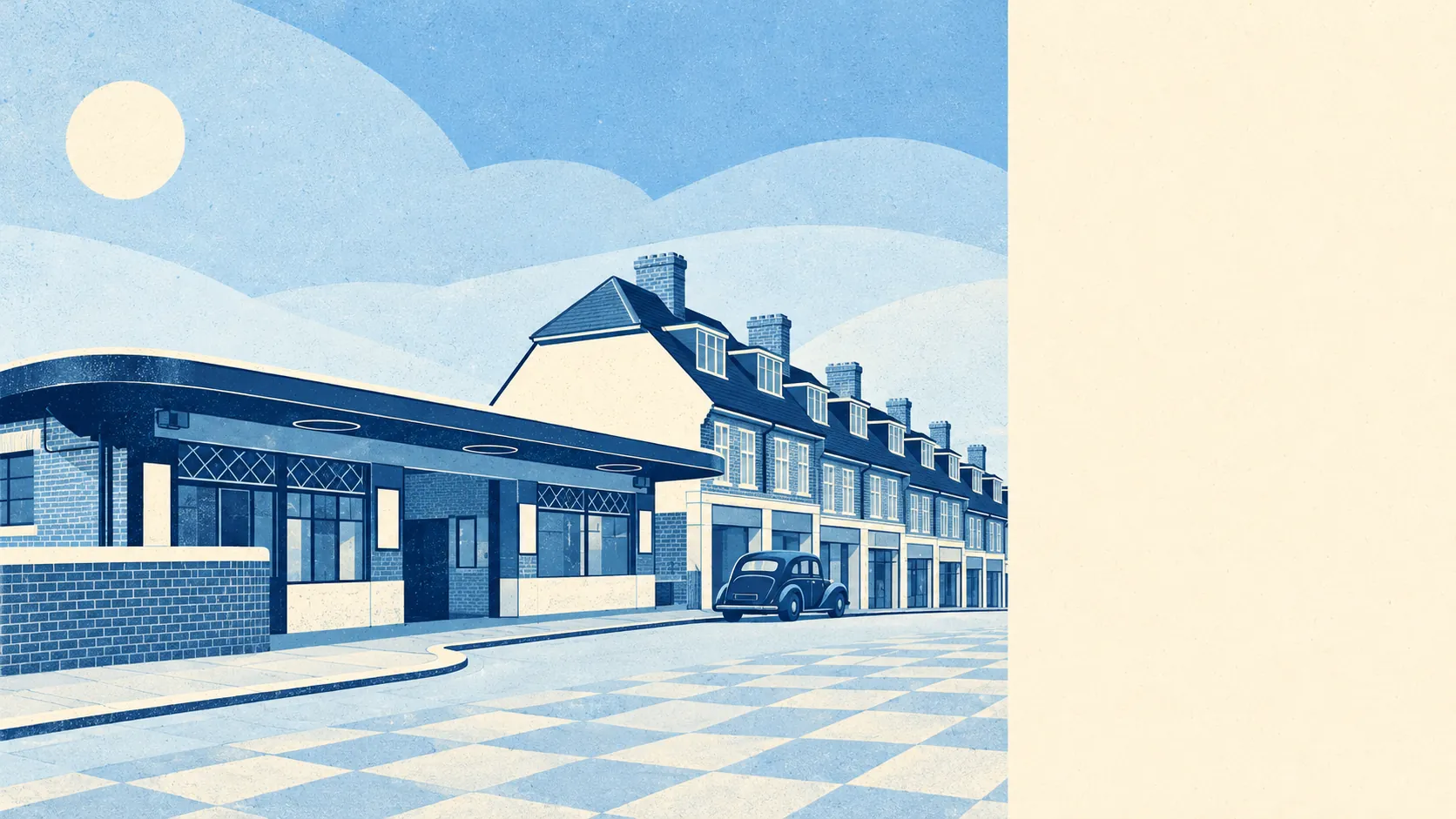
The area around Elm Park is green, flat and ordinary in the best sense, with parks close to almost every street and a high street that sells what people actually need. There are parks within a short walk of most front doors. There is water nearby too, which an inland suburb isn't usually given credit for. The shopping is a run of small units along The Broadway and the parades either side of it. People come here for the open space and the useful shops, and nobody makes the trip for the nightlife.
Green space is the strong suit. The nearest park or open space is on average about 210 metres from a home in Elm Park, and the typical household has 18 within a kilometre. Harrow Lodge Park, Hornchurch Country Park, Brettons Park, Swallow Walk and Eastbrookend Country Park, part of the Thames Chase forest, are all in reach, so dog walkers here have a weekly rotation to work through.
Water is closer than most people would guess. The nearest lake, pond or stretch of river is on average about 490 metres away, with 14 within a kilometre of the typical home. None of it makes Elm Park a waterside place, but a walk past water is easy to fit in.
Cycling routes are less convenient. The nearest stretch of the National Cycle Network is on average about 1,260 metres away, and only about 15% of the area counts as close to it. Elm Park's cycling is mostly park paths and suburban roads.
The high street is built for errands. The valuation list counts 317 shops in the area, 17 restaurants and 7 pubs, which is a parade made for picking up a prescription and a loaf on the way home. The original plan grouped the shops along The Broadway with Station Parade and Tadworth Parade on either side, so the shopping still runs in a line out from the station, the way the estate was drawn.
Havering as a whole, the council area Elm Park belongs to, recorded fine-particle pollution of about 8 micrograms per cubic metre in 2024.
The character was set at the start. Elm Park Garden City opened in May 1935 with a minister cutting the ribbon and the Dagenham Girl Pipers playing, and the Assembly Hall was handed to a residents' association set up that July. The estate was given to its residents with bagpipes and a committee, and the streets of semis and the long parade of shops still follow the layout of that opening year. Hornchurch's older landmarks, Langtons and St Andrew's Church among them, sit at the edge in conservation areas of their own, so the history here comes from the neighbours.
Most homes have a proper garden as well. Elm Park has about 74,000 square metres of private garden for every 1,000 residents, the result of an estate built for semis with a lawn front and back, a long way from flats with balconies. Between the parks and the gardens, not many households here are short of somewhere outside to sit.
Behind the shop fronts, the business rates valuation list records 595 rateable premises across the area. Shops make up the biggest group by a distance, with 63 offices next. Those are premises on a valuation list, so empty units count alongside trading ones, but the mix makes plain that this is a shopping parade with a few offices above and behind it.
Of the 162 food premises the Food Standards Agency has rated, about 69% hold the top hygiene score and about 3% fall into the lowest bands. For a parade that runs mostly on takeaways, cafes and a couple of small supermarkets, the kitchens are mostly in good order.
No protected landscape designation covers Elm Park. There is no area of outstanding natural beauty, no site of special scientific interest and no ancient woodland. The green space here is parks and country parks laid out for people to use, and nobody has had to fence any of it off to protect a rare orchid.
The surroundings are one of Elm Park's real strengths. Few outer London suburbs put this much open space, water and garden this close to an ordinary semi, and Elm Park gives its residents room to get outdoors without driving anywhere.