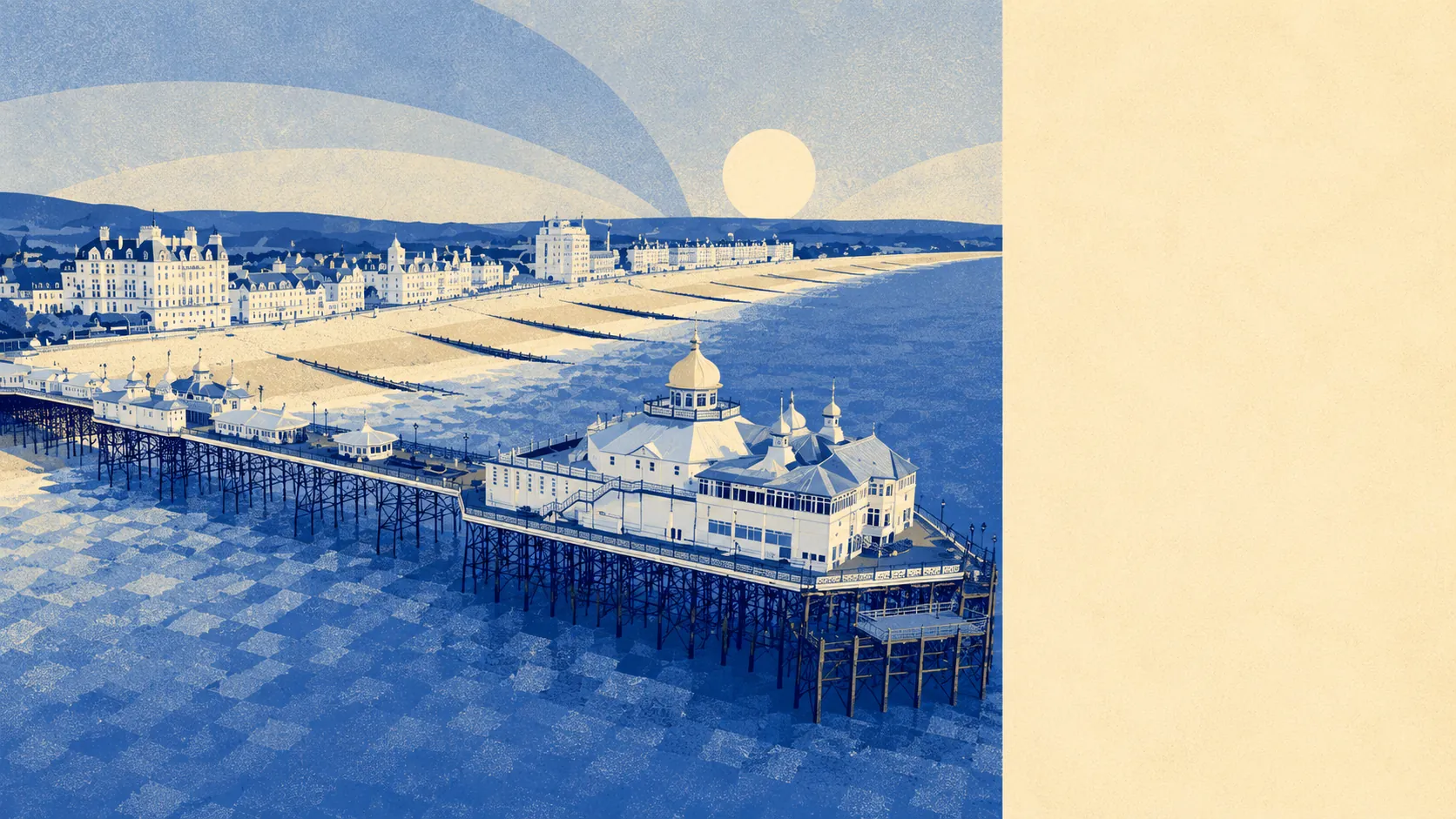
Eastbourne is what other south-coast resorts pretend to be. The median age is 46. About four in ten households rent. A quarter don't own a car. Those numbers aren't pensioner-town. They're working-coastal-town with the Downs at the back and Beachy Head down the road.
The housing is mostly houses, with flats making up about four in ten of the stock and bungalows another one in twelve. The dominant era is post-war, between 1950 and 1982, when the town filled in around the Victorian core. Roughly half the homes now sit in the better energy-rating bands of A to C, about four in ten in band D, and one in eight at E or worse. The easy retrofits have happened. The expensive ones haven't.
The typical home changed hands for around £282,500 over the past 12 months, across roughly 1,455 transactions, which is healthy depth for a south-coast town. Detached houses run to about £421,500, semis around £330,000, terraces around £277,000, and flats around £190,000. Council tax mostly sits in band B, with about four in ten dwellings in bands A or B combined. For a Victorian seaside town with the highest chalk cliff in Britain at the western edge of the parish, the price point reads as honestly mid-market.
Typical private rent across the Eastbourne area runs to about £1,160 a month, which is closer to what people actually pay than the marketing suggests and well under what Brighton commuters now treat as normal. Rents have moved up around 1% in the past year, which is rare and welcome on the south coast.
The crime rate runs at around 128 per 1,000 residents over the past 12 months, sitting broadly in line with the local-authority average. That puts Eastbourne at the safer end of comparable coastal towns. The pattern is what you'd expect: heavier in the central wards near the seafront, lighter once you cross into the residential suburbs.
The town has its own railway station with trains to London Victoria taking around 1 hour 36 minutes, plus Hampden Park station to the north, holding the unofficial title of busiest level crossing in the country, and Polegate station further out for the commuter overflow. Some 546 bus stops sit across the four postcode districts. Around 82% of premises can get gigabit broadband, which puts Eastbourne well ahead of the south-coast average for the kind of speeds people now treat as load-bearing.
Around one in ten postcodes carry a high surface flood risk, another one in eight a medium one, and about one in five sits inside the highest flood zone. Most of that exposure clusters where you'd expect: the low-lying eastern marshes around Langney and the seafront frontages. Green space is the other side of the ledger. The average postcode sits less than 200 metres from a piece of public green, with around 20 separate greenspaces within a kilometre. The Downs themselves are the back garden, owned by the town in perpetuity since the 1926 Eastbourne Corporation Act, and the single best reason to live here.
The town carries 222 listed buildings: 12 at Grade One, 16 at Grade Two starred, and 194 at Grade Two. There are 16 conservation areas, taking in Meads, Upperton, Warrior Square, Ratton, Willingdon, the town centre and seafront. There are 57 scheduled monuments across the wider area, most of them Bronze Age barrows on the Downs and the Pevensey Castle complex east of town. If you buy in the centre or in Meads and want to swap the windows, extend at the back, or paint the front door something the Council didn't have in mind, the planning department will be involved. The freedom to alter your home is, frankly, the weakest thing about Eastbourne, and the price you pay for the prettiest townscape on this stretch of coast.
Around 62% of households own. The median age of 46 is older than the national figure but not by as much as Eastbourne's reputation suggests. Median household income runs to around £50,000, which places the town in the comfortable middle of the South East rather than at either end. The streetscape carries this honestly: solidly built, well-kept, more bungalows than the brochure photography ever admits, and a steady gentrification at the edges that hasn't yet displaced what was there.
This page also covers the neighbourhoods of Hampden Park to the north, Langney to the east towards Sovereign Harbour, Willingdon and Jevington above the Downs, and the cluster around East Dean and Friston in the chalk valley west of town. Each carries its own character within the wider Eastbourne identity, and each is closer to the centre than the rural appearance suggests.
Eastbourne suits the buyer who wants a Victorian seaside town that takes itself seriously without being insufferable about it, the family priced out of Brighton who has done the maths on the train fare, and the downsizer who wants the Downs in walking distance. The car-free arithmetic genuinely works here, which surprises people who arrived expecting Hastings.
It does not suit the buyer who needs a daily London commute, the buyer who wants to extend their kitchen without filing three forms, or the buyer who quietly wanted Brighton and is hoping nobody notices. Brighton is 19 miles west, costs more, and is more interesting in the way Brighton residents prefer to put it.
The town's literary roll call includes Lewis Carroll, George Orwell, Aleister Crowley, Angela Carter and Charles Webb, who wrote The Graduate. Its most famous twentieth-century medical man was John Bodkin Adams, a local general practitioner whom Scotland Yard's archives credit with up to 163 patient deaths before a 1957 trial at the Old Bailey acquitted him. He resumed practising in the town four years later. Eastbourne does not advertise this, but it has stopped pretending it didn't happen. The 1780 visit by four of King George the Third's children started the resort trade that everything since has rested on.
Eastbourne is a good place to live, which is roughly what three and a half out of five amounts to before the breakdown. The surroundings, with the Downs at the back and the seafront at the front, score the maximum five and carry the rest of the verdict. The freedom to extend or alter your home scores the lowest possible one, and that's the price of the prettiness. Everything in between is what you negotiate to get the combination. The Empress of Watering Places, still doing exactly what it was built for in 1849, and rather better than most of the competition is willing to admit.