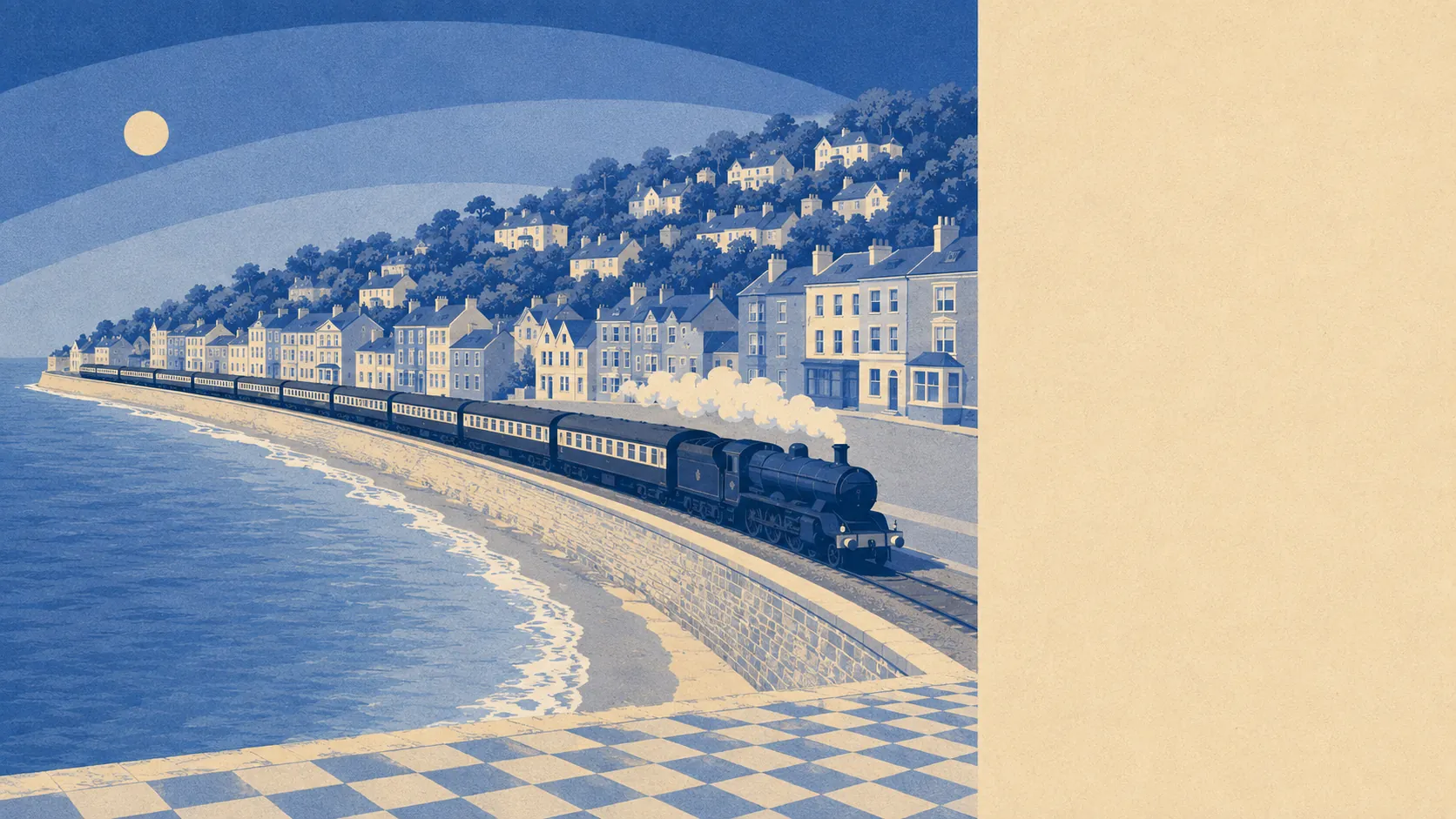
Yes, if you want the coast without paying resort money for it. About two-thirds of people here own their homes. The typical resident is in their early fifties. Green space starts a couple of minutes from most front doors. Dawlish is not a town that is arriving. It arrived when somebody straightened the stream, laid a lawn along both sides of it and pointed the terraces at the water, and it has never found a persuasive reason to keep going.
The council tax valuation list, which covers every dwelling rather than only the ones certificated since 2008, splits the stock fairly evenly: terraced houses and flats at about 24% each, detached at 21%, semi-detached at 15%, bungalows at 14%. Around 22% of the 7,870 dwellings went up before 1930. The bungalow share is the honest tell, because that is a town building for knees. Energy certificates cover 4,347 homes, of which 56% sit in bands A to C, 33% in band D and 11% in band E or worse. About 73% run on mains gas and about 12% on electricity alone, which is the figure to establish before you fall for a converted seafront flat with a view and a storage heater.
The Land Registry recorded 152 sales in the twelve months to May 2026 at a median of £260,000, and the median flattens a real spread. Flats came in around £135,000, terraced houses around £227,500, semi-detached at £290,000 and detached around £387,500. The most common council tax band is C, with about 38% of dwellings in bands A or B. This is south-coast living priced like somewhere that gave up competing with the bigger resorts along the bay and got on with its own afternoon.
Renting is only measured across the wider Teignbridge area rather than Dawlish alone, so take it as the area typical: about £950 a month on the Office for National Statistics rent index as of April 2026, up 3.9% over the year. By size, that runs to about £645 for a one-bedroom, about £860 for two and about £1,070 for three.
Safety is where the town takes its hit. The published rate is about 87 crimes per 1,000 people in the twelve months to May 2026, roughly 42% above the Teignbridge average of about 61. Violence and sexual offences account for about 46% of recorded crime against about 35% across England and Wales, a statutory grouping broad enough to include common assault without injury. Devon and Cornwall Police charged a suspect in about 8% of cases against about 12% nationally. One caveat worth carrying to any viewing: the town supports 103 shops, 16 pubs and 89 holiday lets on the business rating list, and a rate calculated per resident cannot tell a resident from somebody down for the week.
Two primary schools in the district have published key stage two results, with an average maths score of 101. Dawlish College, the town's secondary, has an Attainment 8 score of about 39. Ofsted's grading across Devon puts 138 of 172 graded settings at good or better, with 3 outstanding, 31 requiring improvement and 3 inadequate. Gatehouse Primary Academy and Westcliff Primary Academy serve the town, with Orchard Manor School and Oakwood Specialist College covering specialist provision. Modelled journeys put a primary about 12 minutes' walk away and a secondary about 17. The catchment arms race that governs house prices elsewhere never really starts here, because there is one secondary and nothing to argue about.
Dawlish Rail Station sits on the seafront, with Dawlish Warren, Starcross and Teignmouth stations along the same stretch of line. About 3% of working residents commute by train and 3% by bus, against 52% who drive and 24% who work from home, with 12% walking. The town has 62 bus stops, averaging about 41 scheduled weekday departures each, and every stop with published service data runs at weekends too. Gigabit broadband reaches about 54% of premises and superfast about 98%, with about 97% of the area covered by all mobile operators. Department for Transport modelling from 2019 puts a town centre about 14 minutes away by car and a hospital about 32, though the public transport figures in that set age faster than the driving ones. The most photographed railway in the country, and hardly anyone here catches it to work.
On flooding, about 8% of postcodes carry a high rating on at least one flood indicator including surface water, and about 10% a medium one. In the Environment Agency's river-and-sea flood zones, about 5% of the area falls in zone 3, rising to about 10% once climate allowance is applied. One flood event is on the record, in November 2012, when a main river exceeded channel capacity. Green space averages about 135 metres away with about 16 sites within a kilometre, and water about 260 metres with about 50. Around 43% of postcodes sit within half a kilometre of the coast, where the shoreline management policy is to hold the line. Ground conditions are the lowest hazard class across the board and radon sits in the low band. About 77% of postcodes sit near rail noise of 65 decibels or more, which is the price of the view.
Heritage constraint is real but contained: 91 listed buildings, two of them grade two star and the rest grade two, plus one conservation area over the old core. If your house is in it, windows, solar panels and extensions become a conversation with the council rather than a decision you make on a Saturday.
Around 66% of homes are owner-occupied, the median age is 52, and gross household income runs to about £45,650 in the financial year to March 2023. About 34% of households are one person and about 19% a pensioner living alone. Deprivation sits mid-table nationally and has improved slightly since 2019. This page also covers Ashcombe, inland and small, and Dawlish Warren out on the spit, which is mostly holiday accommodation and behaves accordingly.
It suits downsizers, remote workers, and anyone who wants water and green space within a short walk and can live with a town that closes early. Families do fine, particularly with one secondary and short walking distances.
It does not suit anyone who needs a daily rail commute to make the sums work, or who wants a period seafront property and modern running costs in the same purchase. Those two things are not sold together here.
The town has quietly collected people who did their interesting work elsewhere: Herman Merivale the historian and civil servant, Robert Shuttleworth the botanist, Thomas Vowler Short who went on to be a bishop, and Colonel Sir Arthur Hammond, who won a Victoria Cross and then presumably wanted somewhere quiet. Brunel had a go at running an atmospheric railway through here in the 1840s, using a pneumatic tube and considerable confidence, and the directors abandoned it for ordinary trains. Dawlish has always been where ambitious ideas come to be politely retired.
Its real strength is the surroundings: green space and water are both within a few minutes of nearly every door, and the ground under the town is about as boring as ground gets, which is exactly what you want it to be. The weak spot is safety, where the published rate sits well above the district average and the mix leans harder on violent categories than the national picture. Buy here for the coast, the space and the price, take the crime figures seriously enough to walk the street at eleven on a Saturday, and understand that the sea is a permanent negotiating partner rather than a feature.