The area around Dartford is greener and wetter than its traffic reputation would suggest. Most homes have a park a short walk away. Two rivers run through the town and the Thames is at the top of it. The high street is busy and practical. Nobody comes here for chocolate-box countryside, but plenty stay for the open space.
The average home in Dartford is about 150 metres from public green space, with roughly 25 green spaces within a kilometre. Central Park runs along the River Darent through the middle of town, and Dartford Heath opens out to the west. A lot of the green is close to home here, so a dog walk doesn't need the car.
Water is close too. The nearest river, pond or stretch of open water is about 600 metres away on average, with around 34 bodies of water within a kilometre. The Darent and the Cray meet on the Dartford Marshes north of the town before both reach the Thames. Joyce Green, out on that marsh, was one of the first Royal Flying Corps airfields in 1911, was replaced by Biggin Hill and closed in 1919.
The National Cycle Network is about 640 metres from the average home, and about 51% of homes are close to a route. Along with the marshes and the Darent Valley, that gives cyclists a way out of town that avoids the main roads.
The rated-premises list counts 1,044 shops, 64 pubs and 104 restaurants. Most of Dartford's high street is shops, which you would expect in a town whose name gets used for a shopping trip.
Dartford's council area recorded fine particles in the air at about 8 micrograms per cubic metre in 2024, a single figure for the whole borough.
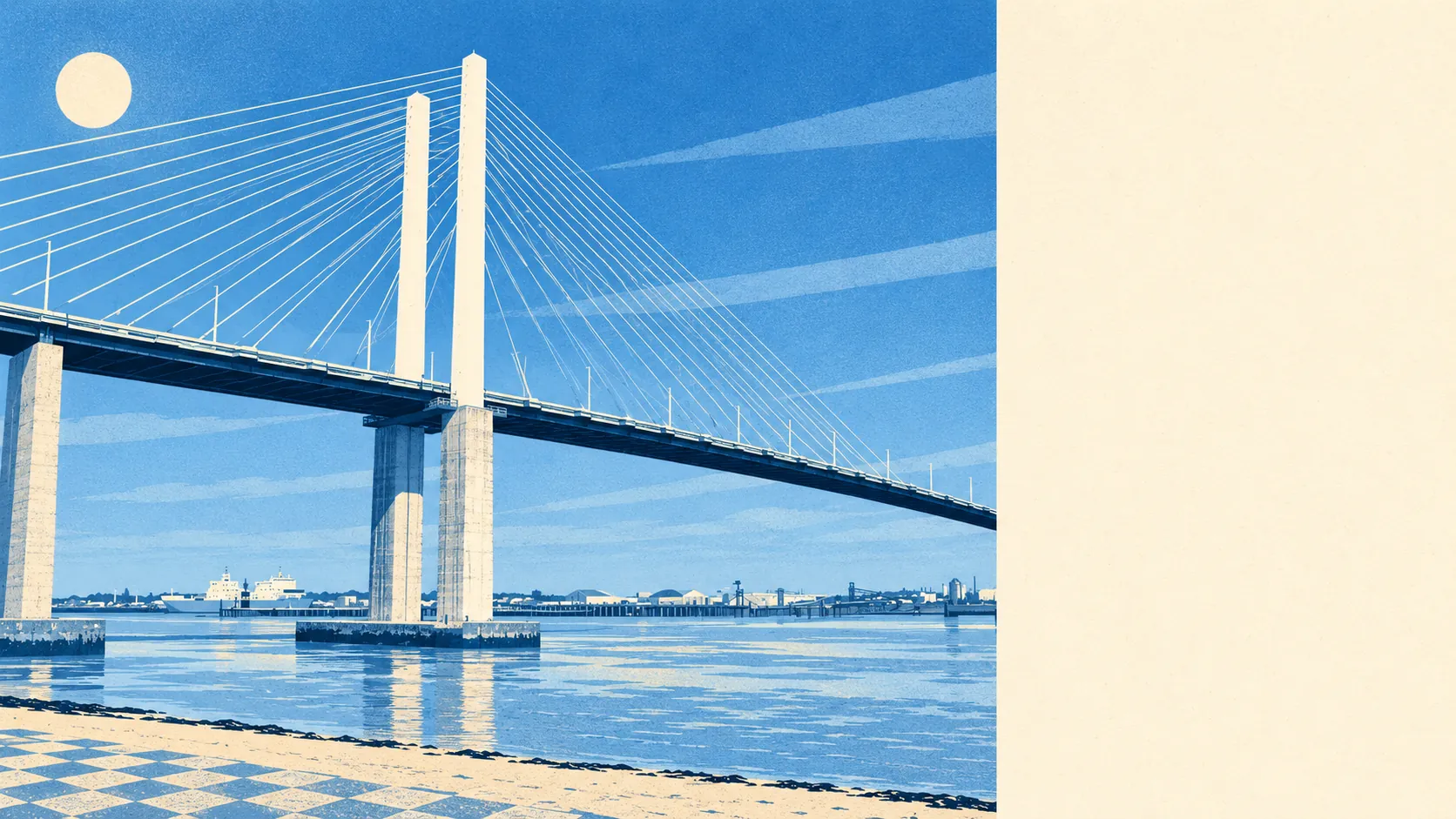
In character the town is a working place with plenty of history. The centre still has the Orchard Theatre and The Orchards, and Crossways Business Park spreads along the Thames by the bridge. Further out is St John's Jerusalem at Sutton-at-Hone, a remnant of the Knights who once held the manor. Wilmington, Stone and Hawley run on from the town to the south and east, so the edge of Dartford is hard to spot on the ground.
Private gardens are reasonable. There are about 62,000 square metres of residential garden for every 1,000 residents, measured across the whole area. Most of Dartford's terraces and semis have their own patch outside the back door.
The business rates valuation list counts 2,118 rateable premises in the area, including 616 offices and 205 warehouses. These are premises on the council's list, not a count of businesses trading today. The warehouses suit a town on the river and the motorway.
For eating out, about 68% of the 402 food premises rated for hygiene hold the top score, and about 5% sit at the bottom of the scale.
No area of outstanding natural beauty, site of special scientific interest or ancient woodland overlaps Dartford. Its land was spent on paper mills, gunpowder, cement and chalk pits, and an industrial history like that rarely earns a national designation.
Easy access to green space is one of Dartford's real strengths. There is a park, a river or a cycle route close to almost every front door, even if none of it is the countryside that ends up on postcards.