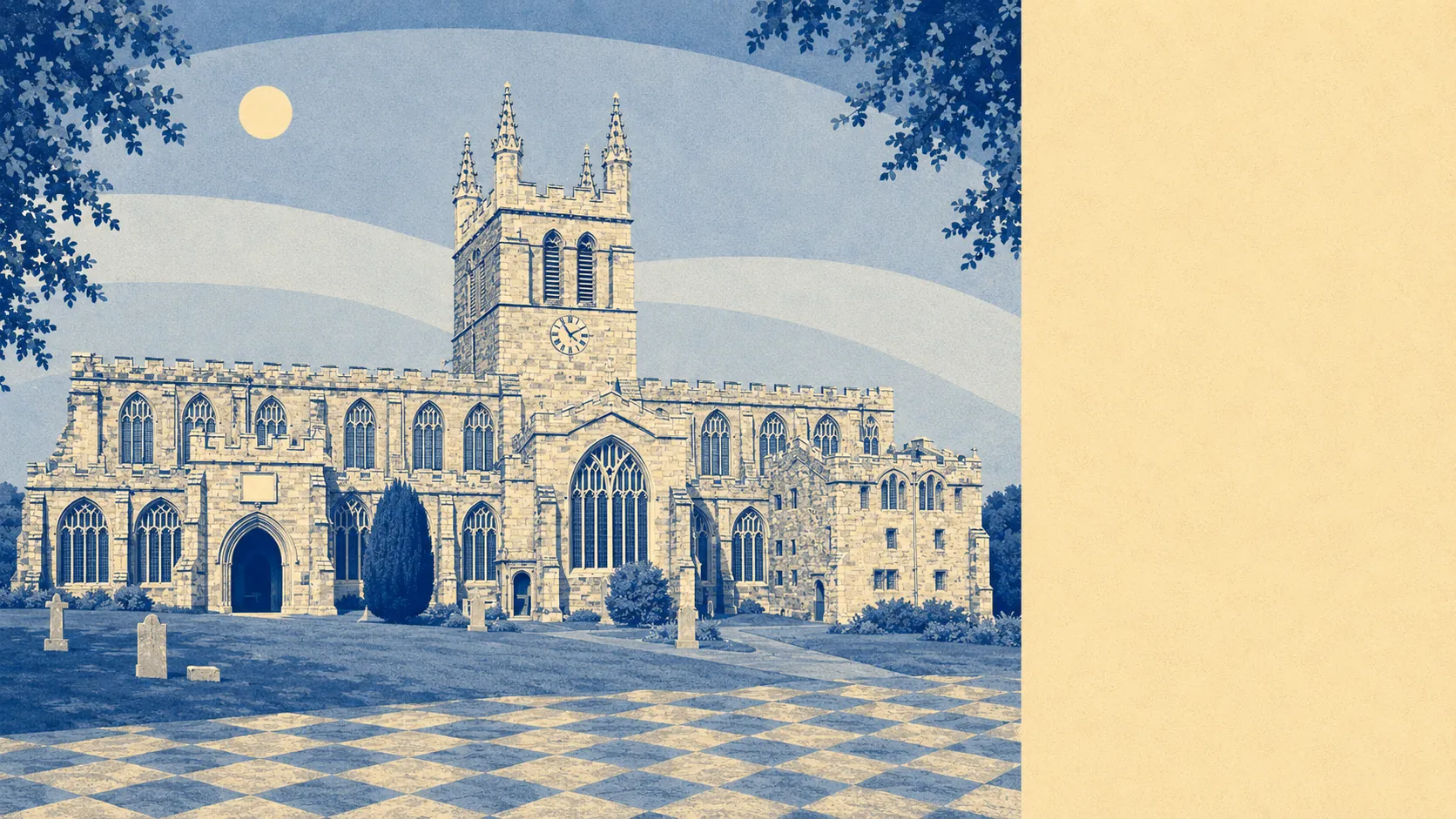
Yes, if you want a working town rather than a view of one. Two-thirds of people here own their homes. The typical resident is in their mid-forties, and half of them drive to work. Green space starts at the end of most streets. Crediton is not a Devon postcard, has never tried to be one, and is cheaper for exactly that reason.
The council tax valuation list, which covers every dwelling in the town rather than only the ones sold or certificated recently, splits the stock almost evenly four ways: 25% detached, 24% terraced, 21% semi-detached, 16% flats and 13% bungalows. About 27% was built before 1930, which in practice means solid walls, sash windows and a builder's quote every decade. On energy ratings, 55% of certificated homes sit in bands A to C, 32% in band D and 13% in E or worse. Around 70% run on mains gas, 2% have no central heating at all, and about 10% are heated by electricity alone. That last figure is the one to check before the second viewing rather than after the first winter, because an electric-only Victorian terrace and a gas-heated one on the same street are two very different bills.
The Land Registry's last twelve months, to May 2026, records 93 sales at a median of £269,000, or about £3,500 a square metre. The type spread is wide: detached homes at a median of £380,000, semi-detached at £269,000, terraces at £225,000 and flats at £114,000. That is the same postcode buying two entirely different lives. Council tax is modest by national standards, with band B the most common and 42% of dwellings in bands A or B, and a band D bill of roughly £2,660 a year.
Renting is straightforward and unglamorous. Typical private rent across the Mid Devon area runs at about £870 a month as of April 2026, up around 2% over the year, with two-bedroom homes around £800 and three-bedroom around £990. Those are area-wide figures covering a district that stretches well past the town into open country, so treat them as a guide to the market rather than a quote for a specific street.
Safety is where the town's numbers are least flattering. Recorded crime runs at about 72 offences per 1,000 people in the twelve months to May 2026, roughly 19% above the Mid Devon average of about 60. Violence and sexual offences make up 44% of the total, a broad statutory grouping that includes common assault without injury and tops the list almost everywhere. The more telling line is shoplifting at 14% of recorded crime against 8% nationally, which is the arithmetic of being the shopping centre for a large rural catchment: the shops are here, the people come in to use them, and the offences get recorded here too. Devon and Cornwall Police charged in 8% of cases across the force over the same period, against 12% nationally, which is a force statistic rather than a Crediton one and no comfort either way.
Isambard Kingdom Brunel designed the railway station, and under 1% of residents commute by train. Crediton sits on the lines to Barnstaple and Okehampton, connecting at Exeter St Davids, with Yeoford and Newton St Cyres both close by, and the town still commutes by car: 50% drive, 26% work from home, 15% walk, 3% take the bus. There are 56 bus stops with an average of about 39 weekday departures each, though only 55% see any weekend service, which is the difference between a bus network and a weekday bus network. Broadband is the quiet triumph. Superfast reaches 99% of premises and gigabit-capable service 91%, with nothing below the minimum standard. Department for Transport modelling from 2019 puts the town centre nine minutes away by car and the nearest hospital at 30 minutes by car or over an hour on public transport, and that last number is the one worth knowing before anyone in the household stops driving.
Flooding needs its labels kept straight, because two different measures apply. On the broader postcode indicators, which include surface water, 12% of postcodes carry a high risk, 11% medium and 20% low. On the Environment Agency's river-and-sea flood zones, about 2% of the area falls inside them. Eighteen historic flood events are on record, the most recent in 1968, caused by an ordinary watercourse exceeding its channel with no raised defences. Against that, the green-space access is the best thing about the place: the average postcode sits about 120 metres from green space with around 23 separate spaces within a kilometre, and water within about 560 metres. Radon is the one to raise with a surveyor, with the highest local band recorded as Elevated and 10% of postcodes in band three or above. Around 32% of postcodes sit near road noise of 65 decibels.
Heritage is present without being a straitjacket. There are 198 listed buildings, one Grade I, four Grade II star and 193 Grade II, plus a scheduled monument in the Romano-British villa at Downes. No conservation areas are mapped across the town. For most buyers that means the usual planning rules apply and nothing more, and for the unlucky few holding a listed deed it means consent for the windows, the door, and the thing you assumed was too small to matter.
The character follows from the ownership rate. About 64% own their homes, the median age is 45, and median household income runs at roughly £52,000 gross, or about £40,000 after tax, for the financial year to March 2023. This is a town of people who bought and stayed. Bow and Copplestone, both covered here, are the same proposition with fewer shops and more lane.
It suits people who want a house with a garden inside a real town, who are comfortable driving for anything specialist, and who would rather spend the difference on the house than on the address. Families do well here, and so do people who work from home and want the walk to be worth taking.
It suits you less if you need a station you will actually use, a hospital within a short drive, or a Saturday that includes a choice of restaurants. Anyone whose weekend depends on public transport should read the bus figures twice.
The town's most famous son, Saint Boniface, left for the continent in the eighth century and never came back, which sets a certain tone. Sir William Peryam went off to become Lord Chief Baron of the Exchequer, and General Sir Redvers Buller collected a Victoria Cross. Queen Elizabeth's Grammar School, founded by Edward VI and refounded by Elizabeth I, is still going as an academy, which is a longer run than most institutions manage anywhere.
Crediton is a good place to live, and an honest one. Its real strength is what surrounds it, with green space closer to the average front door than most towns can offer and countryside starting where the estates end. The weak spot is safety, where the recorded rate sits meaningfully above the district average, driven substantially by the shoplifting that comes with being everyone else's high street. Buy here for the house, the land around it and the price. Nobody is buying it for the nightlife, and nobody here is pretending otherwise.