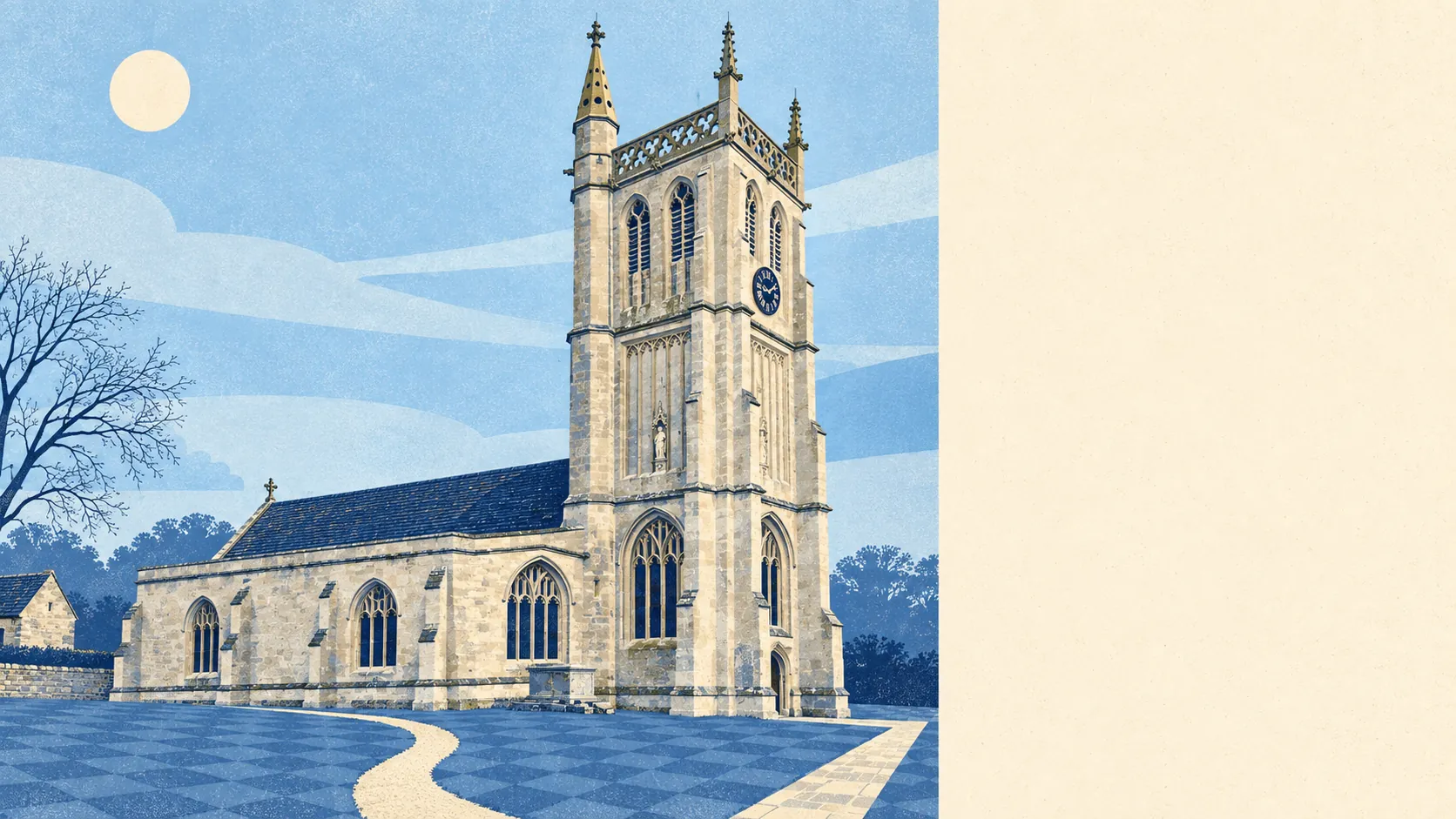
Yes, if you're happy for the car to count as a member of the household. Two-thirds of residents own their homes. Crime sits far below the Wiltshire average. Four in ten work from home, and hardly anyone takes the train. Colerne is a quiet, safe ridge-top village for people who've stopped pretending they'll ever commute by rail.
Colerne is a village of semis. On the council-tax list, 44% of homes are semi-detached, 26% terraced, 18% detached and 11% bungalows. Flats barely register at about 1%, so the cheap one-bed starter doesn't exist here. Only 21% of homes predate 1930, which catches out buyers who arrive expecting old stone on every corner. The old core sits around the church and the High Street, where Daubenys, a Grade II* long house, has been standing since around 1400. Most of the rest is post-war. Among homes with an energy certificate, 60% are in band D, 30% in C or better and 10% in E or worse. Band D is the energy rating's way of saying "fine, thanks". Mains gas reaches 78% of homes, so if a house isn't on it, ask how it's heated before the viewing rather than after the first winter.
The Land Registry recorded 17 sales in the year to May 2026, at a median of £340,000. That's a thin year, and a couple of big houses can move the median on their own. Split by type, the five detached sales had a median of £700,000, the five terraces £297,000 and the seven semis £282,000. The semi gets you into Colerne. The detached house belongs to a different conversation entirely. Band C is the most common council-tax band, and 27% of homes sit in bands A or B, so the bills are closer to a Wiltshire village than a Cotswold brochure.
Typical private rent across the Wiltshire area was about £1,060 a month as of April 2026. That's a county-wide figure from the Office for National Statistics' rent index, not a Colerne-specific one. With 26% of households renting privately and almost no flats, renting here means renting a house, because there's nothing else to rent.
In the year from June 2025 to May 2026, the published crime rate for Colerne was about 22 per 1,000 people, roughly 66% below the Wiltshire average. The place has hosted a Royal Air Force station and then an Army barracks, and its crime figures still look like a village where people borrow each other's ladders.
This is where the bill arrives. Colerne has 13 bus stops, and the stops with timetable data average five weekday departures each, with none in a typical peak hour. On the plus side, every one of those 11 stops has a weekend service. The Department for Transport's modelled journey times, dating from 2019, put the nearest town centre 16 minutes away by car and 44 by public transport, and the bus figures have probably aged worse than the car ones. Unsurprisingly, 46% of workers drive and 40% work from home. So few go by train that the share rounds to zero. The broadband holds up its end: gigabit-capable connections reach 85% of premises and superfast 99%. The working-from-home crowd picked the right hill.
The flood figures are the reward for all that climbing. None of Colerne sits in the Environment Agency's river-and-sea flood zones 2 or 3. On the wider postcode indicators, which also count surface water, 2% of postcodes are at high risk on at least one measure, 4% at medium and 24% at low. Green space is close: the nearest patch averages about 150 metres from home, with around eight within a kilometre, and the whole village lies inside the Cotswolds Area of Outstanding Natural Beauty. The environmental catch is radon. Every postcode sits in the higher radon bands and the highest band appears here, so a radon test belongs on the pre-purchase list next to the survey.
Colerne has 90 listed buildings: one Grade I, one Grade II* and 88 Grade II. It also has a conservation area named after the village. Put that together with the protected landscape and changes to windows, roofs, extensions and anything visible from the street start with the planning department rather than the builder. Double glazing in the old core is a conversation with the council, not a Saturday job.
The village is younger than the postcard suggests. The median age is 38, and 66% of households own their home. The Office for National Statistics models gross household income for the area at around £68,000 for the financial year to March 2023. That means commuters and remote workers with young families, not a retirement enclave. This page also covers Cold Ashton and Marshfield, the villages just across the line in South Gloucestershire, which share the high ground and the same reliance on the car.
Colerne suits households with two cars, at least one job that can be done from a spare bedroom, and children young enough for the nearest primary, about an 18-minute walk away on the modelled times. It also suits anyone who wants a village where the countryside starts at the end of the garden and the crime figures are a non-event.
It doesn't suit anyone who can't drive, or who wants a train station they can walk to, a flat to rent, or a secondary school within walking distance. The modelled walk to the nearest one is over an hour and a half. Buyers who plan to modernise a period cottage the way they'd modernise a London terrace will spend their first year learning how listed building consent works.
The village has always drawn an odd mix. Thomas Norton, alchemist and gentleman of Edward IV's privy chamber, was born here. William Grocyn, scholar and friend of Erasmus, is linked to it too. Centuries later, Derek Fowlds of Yes Minister lived here, as did the England rugby coach Brian Ashton and the electronic duo Goldfrapp. The airfield that opened as RAF Colerne in 1939 became Azimghur Barracks after the Royal Air Force left in 1976, and cadets still fly from it. Colerne has a long record of taking in people who could have lived somewhere busier and chose not to.
Colerne is a good place to live, as long as you go in knowing the terms. Its real strength is its surroundings: protected landscape on every side, green space a short walk from the door, and a hilltop that flood maps barely register. Its weak spot is getting anywhere without a car, with buses too sparse to organise a working week around. If you can live with the car keys, the hill pays you back.