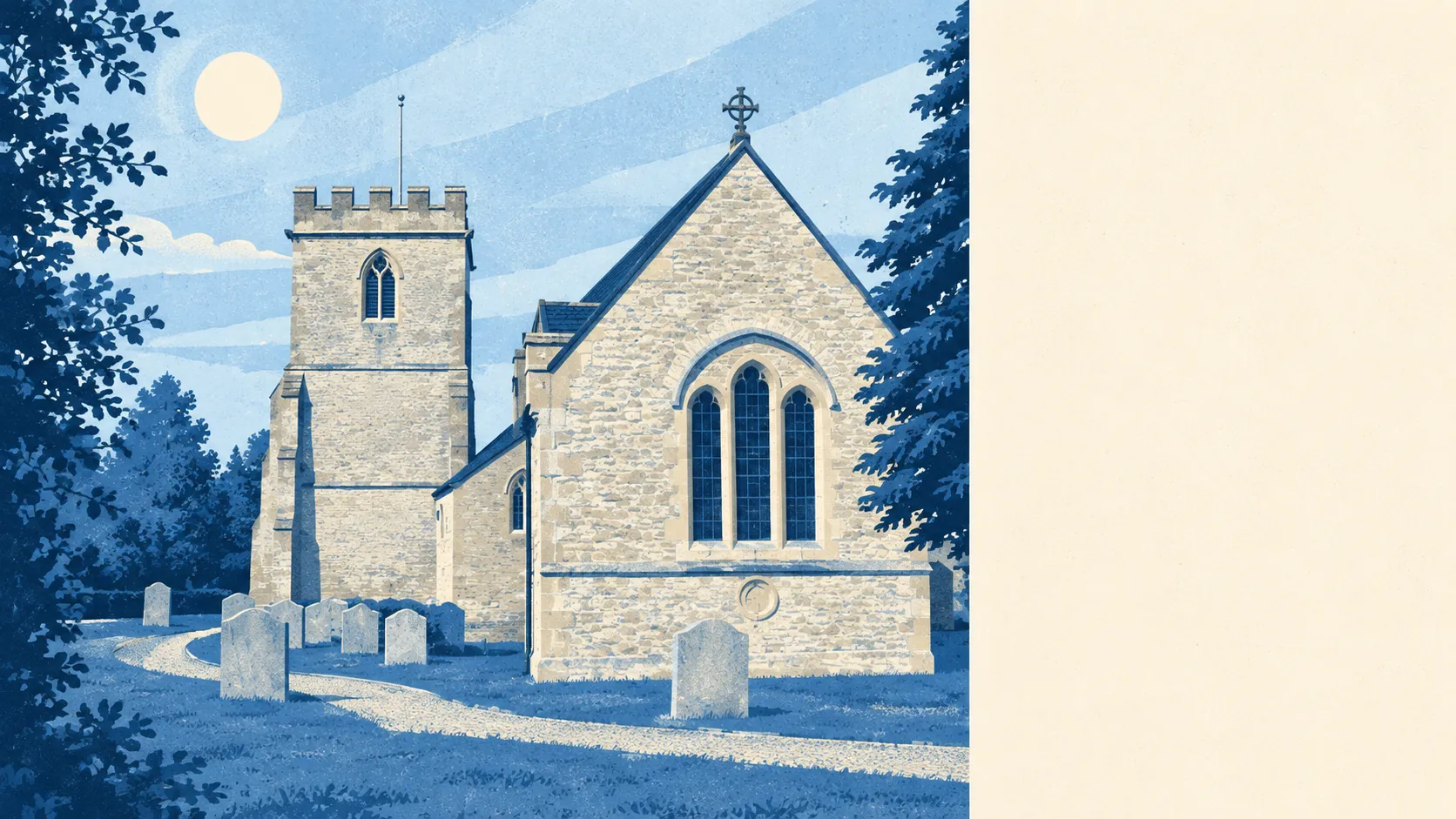
Chiseldon is a good place to live if you own a car and want the view. Three in four own their home. Half the households run two cars or more. The typical resident is past fifty. It is a downland village that commutes by motorway and would rather you didn't mention it.
Chiseldon's housing is houses. Flats barely exist here, about 2% of the homes on the council-tax list. Detached homes make up about 32%, semis about 30%, terraces about 21% and bungalows about 15%, which is enough bungalows to tell you the village expects people to stay until the stairs become a problem. Only about 16% was built before 1930, and the bulk of the rest is post-war, including Ridgeway View, the rows that started life as married quarters for the old army camp. The energy certificates tell the same story. About 54% sit in band D, about 34% reach C or better, and about 12% are E or worse. Mains gas heats about 83% of homes and electric-only heating covers about 6%, so the running costs are mostly what you'd expect and rarely a nasty surprise. The listing will say "well-proportioned". Mostly it means 1970s, with an extension.
The Land Registry recorded 27 sales in the twelve months to February 2026, at a median of about £325,000. That number hides a split. The 11 terraced sales went for a median of about £215,000 and the 11 detached ones for about £535,000, so the same village sells two different lives, and the gap between them is roughly the price of never hearing next door's television. Semis sat around £324,000, though only 4 sold, which is too few to treat as a going rate. Band C is the most common council-tax band, and only about 16% of homes fall in bands A or B.
Renting is thin on the ground. The typical private rent across the Swindon area was about £1,080 a month as of April 2026, but that is a borough figure, not Chiseldon's own, and with only about 8% of homes privately rented the village barely has a rental market to measure. Renters looking here are waiting for a vacancy more than choosing between options.
Recorded crime ran at about 46 per 1,000 residents in the year from June 2025 to May 2026, roughly 48% below the Swindon average of about 88. Burglary made up about 10% of recorded crime against about 4% nationally, but the totals are low enough that a few incidents move the share by several points, so read it as a reason to lock the shed rather than as a pattern. Swindon does the borough's crime and keeps most of it.
The primaries hold up well. Across the 2 primary schools in the district, the average maths score at the end of primary school was 106, and the nearest primary is about an eight-minute walk on the Department for Transport's 2019 modelling. Chiseldon Primary & Nursery School is the village's own. Across Swindon, Ofsted has graded 38 of 46 settings good or better, 3 of them outstanding. Secondary is where the car comes in: about 15 minutes by road, 26 by public transport and 71 on foot. The Ridgeway School & Sixth Form College and Royal Wootton Bassett Academy are among the secondaries within reach. A 71-minute walk is how teenagers here learn to love a lift.
The village had its own railway station until 1961. At the 2021 census, near enough nobody took a train to work, about 47% drove and about 41% worked from home. The 13 bus stops see about 15 departures each on a weekday, which works out at fewer than one an hour at peak, and 11 of the 12 stops with timetable data get a weekend service. Swindon's town centre is about 30 minutes by public transport and 16 by car, and Swindon Rail Station is the nearest line to anywhere. The broadband has no such problem: gigabit is available to about 99% of premises and every mobile operator covers the lot. Faster fibre than buses explains that spare-room commute.
This is where Chiseldon earns its keep. The whole place sits inside the North Wessex Downs Area of Outstanding Natural Beauty, the nearest green space is about 150 metres away on average, and there are about 7 within a kilometre. The National Cycle Network passes within about 160 metres of the average address. On flooding, none of the village is in the Environment Agency's river-and-sea flood zones, while about 9% of postcodes carry a high rating on at least one flood indicator including surface water, so the exact address still gets checked. The price of the downs is the road: about 98% of postcodes sit near road noise of 65 decibels or more, courtesy of the M4 and the A346. Radon is low. Every postcode is class 3 on the British Geological Survey's shrink-swell clay scale, which is a line for your surveyor, not a reason to walk away.
There are 25 listed buildings, one of them Grade I and the other 24 Grade II, plus 2 conservation areas, Chiseldon and Badbury, the village one designated in 1990. Inside those boundaries, new windows, extensions and anything visible from the street go through the council first, and a listed home adds listed building consent on top. Buy the cottage and you also buy a relationship with the planning department.
About 75% of households own their home, the median age is 51, and gross household income averaged about £57,000 in the financial year to March 2023, as modelled by the Office for National Statistics across the wider area. That is a settled, comfortable village where people arrive with the deposit already sorted.
Chiseldon suits a couple or a family with two cars, a job that is mostly remote or reachable along the M4, and a preference for walking boots over nightlife. It suits people who want Swindon's salaries within reach and the Marlborough Downs out the back door, and who are happy to pay the detached-house premium for both.
It does not suit anyone planning to live without a car, commute by train, or rent on a short notice. Teenagers with social lives will find the bus timetable educational. Anyone who wants a café scene will be driving to find one.
Chiseldon is an above-average place to live, and its case rests on the land around it. Its real strength is the surrounding downland and green space, with the whole village inside protected landscape and a field never far away. The weak spot is transport and connectivity, because a village that lost its station in 1961 has been driving ever since. If the car is a given, the view is the bonus. If it isn't, you'll be very well acquainted with a bus timetable.