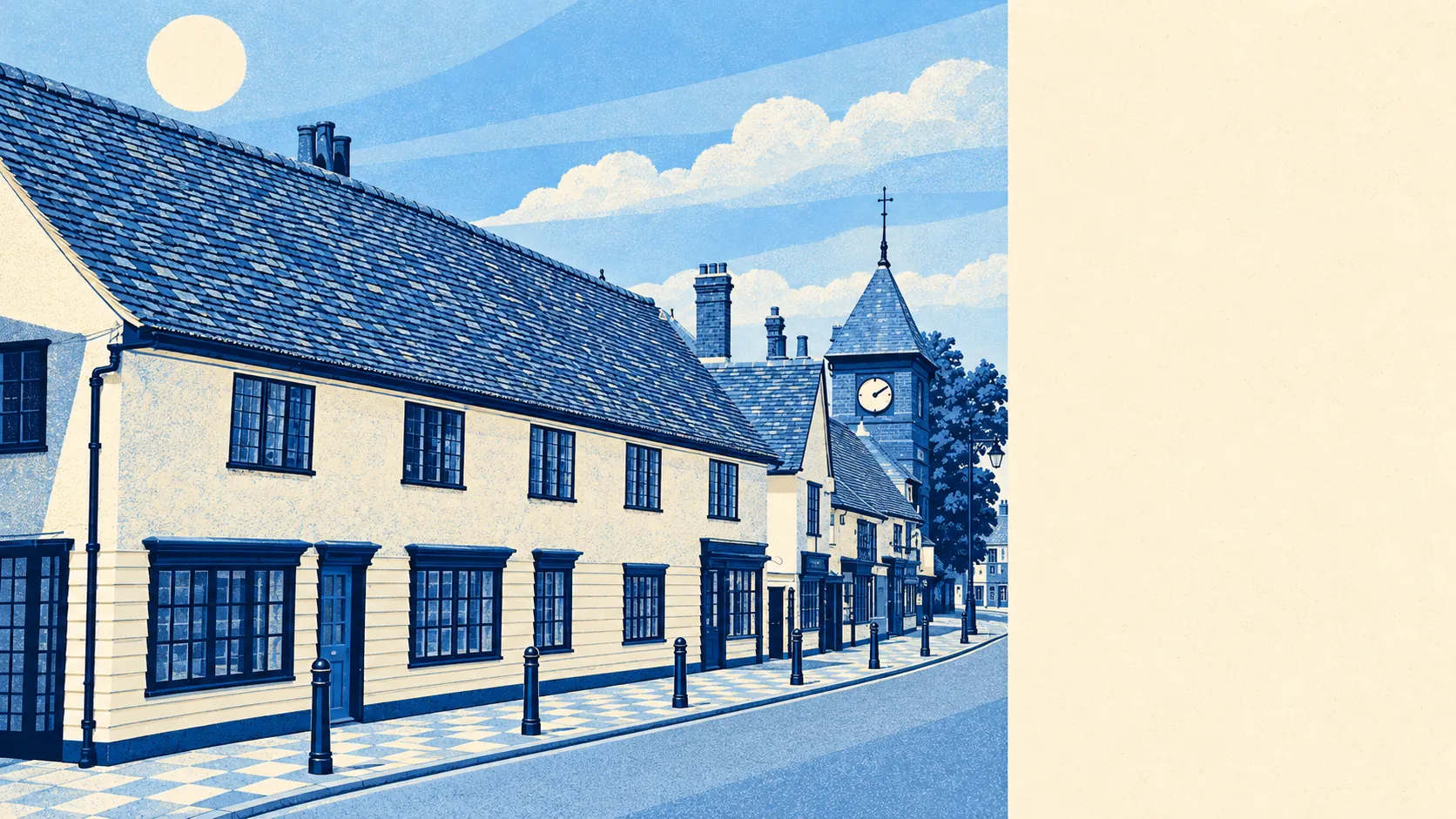
Chipping Ongar charges about £437,000 for a typical home and throws in almost everything except a way to get to work without a car. A detached house costs nearer £750,000. Seven in ten households own their home. About half of working residents drive to the job. What the money does buy is low crime and a High Street wide enough to make the trip into town worth it.
The Land Registry recorded 79 sales across the Chipping Ongar area in the year to mid-May 2026, at a typical price of about £437,000. Flats went for about £254,000, terraces about £445,000, semis about £475,000 and detached houses about £750,000. The terrace buyer and the semi buyer are bidding in roughly the same range, and only one of them gets a side passage for the bins. Council tax follows the same shape. Band D is the most common band, Bands A and B together cover about 6% of homes, and a Band D bill comes to about £2,280 a year. The cheap end of the council tax list is mostly a rumour here.
Renting is no cheaper. The Office for National Statistics puts typical private rent across Epping Forest district at about £1,840 a month as of April 2026, up about 7% on a year earlier. That is a district-wide mean, and it includes the parts of the district with a Tube station on the doorstep.
Semis are the house type here. They make up about 36% of every dwelling on the council-tax list, ahead of detached homes at 23%, terraces at 16%, flats at 14% and bungalows at 10%. Only about 17% was built before 1930, so for all the old timber on the High Street, most people live somewhere post-war or newer. About 48% of homes with energy certificates rate A to C and 14% rate E or worse, and about 78% heat on mains gas. The post-war semi built the place. The listed buildings get the photographs.
Crime is where Chipping Ongar earns its keep. Police records put the area at about 56 crimes per 1,000 residents in the year to May 2026, against about 76 per 1,000 across Epping Forest as a whole. Anti-social behaviour makes up about 9% of reports, against 16% across England and Wales, which leaves the town's online noticeboards with less material than they let on.
Heritage is the other side of that calm. The area holds 202 listed buildings, three of them Grade I and seven Grade II*, plus four conservation areas: Chipping Ongar's own along the High Street, High Ongar, Great Stony School, and Blake Hall at Bobbingworth. In those streets new windows, extensions and anything visible from the road go through Epping Forest's planners first, on their timetable. Ongar Castle was demolished in the Tudor years, which was the last time anyone here altered a frontage without asking.
Flood depends on which measure is in front of you. In the Environment Agency's river-and-sea flood zones, fewer than 1% of postcodes fall in zone 2 and none in zone 3. On the wider postcode indicators, which also count surface water, about 10% of postcodes carry high risk on at least one indicator, 9% medium and 30% low. The only flood the Environment Agency has on record is from December 1993, when a main river burst its channel. The rivers mostly behave. The surface-water numbers do the worrying.
Green space is about 210 metres from the average front door, and some kind of water is about 250 metres away. Outside town it is big arable farmland. The farms spent the 1960s tearing hedges out and the 1990s putting them back, which is about as close as rural Essex gets to an apology.
About 71% of households in the Chipping Ongar area own their home, the median resident is 44, and the Office for National Statistics models gross household income at about £64,000 a year, averaged across the area for the financial year to March 2023. That is the income of people who earn somewhere bigger and come home to somewhere smaller on purpose. Jane Taylor, who wrote the words to Twinkle, Twinkle, Little Star, is buried at the United Reformed Church, and the town keeps bedtime hours to match.
Getting anywhere means driving. The Underground branch closed in 1994 and now runs heritage trains, and there is no commuter rail from the town. At the 2021 census, fewer than 2% of working residents went by train and about 1% by bus, against about 53% who drove and 32% who worked from home. The area has 53 bus stops averaging about 38 weekday departures each, and at peak that works out to roughly one bus an hour per stop. The Department for Transport's 2019 model puts the nearest town centre 21 minutes away by car and 44 by public transport, and the hospital 29 minutes by car and 78 by bus and train. One bus an hour at peak is, technically, a timetable. Broadband is better than the buses: gigabit reaches about 82% of premises, superfast about 89%, and all four mobile networks cover 99%.
For schools, the five primaries in the district average a Key Stage 2 maths score of about 104. They include Chipping Ongar Primary School, Ongar Primary School in Shelley and High Ongar Primary School. The one secondary in the district averages an Attainment 8 score of about 37, and secondary education for the town is The Ongar Academy, also in Shelley. Ofsted rates 218 of the 246 graded settings across Essex good or better, though that is a county figure and says nothing specific about these schools.
Chipping Ongar is right for two-income households with a car each who want a market town that stays calm after dark, with Moreton, Bobbingworth or High Ongar close by for anyone who wants fields as well. Anyone who needs a train in the morning, or wants a first house for what a flat costs, should look elsewhere.
Price is the hard part. About £437,000 in the middle of the market buys a post-war semi and a car on the drive, and nothing cheaper is waiting nearby. Pay it and the town gives you back streets where crime runs well under the district average and a High Street that outlived both its castle and its Underground line. Overall it is better than average, as long as you can afford to get in and own the car you'll need to get out.