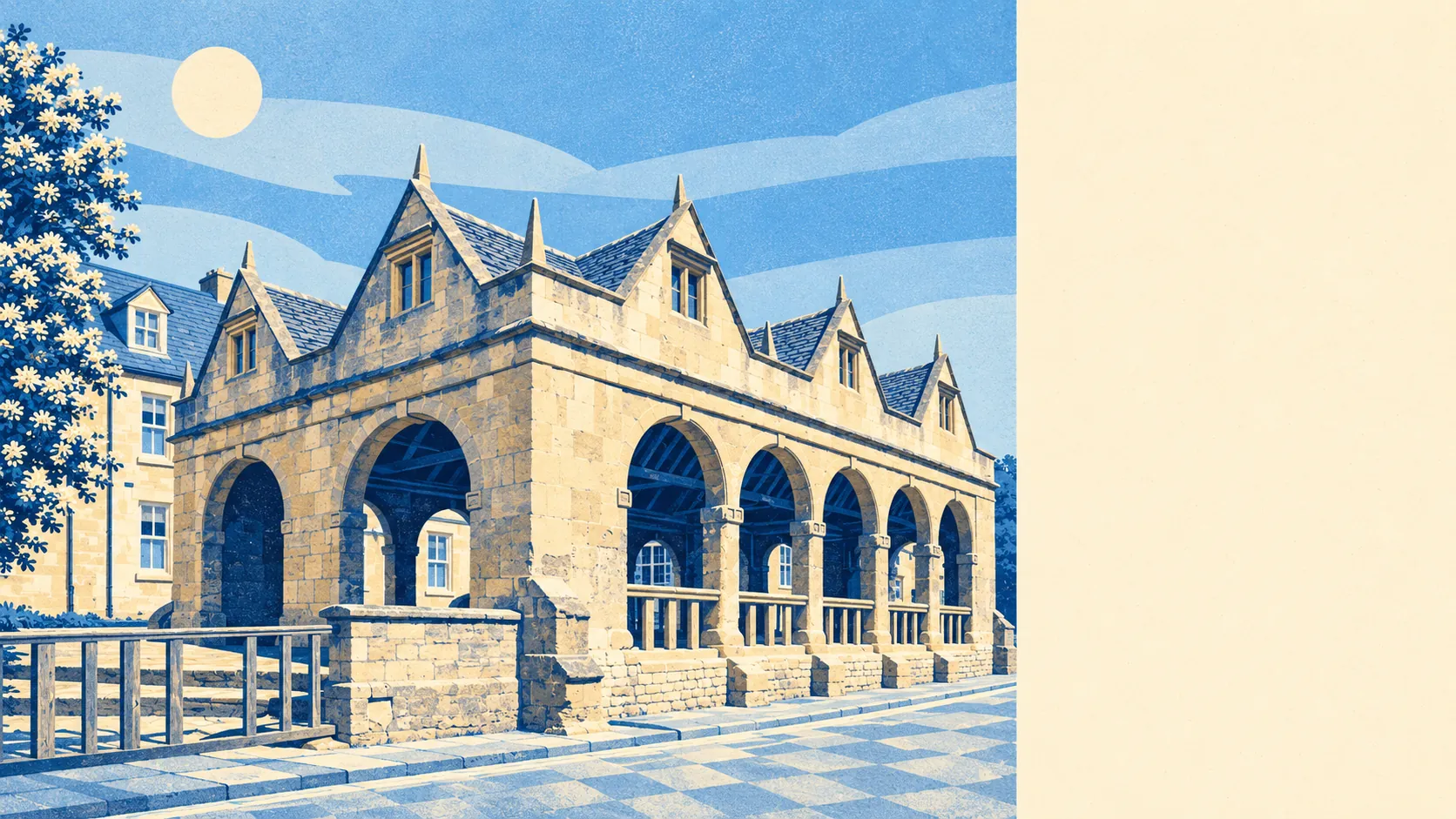
Chipping Campden is a decent place to live for anyone who likes their house exactly as it was handed over, because the area carries 478 listed buildings and nine conservation areas. Fancy a bigger kitchen? That is now a negotiation. The stone, the hills and the footpaths are first rate. The cost is permission, and the queue for it is long.
Of those 478 listed buildings across the Chipping Campden area, 11 are grade I, 36 are grade II* and 431 are grade II. The nine conservation areas include Chipping Campden itself, plus Broad Campden, Ebrington, Aston Subedge and Mickleton. The High Street and much of the town centre were made a conservation area in 1970. For a buyer, that changes small jobs: replacement windows, a new roof covering, a rear extension or a satellite dish can all need consent, and on a listed building the interior is protected too. Some homes escape all of it, though a buyer has to check each address. The almshouses Sir Baptist Hicks built on Church Street in 1612 still house pensioners, which shows how much appetite the town has for a change of use.
The Land Registry recorded 73 sales in the Chipping Campden area in the year to May 2026, at a median of £540,000. Detached houses, 36 of those sales, went for a median of about £668,000. Semis came in around £506,000 and the 15 terraced sales at about £370,000. Council tax band C is the most common, and only about 10% of homes are in bands A or B. The terrace is the cheapest way in, which fits a town that is famous for its terraced High Street.
The typical private rent across the Cotswold area was about £1,260 a month as of April 2026. That is the district's figure, an average over the whole council area, so it includes plenty of places with less honey-coloured stone than this one.
The council-tax list, which covers every home, says about 37% of the area's dwellings are detached, 22% semi-detached, 22% terraced, 12% bungalows and just 5% flats. About 29% were built before 1930. On energy certificates, about 46% of rated homes reach band A to C, 35% are band D and 20% are band E or worse. About 64% of homes heat with mains gas and about 6% with electricity alone. Thick walls of old stone are wonderful to look at and indifferent to your heating bill. Insulating them is often a job that needs consent before it needs a builder.
Flood risk splits in two depending on which measure is used. About 24% of postcodes in the Chipping Campden area show high risk on at least one flood indicator, surface water included. In the Environment Agency's river-and-sea flood zones the share is far smaller: about 2% of the area lies in zone 3 and about 6% in zone 2. The most recent flood on record was in July 2007, from a main river whose channel could not hold the water. Most of the gap between those two numbers is surface water, and a river map does not show it.
There is no station. Chipping Campden lost its stop on the Cotswold Line in 1966, and people have been proposing to reopen it since 2014. The nearest stations are Moreton-in-Marsh and Honeybourne. In the 2021 census under 1% of workers commuted by train, about 45% drove and about 43% worked from home. Across 69 bus stops, the average stop gets about eight weekday departures. Gigabit broadband reaches about 82% of premises and superfast about 96%. Broadband ended up doing the job the railway was meant to do.
About 69% of households in the area own their home, and the median resident is 55. Gross household income averaged about £60,000 in the financial year to March 2023, on the Office for National Statistics' modelled estimates. The town has a long habit of creative people. The Guild of Handicraft moved into the Old Silk Mill on Sheep Street in 1902, Gordon Russell made furniture here, and the plantsman Ernest Wilson was born here and has a memorial garden. Graham Greene and his wife Vivien lived at Little Orchard from 1931 to 1933. Two years was apparently enough for a novelist who needed a bit of sin to write about.
Police.uk recorded about 37 crimes per 1,000 residents across the area in the year to May 2026. That is roughly 9% below the average for the Cotswold district, where Gloucestershire Constabulary does the policing. The totals are small, so a handful of incidents can move the rate noticeably from one year to the next.
The surroundings are where Chipping Campden earns its money. About 72% of the area lies inside the Cotswolds Area of Outstanding Natural Beauty. The nearest green space is about 350 metres from the average home, there are eight or nine within a kilometre, and water is about 340 metres away. Hidcote Manor and Kiftsgate Court are both close. Weston-sub-Edge and the other villages on this page have the same hills behind them. Few people here are short of a walk.
Chipping Campden is right for people who want a finished house, a long walk from the front door and a car for everything else. It is hard going for anyone planning to knock through, build out or commute by rail every day. The open country is the reward and the planning rules are the price. A buyer who wants to make a house their own will spend more time asking permission than doing the work. Taken as a whole it is a middling choice: a beautiful place to live, provided you don't need to change it.