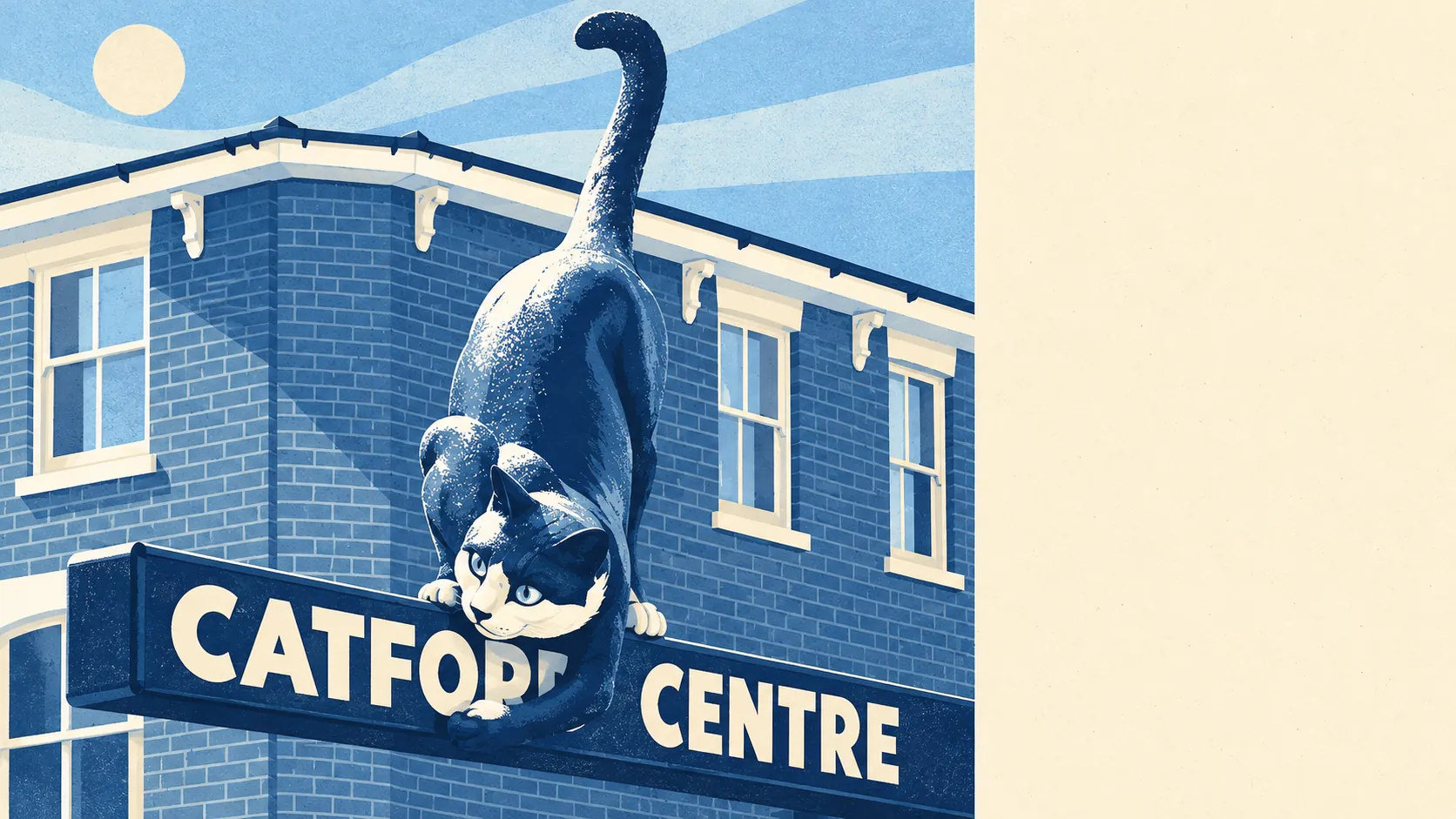
Catford has much more green space than its traffic would suggest. A park is a couple of minutes' walk from most front doors. Two rivers still run through it in the open. The high street is mostly shops, with only a handful of pubs. It's a busy inner-London district with more parkland and riverside than anyone driving through would guess.
The average home in Catford is about 140 metres from public green space, with around 33 green spaces within a kilometre. In a district this densely built, that's a lot of grass. One of the parks, next to University Hospital Lewisham, is three fields with a river through the middle and one of the last established Dutch elms in London. Charlton Athletic played its home games at The Mount in that park in the 1920s, and the council still holds its People's Day there every July.
Water is close as well. The average home is about 470 metres from a river, stream or pond, with around 27 within a kilometre. The Ravensbourne and the Pool both run through the district, and the Pool stays above ground for most of its length, through Linear Park from Southend Lane to Catford Hill. That's rarer in London than it should be, since most of the city's small rivers were long ago put into pipes.
The National Cycle Network is about 850 metres from the average home, and about 41% of postcodes are close to it. The Waterlink Way follows the rivers from Sydenham toward the Thames, which makes it possible to ride most of the way north without going near the South Circular.
Out of 888 business premises on the Valuation Office's rating list for Catford, 366 are shops and 100 are offices, against 20 restaurants and six pubs. Those are rateable premises, which isn't the same as businesses currently trading, but the shape is clear. Catford is somewhere you go shopping more than somewhere you go out for the evening. With only six pubs in the area, nobody here has to argue about which is the local.
Of the 292 food premises the Food Standards Agency has rated, about 59% hold the top score of five, and about 6% are rated low.
Fine-particle air pollution in Lewisham averaged about 9 micrograms per cubic metre in 2024, a borough-wide figure that includes the main roads and the back streets together.
What the area feels like depends on which side of the main roads you're on. The commercial centre sits where two main roads meet, with the town hall serving the whole borough. Away from the junction, the streets are long rows of Edwardian and interwar terraces running down to the rivers, and Bellingham extends the district south toward its own station. Iona Close Orchard is a preserved Victorian garden of high nature-conservation value, and St Dunstan's College has its Jubilee Ground for sports. Beckenham Place Park and the Horniman Gardens are both within reach for a longer weekend walk. You don't need to leave Catford, though, to get to green space.
Private gardens are respectable for inner London, at about 43,700 square metres of garden for every 1,000 residents. Most of the houses have a back garden. Many of the flats don't, which is one more reason the public parks get so much use.
There's no area of outstanding natural beauty, site of special scientific interest or ancient woodland in Catford. It's an urban district whose green space comes from parks, river corridors and back gardens.
For a district built where two main roads meet, Catford's surroundings are one of its real strengths. There's grass, water and a cycle route within a short walk of almost every home.