Castle Cary is a town that got a station and never quite worked out what to do with the attention. Two thirds of homes are owned outright or on a mortgage. The typical resident is in their early fifties. Most people who work drive, and almost a third work from home. It is a small Somerset town with a mainline platform bolted to the side of it, and that single fact does more to explain the place than any amount of talk about market towns.
The housing stock is old and it is mostly houses. On the council tax valuation list, which covers every dwelling rather than only those with a recent energy certificate, detached homes make up around 35% of the stock, semi-detached around 22%, terraces around 16%, and bungalows around 16%. Flats account for roughly 6%, which in practice means that if you want a flat here you are choosing from a small pool and taking what is available. Around 38% of dwellings were built before 1930. Energy certificates put around 56% of certificated property in bands A to C, with 31% sitting in band D and 13% in band E or worse. Around 56% of homes run on mains gas and around 10% are heated by electricity alone, which is the figure to check before you fall for a stone cottage with exposed beams and no radiator that could be described as modern.
Sale prices are the part where the town looks reasonable and then immediately stops looking reasonable, depending on what you want. The Land Registry's last twelve months put the median sale at around £262,500 across 60 transactions. Terraced homes came in at a median of about £225,000, semi-detached at about £265,000, and detached at about £549,000. That is not a gentle gradient. It is a cliff, and it sits between the semi and the detached, which is exactly where most families move next. Council tax is a spread rather than a cluster: band C is the most common, and around 26% of dwellings sit in bands A or B.
Renting is the thinner part of the picture. Typical private rent across the Somerset area runs at about £990 a month, up around 4% on the year. That is a local authority figure covering the whole of Somerset rather than Castle Cary itself, so treat it as the shape of the market rather than a quote for a specific street.
On safety the town does well and does it convincingly. The published rate is around 50 recorded crimes per thousand residents over the twelve months to May 2026, against a local authority average of around 93. That puts Castle Cary roughly 46% below the Somerset figure. Avon and Somerset Constabulary charges in around 11% of cases, close to the national figure of about 12%, which is a fact about the force rather than about this town, and worth separating from the rate itself. Violence and sexual offences account for around 44% of recorded crime here against about 35% nationally, a category broad enough to include common assault without injury. Burglary runs at around 9% of the mix against about 4% nationally, which is the one line in the data a rural buyer should actually read twice.
Schools are a short list here. The town has one primary and one secondary, which are Castle Cary Community Primary School and Ansford Academy, along with Lovington Church of England Primary School nearby. Key Stage 2 maths in the district averages a scaled score of 104. At Key Stage 4 the Attainment 8 score is around 44. Across Somerset, Ofsted has graded 101 of 140 settings good or better, with 5 outstanding, 32 requiring improvement and 7 inadequate. A primary school is around a nine minute drive, a secondary around twelve.
Connectivity is where the town punches above its size in one direction and falls over in another. Castle Cary Rail Station sits about a mile north of the town on the Reading to Taunton line and the Heart of Wessex line, and Bruton Rail Station is the other option nearby. Despite that, fewer than 1% of working residents commute by train, and around 55% drive. Around 31% work from home. There are 36 bus stops in the area, with an average of eight scheduled weekday departures per stop and around 85% of stops carrying some weekend service. Peak-hour frequency averages under one bus per stop, so the bus is a thing that exists rather than a thing you plan around. Broadband is the genuine strength: gigabit-capable service reaches around 86% of premises, superfast around 99%, and no premises fall below the universal service obligation. Mobile coverage from at least one operator reaches almost every premise.
Flooding is a modest concern rather than an absent one. Around 12% of postcodes carry a high rating on at least one flood indicator including surface water, and around 26% carry a low rating on at least one. On the Environment Agency's river-and-sea flood zones, which measure something narrower, around 2% of the area falls in flood zone 2 and effectively none in flood zone 3, rising to around 2% under the climate-adjusted zone. Radon is the more interesting environmental fact: around 47% of the area sits in the higher radon bands, with the maximum band recorded at the highest level, which means a radon test is a sensible line on the survey rather than an optional extra. Green space is close and plentiful, averaging around 330 metres to the nearest and around eight sites within a kilometre. Water is closer still at around 380 metres. Ground conditions are benign, with shrink-swell and landslide hazards at low classes throughout.
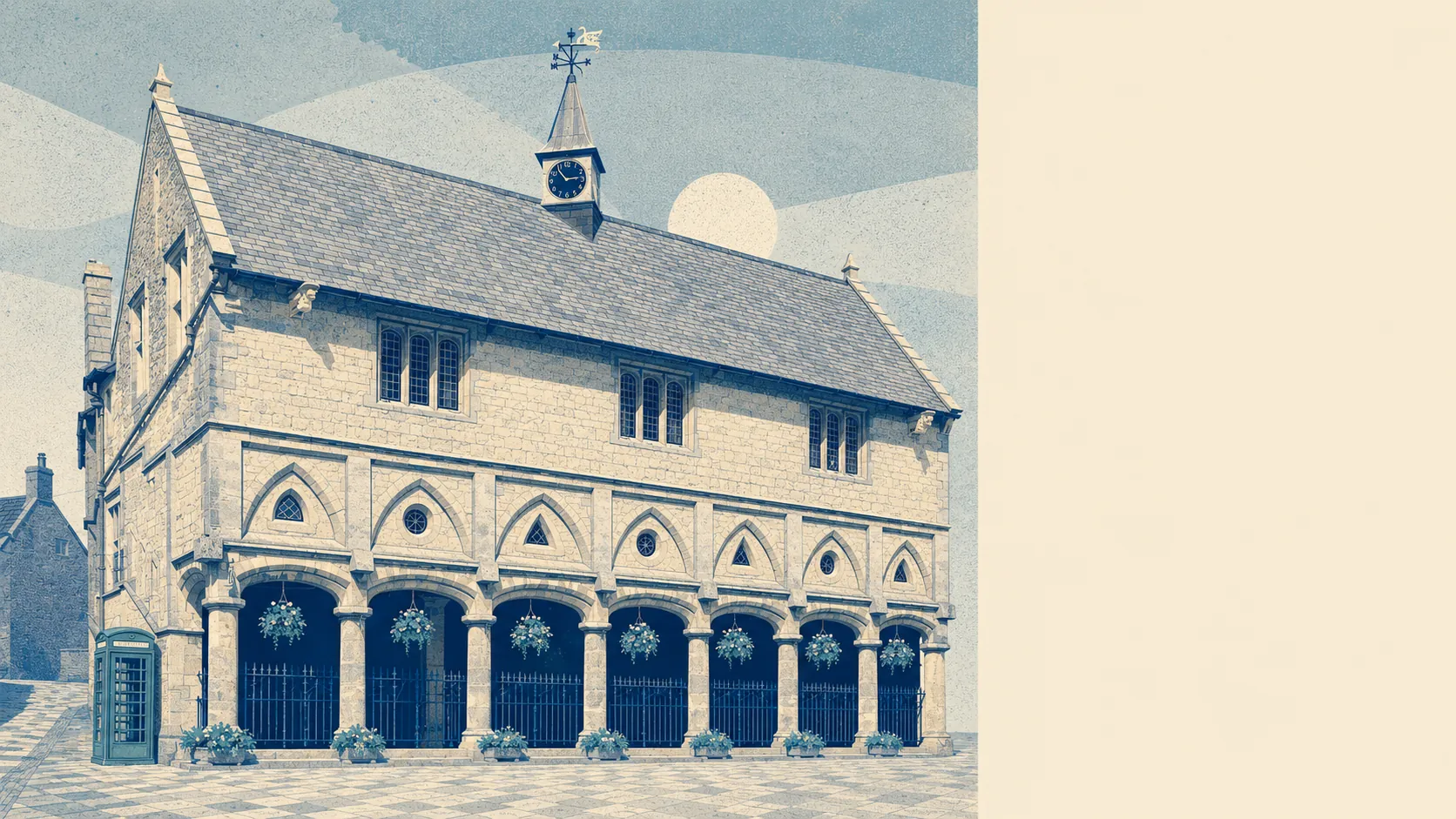
Heritage is where the town charges you for its looks. There are 186 listed buildings in the area, three of them Grade I and 13 Grade II star, and five conservation areas covering Castle Cary, Ansford, Hadspen, Pitcombe and Higher Flax Mills. The Market House, a Grade II star building from 1855, sits at the centre of it. Two listed buildings in the area sit on the Heritage at Risk register, one of them the Top Mill Building at Higher Flax Mills. What that means in practice is that a great many homes here come with a planning department attached. Replacing windows, altering a roofline, or putting up anything that changes the front elevation becomes a conversation rather than a decision. Buyers who want to extend should establish what is possible before the offer, not after.
The character of the place follows from all of that. Around 67% own their homes, the median age is 53, and modelled household income for the area runs at around £58,200 gross before tax. A third of households are single-person and around 19% are single pensioners. The page covers Ansford on the northern edge, Alford a couple of miles west, and Lovington to the south west, all of which share the town's rhythms without sharing its station traffic.
Castle Cary suits people who have stopped needing a city to be five minutes away, who work from home or travel for work rather than commuting daily, and who want a period house in a town small enough that the shopkeepers learn your name inside a month. It suits people planning to buy a house that already works, rather than one they intend to reshape.
It does not suit anyone who needs to be on a train at seven every weekday morning, because the commuting numbers here show that almost nobody manages it. It does not suit anyone dependent on buses. And it does not suit the buyer whose plan involves a rear extension, a loft conversion and new windows within eighteen months, because the conservation map has opinions about at least one of those.
The town has form for producing people who went elsewhere and did something. James Woodforde was curate in the 1760s and 1770s and kept a diary for nearly forty five years recording rural life so ordinary it became historically valuable. Douglas Macmillan, who founded the cancer charity that carries his name, came from here, and the Macmillan Way walking trail runs through the town. Herbert Pitman, third officer of the Titanic, lived here during his career, which is either a fine local footnote or a warning about the confidence of well-built things, depending on the mood you read it in.
So: a good place to live, with the qualification that the town decides quite a lot for you before you arrive. Its real strength is safety, and not marginally so, sitting well below the county rate on a published measure. The weak spot is the freedom to alter a home, where 186 listed buildings and five conservation areas mean the building you buy is closer to the building you keep than most buyers expect. Buy the house that already suits you, and Castle Cary is one of the more comfortable small towns in Somerset. Buy the one you plan to fix, and the first person you meet will be a conservation officer.