Brookmans Park is worth living in if you can get in, and getting in costs close to a million pounds. Nearly nine in ten households own their home. The residents once clubbed together to help buy the woods next door. The houses that come up are big, mostly detached and priced to match.
People here own their homes and tend to stay. About 86% of households own the home they live in, the typical resident is 47, and the Office for National Statistics models gross household income for the area at around £75,800 in the financial year to March 2023. The community has a history of pulling together. In 1956 North Mymms Parish Council bought the lake and open ground at Gobions to keep it away from development. In 1985 householders across the parish paid into a fund that helped the Gobions Woodland Trust buy most of the rest of the estate. That is a village willing to buy the countryside to stop anyone building on it, and anyone wondering why so few new houses turn up has found part of the answer.
That instinct shows in the prices. The Land Registry recorded 27 sales in the year to April 2026, at a typical price of about £937,500. Thirteen detached houses sold for around £1,350,000 each, ten semis for about £810,000, and the three flats that changed hands went for around £595,000. Band G is the most common council tax band, and only about 5% of homes are in bands A or B. The council tax bill starts from the assumption that you are doing well.
Renting is a small corner of the market here, with about 12% of households renting privately. Welwyn Hatfield's typical private rent was about £1,470 a month in April 2026. That is a figure for the whole borough, and it is the nearest guide on offer for a village where so few homes are let.
The housing was built for people who wanted a drive, a garage and a hedge between them and the neighbours. On the council tax list, about 35% of dwellings are detached, 22% semi-detached, 12% bungalows, 15% flats and 11% terraced, and only about 16% were built before 1930. Space comes as standard, and about 58% of households have four bedrooms or more. Of the homes with an energy certificate, about 44% are rated C or better, 39% sit at D and 17% at E or worse. About 78% are on mains gas. A big twentieth-century house costs more to heat than its age suggests, because every one of those bedrooms needs a radiator.
On flooding, the Environment Agency puts none of Brookmans Park in its river-and-sea flood zones, and no historic flooding is on record. Surface water is another matter. About 30% of postcodes carry a high reading on at least one flood indicator, surface water included, and another 21% a medium one. There is no river to blame. The risk comes from rain with nowhere to drain.
Hertfordshire Constabulary's figures give a crime rate of about 54 per 1,000 residents over the twelve months to May 2026, roughly 46% below the Welwyn Hatfield average. The mix leans one way, though. Burglary makes up about 10% of recorded crime here against about 4% across England and Wales. Burglars read the house prices too.
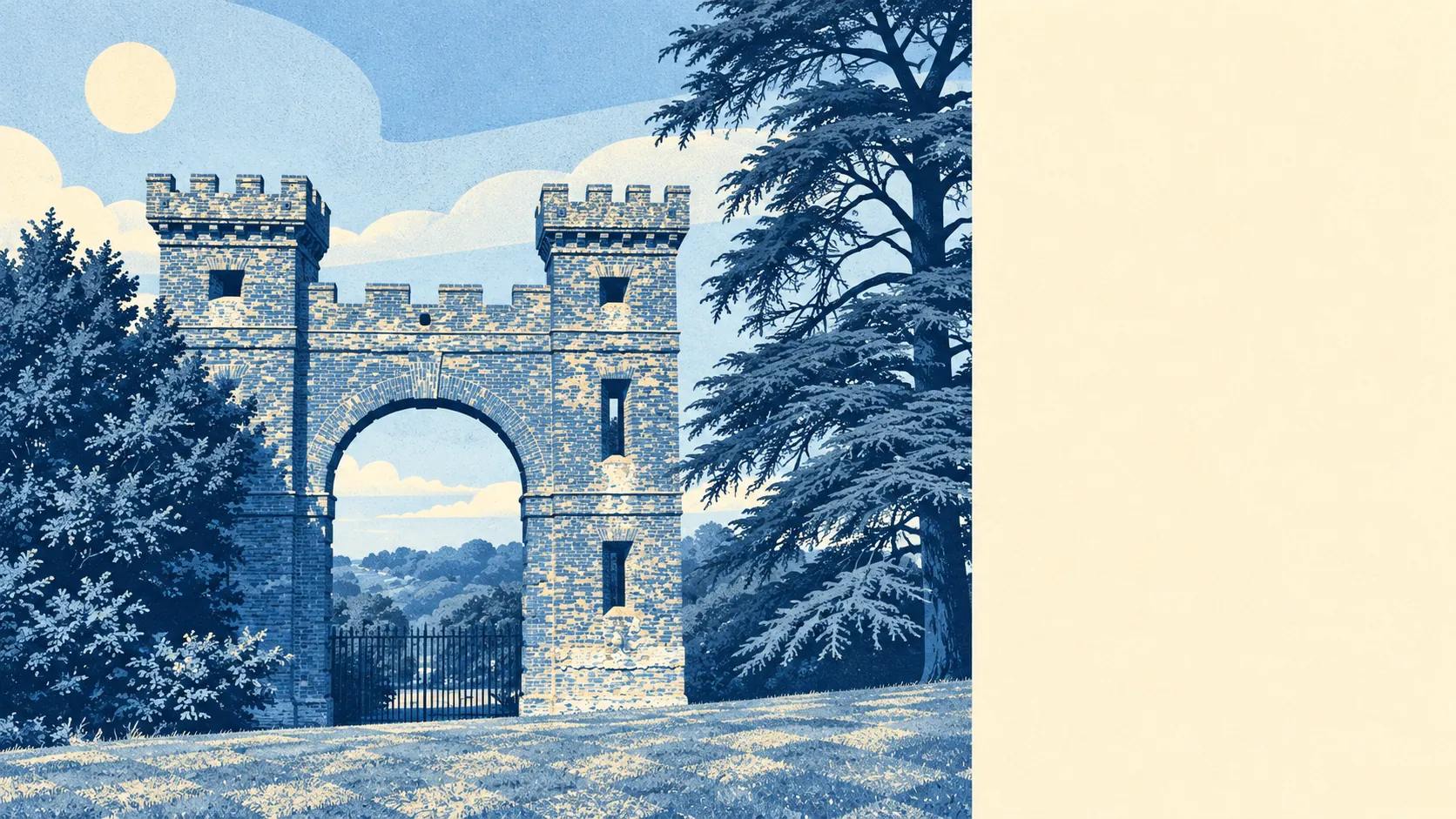
Planning is easier than the money suggests. The village has nine listed buildings, one Grade II* and eight Grade II, and no conservation areas, so most extensions go through ordinary planning. The best-known local landmark, the Folly Arch, is Grade II* listed. Charles Bridgeman designed it around 1740 as an entrance to the Gobions estate. The grandest building anyone here has to live up to is a gateway to a mansion that has almost entirely gone.
Outdoor space is close at hand. Green space is roughly 340 metres from the average home, with about five green spaces within a kilometre, and water is about 420 metres away. The old Gobions grounds are now Gobions Wood, run by the Herts and Middlesex Wildlife Trust, and Gobions Open Space. The dog walk comes with a history most suburbs would have to invent.
Brookmans Park Rail Station is in the village, but at the 2021 census only about 3% of working residents took the train to work. About 37% drove, and about half worked from home. Buses are thin. There are 25 stops, averaging around 14 weekday departures each, and only about 37% of the stops with timetable data see a bus at weekends. Superfast broadband reaches about 87% of premises and gigabit only about 46%, though every postcode gets a mobile data signal from at least one network. With half the workforce at home, the broadband map matters more than the train timetable, and the gigabit half of it is unfinished.
For schools, the five state primaries across the village's postcode districts average about 105 in the end-of-primary maths assessment, and the one secondary counted averages an Attainment 8 score of about 48. Brookmans Park Primary School is the village's own, and Chancellor's School is the local secondary. Across Hertfordshire, Ofsted has graded 203 of 227 settings good or better, 40 of them outstanding. That is a county-wide figure, so it shows what the wider pool looks like and says nothing about any one school.
The village has a short list of notable residents. Tracey Thorn of Everything but the Girl was born here. John Somers, the Whig politician, spent his later years here. Martin Chivers, the Spurs footballer, retired to the village and ran the Brookmans Park Hotel from 1983 to 1996. Michael Perham went to Chancellor's School and in 2009 became the youngest person to sail around the world alone, which is one way to get out of a commuter village.
Brookmans Park is right for a household with equity, a car and a liking for joining things, the kind of buyer who plans to stay twenty years and sit on a committee. First-time buyers, renters and anyone who needs a bus on a Sunday should look further along the line.
It is a better than average place to live, and you pay for every bit of it. The neighbours will club together to save a wood, but nobody is collecting towards your deposit.