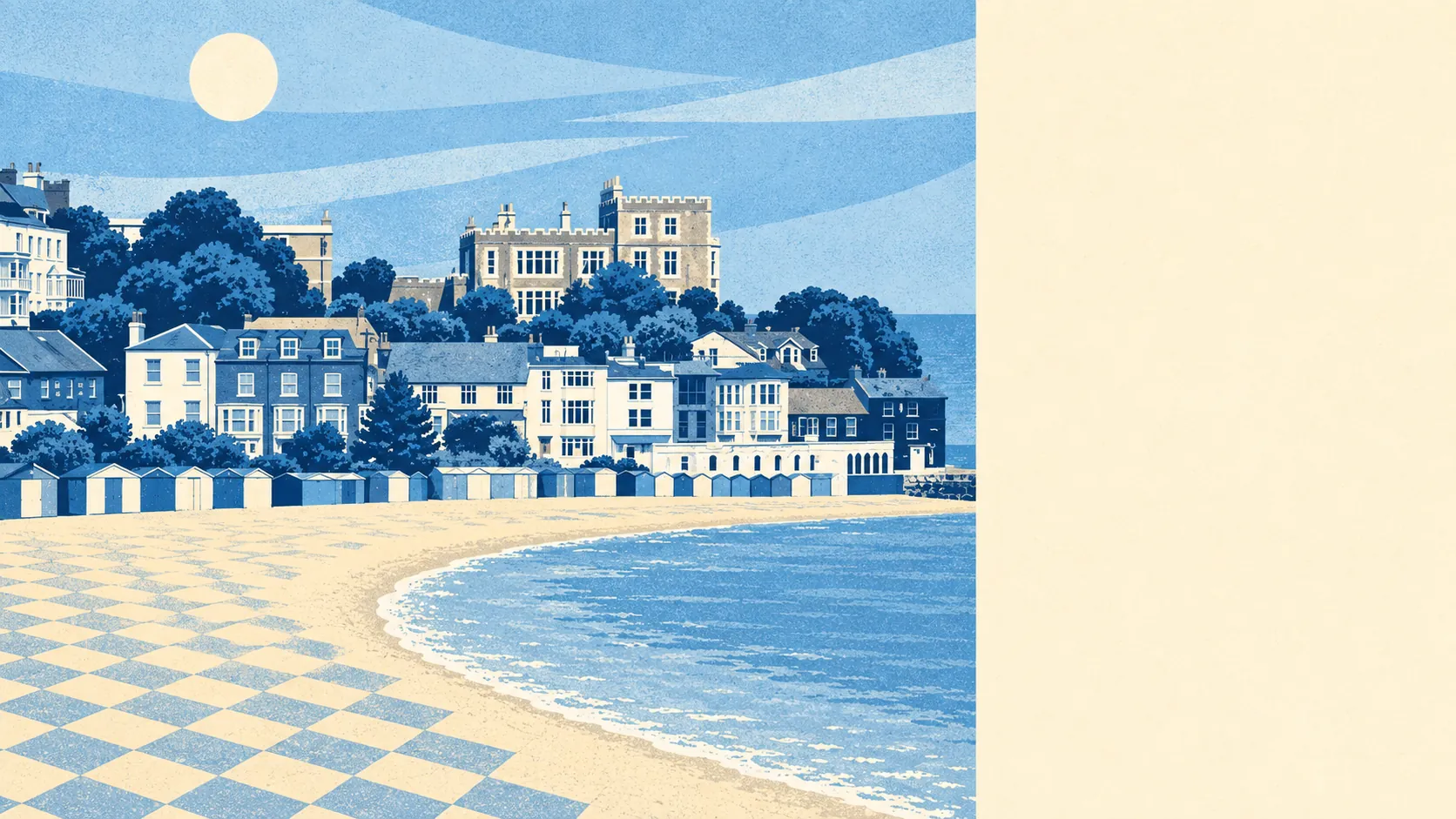
Mostly beach, and the rest is park. Seven bays line the coast. A green space sits a couple of minutes from most front doors. Pubs run to nearly a hundred. Living here and failing to get outside takes real commitment.
Green space is close to everyone. The average home in Broadstairs is about 180 metres from the nearest public green space, with around 16 of them within a kilometre. Albion Place Gardens is the registered park and garden in the area, and Pierremont Park sits on the grounds where Princess Victoria spent her childhood summers. Nobody here is short of a patch of grass to walk a dog round.
The water is further than the postcards suggest, but not by much. The nearest blue space averages about 830 metres from home, with about 12 bodies of water within a kilometre. For a coastal town that sounds a touch far, until you remember that most of Broadstairs sits on the cliff top, not the beach, and the distance is the walk down to it.
Getting further out is easy enough on two wheels. The National Cycle Network averages about 960 metres from home, and about 35% of postcodes sit close to it. There's no ancient woodland to speak of; the landscape is chalk, fields and sea.
The high street is busier than the town's size would suggest. The rated-premises list counts 1,072 shops, 98 pubs and 146 restaurants across the area, a count that takes in the edges of neighbouring towns as well as Broadstairs itself. That's a lot of places to buy a pint and a cone in a town where the median resident is past fifty and not in any hurry.
Air quality for the Thanet council area averaged about 7 micrograms per cubic metre of fine particles in 2024, a council-area figure, not a street-level one.
The coast gives the place its shape. From south to north, the bays run Dumpton Gap, Louisa Bay, Viking Bay, Stone Bay, Joss Bay, Kingsgate Bay and Botany Bay, with North Foreland rising between Stone Bay and Joss Bay. Viking Bay is the main beach, lifeguarded in summer, full of water at high tide and bare sand at low. Kingsgate Castle, once part of Lord Holland's estate, has been converted into private residences, which is about the most Broadstairs thing a castle could do. The Pavilion on the Sands on Harbour Street runs a summer show, Crampton Tower by the station houses a railway museum, and the Dickens House Museum sits on the seafront. It is the kind of town where the attractions are mostly the coastline and the people who once came to look at it.
Private gardens are generous too. The area has about 120,000 square metres of garden per 1,000 residents, spread across all 19 of its neighbourhood areas. With bungalows and semis making up much of the stock, most homes come with a proper patch of their own, not a yard with a bin in it.
The valuation list gives a firmer view of what the town is made of. It counts 1,028 rateable business premises, with shops the largest single group at 191 and offices accounting for 103. These are premises on the rating list, not a count of businesses open today, so an empty unit and a thriving one look the same on paper.
Eating out is a safe bet on hygiene. Of 228 rated food premises, about 94% hold the top score, and fewer than 1% sit at the low end. Food poisoning is not one of the town's traditions.
On designations, the picture is thin by choice of geography. There's no area of outstanding natural beauty overlapping the town and no ancient woodland. The only protected designation is a sliver of the Thanet Coast Site of Special Scientific Interest along the shoreline, covering well under 1% of the area. That says nothing against the place; the beauty here is the sea, and nobody needed a designation to point at it.
The surroundings are one of Broadstairs's real strengths: parks within a short walk of almost every door, seven bays within reach, and enough pubs to see off the weather.