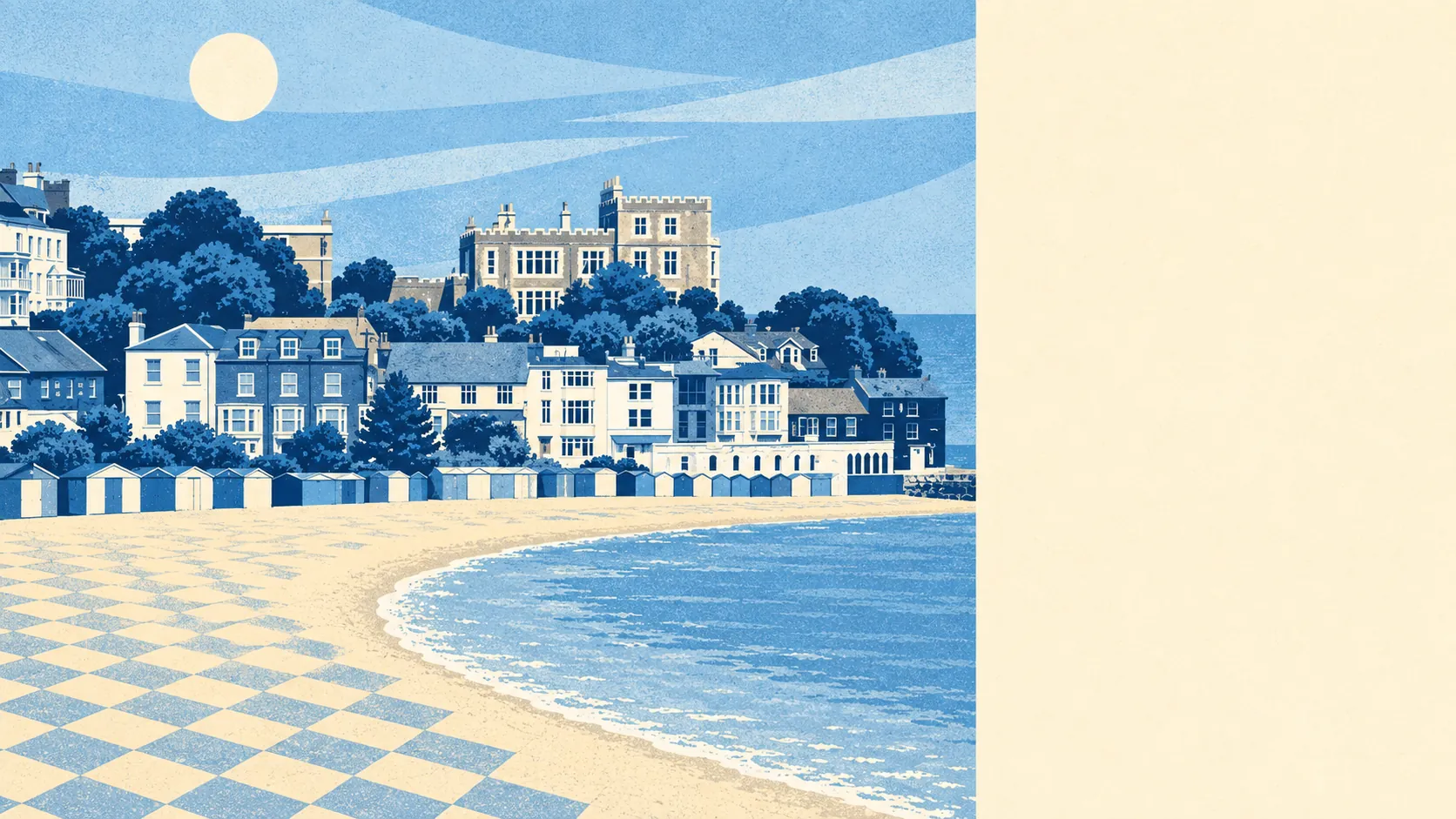
Yes, provided you have finished being in a hurry. Most people own their home. The typical resident is fifty. Crime runs well below the rest of Thanet. Broadstairs is a good place to live for people who have stopped trying to prove anything to anyone.
The housing is a mix with no single boss, which makes Broadstairs unusual for a seaside town. On the council-tax valuation list, semis are the largest group at about 24%, flats and bungalows each take about 21%, detached houses 18% and terraces 15%. That bungalow share tells you who the town has been built for over the decades, and it wasn't people planning loft conversions. About 30% of homes predate 1930, so the Victorian and Edwardian stock is there, but the post-war bungalow is the more honest emblem. The energy certificates put about 41% of certificated homes in band D and about 15% in band E or worse, against 44% in bands A to C. Around 85% of homes run on mains gas, and about 5% rely on electric-only heating, which is worth checking on the listing before the viewing, when the storage heaters are still just furniture.
On the Land Registry's figures for the year to May 2026, 320 homes sold at a median of about £339,000. Detached houses went for about £531,000, semis about £330,000, terraces about £270,000 and flats about £197,000. The spread is wide enough that "average price in Broadstairs" means almost nothing on its own. Council tax sits mostly in band C, with about 35% of homes in bands A and B, so the bills track a town that is comfortable rather than grand.
Renting is priced at the Thanet level. The typical private rent across the Thanet area was about £1,110 a month in April 2026, up about 6% on a year earlier. That figure covers the whole district, so a flat with a sea view in Broadstairs will cost more than the district typical, and a room above a shop in the back streets of Margate will pull the average the other way.
Safety is where Broadstairs quietly beats its neighbours. Police figures for the year from June 2025 to May 2026 put the crime rate at about 87 per 1,000 residents, roughly a quarter below the Thanet average. The town has had centuries to get the criminal element out of its system. Smugglers ran tea, spirits and tobacco through tunnels in the chalk for generations, and by the 1840s the smuggling had ceased. The modern trade is ice cream.
Schools look decent on the published numbers. Across Kent, Ofsted has graded 221 of 245 settings good or better, with 38 outstanding. Locally, the Key Stage 2 maths average across the town's schools with published results came in at about 104, a little above the expected standard. Names parents will hear include Bromstone Primary School, Callis Grange Nursery and Infant School and St Joseph's Catholic Primary School at primary level, with Dane Court Grammar School and The Charles Dickens School at secondary. Kent runs a grammar system, and the eleven-plus shapes family decisions here more than any estate agent will admit.
Connectivity is better than the train numbers suggest. Broadstairs Rail Station and Dumpton Park Rail Station both serve the town, and the high-speed service runs through Ashford to London St Pancras. Only about 2% of working residents commute by train, while about 29% work from home and about half drive. Local buses cover the town well, with 299 stops, an average of 78 weekday departures a stop, and weekend service at about 94% of stops. Gigabit broadband reaches about 83% of premises and superfast about 99%, which is what makes the work-from-home share possible. Modelled times from 2019 put the town centre about 14 minutes away by public transport and the nearest hospital about 11 minutes by car.
The weak spot is flood risk, and it needs reading carefully. Of the town's postcodes, about 12% sit at high risk on at least one flood indicator including surface water, about 16% at medium risk and about 31% at low risk. The Environment Agency's river-and-sea flood zones tell a different story, with about 1% of postcodes in flood zone 3 and none in zone 2. The problem is mostly water arriving from the sky and running off the streets, not the sea coming up the beach. Along the coast, about 30% of postcodes sit close to the shore, and the shoreline management plan's policy for the next century is to hold the line.
The surroundings are the town's real strength. The nearest green space averages about 180 metres away, with around 16 within a kilometre. Seven bays run along the coast from Dumpton Gap to Botany Bay, and the cliffs belong to the Thanet Coast Site of Special Scientific Interest. You get the beaches on your doorstep. You pay in chalk steps every time you walk back up from them.
Heritage restrictions are lighter than the postcard suggests. The town has 176 listed buildings: one at Grade I, four at Grade II star and 171 at Grade II, plus two scheduled monuments. No conservation areas are recorded within the town's boundary. For most homes, extensions and new windows go through ordinary planning rather than a heritage fight, unless you have bought something listed, in which case you already know.
In character, Broadstairs is settled and slightly greyer than most places. About 74% of households own their home, the median age is 50, and median household income was about £51,000 in the financial year to March 2023. St Peter's, the older inland village that Broadstairs outgrew after 1841 and later absorbed, reads as a quieter residential extension of the same town. The two merged administratively long ago and nobody has since found a reason to argue about it.
Broadstairs suits buyers who want the sea within walking distance, crime well under the district's rate, and a working-from-home life with full broadband. Downsizers who want a bungalow near the beach will find more choice here than almost anywhere on this stretch of coast. Families who can play the grammar system do well too.
It suits people who need nightlife, a large rental market or a fast daily train commute less well. The town goes to bed early and a quarter of households rent. Anyone buying at the bottom of a slope should check surface-water risk at their exact address before they check the view.
The town has always attracted people escaping something. Princess Victoria spent summers at Pierremont Hall between 1826 and 1836. Charles Dickens wrote here, and the Dickens House Museum on the seafront still trades on it. Edward Heath, Oliver Postgate and John Buchan are all on the list of names linked to the town, and Thomas Russell Crampton, the railway engineer, has a museum in Crampton Tower by the station. Frank Muir grew up as a "Beach Boy" on the sands at Viking Bay. For a small town, it has hosted a lot of people who wanted some peace.
Broadstairs is a good place to live, and better than good if what you want is quiet by the sea. Its real strength is the surroundings, with seven bays, clifftop green space and a park never far from the front door. The weak spot is flood risk, mostly surface water, which a buyer should check street by street. The town was named after a flight of stairs, and after nine centuries it still assumes you'll take them slowly.