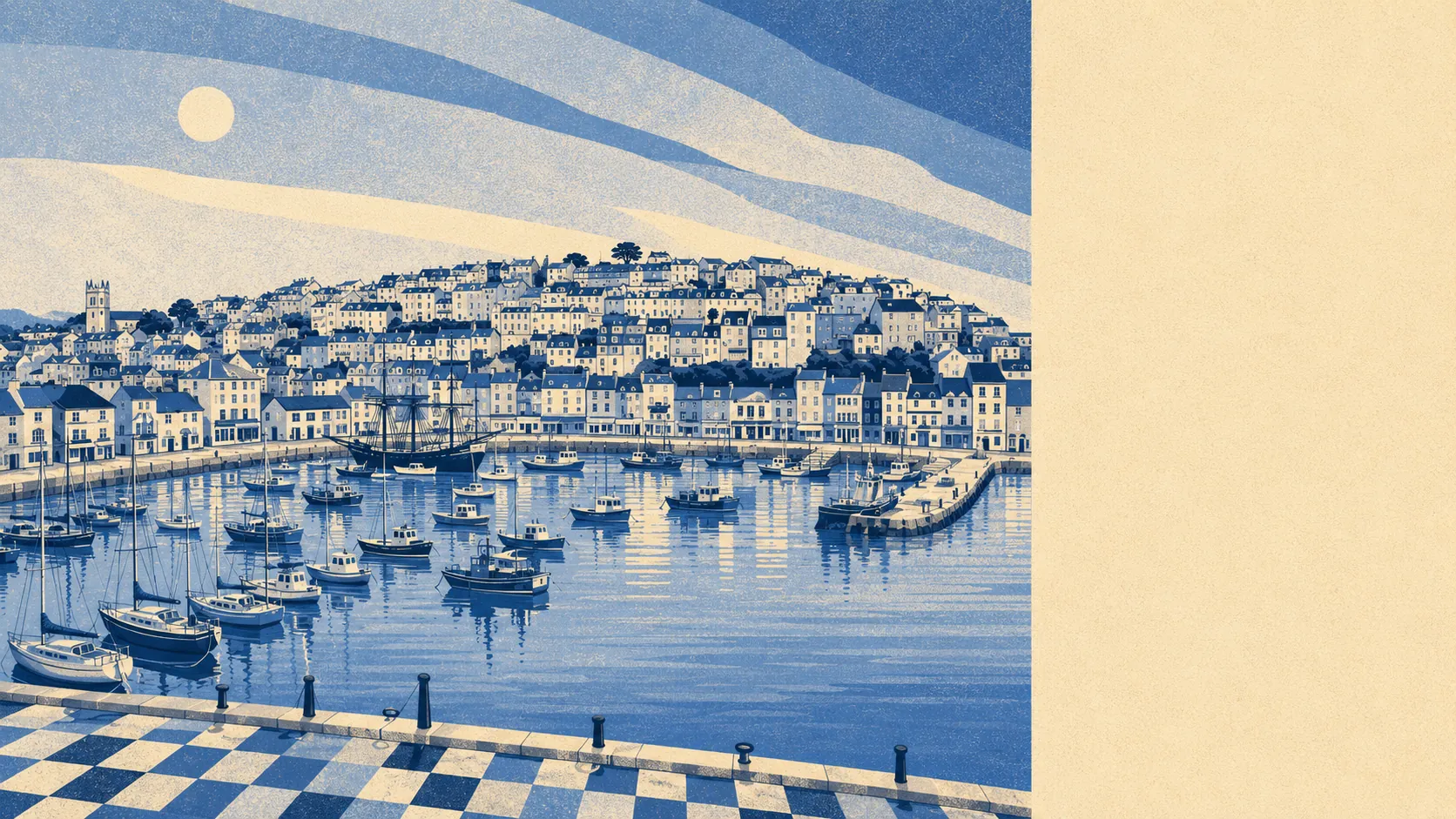
Yes, provided you accept that Brixham is a bungalow town with a fishing habit. Seven in ten own their homes. The middle resident is in their mid fifties. Crime runs a long way under the Torbay average. This is not a place waiting to turn into something else, and the people who worked that out early are the ones who stayed.
The council tax valuation list, which covers every dwelling rather than only property certificated since 2008, puts bungalows at about 30% of the stock, terraces at 24%, flats at 18%, detached houses at 15% and semis at 12%. Bungalows outnumbering everything else tells you more about who has been buying here for fifty years than any brochure would. Around 23% of dwellings went up before 1930, most of them the cottages stacked along the narrow streets above the harbour, with Cowtown and Higher Brixham filling in through the middle of the last century. On energy certificates, roughly a third of the certificated stock sits in bands A to C, 46% in band D and 21% in band E or worse. About 77% runs on mains gas and roughly 10% on electricity alone, which in an old stone cottage with a band E rating is the difference between a nice view and a nasty January.
The Land Registry recorded 226 sales in the twelve months to May 2026 at a median of £280,000. Detached houses came in at a median of £427,500, semis £270,000, terraces £240,000 and flats £190,000, so the gap between the top and the bottom of that list is the entire argument about where in town you end up. The wider price index for the area has slipped about 2% over those same twelve months while sitting roughly 8% above where it was five years ago. The most common council tax band is C, and about 36% of dwellings sit in bands A or B, which makes it a cheaper town to run than a coastline usually allows.
Renting is measured across the whole of Torbay rather than Brixham on its own, and the typical private rent across the Torbay area is about £900 a month, up around 4% over the year to April 2026. By size, a one bed averages about £610, a two bed £800 and a three bed about £980. Those are area figures, not what a landlord has in mind for a harbour flat in August.
Recorded crime runs at about 62 offences per 1,000 residents over the twelve months to May 2026, well under the Torbay average of 109. That is a published rate, not a sum anyone should attempt at home, and it puts Brixham among the calmer corners of the borough by a wide margin. Violence and sexual offences account for about 48% of the total against 35% across England and Wales, though that grouping is broad enough to include common assault without injury and tops the list almost everywhere. The less comfortable number belongs to the force rather than the town. Devon and Cornwall Police charge a suspect in about 8% of cases against roughly 12% nationally, which places them last of the 42 forces in England and Wales. Low crime and low charge rates are a fine combination right up until you are the one making the call.
Ofsted has graded 22 settings across Torbay, of which 20 are good or better and two are outstanding, with two at requires improvement and none inadequate. Across the five primaries in the district the average Key Stage 2 maths score is 105, and the two secondaries sit at about 53 on Attainment 8. Brixham College is the town secondary, Churston Ferrers Grammar School Academy is the other one nearby, and the primaries include Furzeham, Galmpton Church of England, Eden Park and Brixham Church of England. One primary in the town has closed in recent years, and a town whose middle resident is 56 does not run short of places. The typical primary is a ten minute walk, the typical secondary about 23 minutes on foot or ten by car.
There is no railway station. The Torbay and Brixham Railway went in 1963 with the Beeching cuts and the track bed has largely been built over, so the nearest platform is Paignton Rail Station and the bus is how you reach it. About 0.4% of residents commute by train and 3% by bus, against 53% who drive and 23% who work from home. The bus network is genuinely there: 159 stops in the area, 126 of them with published service data averaging 23 departures a day, and 94% carrying a weekend service. A fifth of households run no car at all and 36% keep two or more. Journey times modelled in 2019 put the town centre nine minutes away by car and 22 on foot, the nearest surgery about nine minutes by car, and the nearest hospital 31 minutes by car or 69 by public transport, which is worth reading twice if somebody in the house has a standing appointment. Broadband is the quiet win: superfast reaches about 98% of premises, gigabit about 80%, and nothing falls below the minimum standard. Public charging for electric cars runs to one point with two sockets, neither of them rapid.
About 14% of postcodes carry a high rating on at least one flood indicator, surface water included, and roughly 9% sit in the Environment Agency's river and sea flood zone 3, with 1% in zone 2. Those two measures count different things, and the coastal one is the one that bites here. The median postcode sits about 630 metres from the sea, the closest about 16 metres from it, and the shoreline management policy across the area is to hold the line over the coming century. The sea at the Devonport gauge has been rising about 2.35 millimetres a year. Radon is the fact nobody raises at a viewing: every postcode in Brixham falls in the higher band group and the top band recorded here is the highest there is, so a test is a line item rather than a formality. Ground conditions are otherwise mild, with shrink swell and soluble rock hazards at the lowest class. What you get in return is the setting. Green space averages 186 metres from the doorstep with about 17 spaces inside a kilometre, water is nearer still at 334 metres, gardens make up about 30% of the town's area, and 14% of it sits inside the South Devon Area of Outstanding Natural Beauty.
There are 235 listed buildings in and around the town, five of them grade two star and the remainder grade two, plus four conservation areas covering Brixham Town, Higher Brixham, Galmpton and Churston Ferrers, and three scheduled monuments. Two listed entries sit on the heritage at risk register. In practice, that means your windows, your render, your roof and your plans for a dormer are somebody else's decision, and that somebody works for the council. The freedom to change a house is the thinnest thing about living here, and it is thinnest exactly where the views are best.
About 72% own their homes, the median age is 56, a third of households are a single person and a fifth of all households are a pensioner living alone. Household income sits around £47,000 gross before tax, or about £37,000 after it, modelled for small areas rather than counted door to door. Roughly 348 holiday lets sit on the business rating list alongside 181 shops and 24 pubs, which is the town's whole tension in one line: the harbour front people photograph is housing somebody else wanted to live in.
It suits people who have finished commuting. Retirees, remote workers, anyone who wants a bungalow and a garden within a short walk of open water and can shrug at a hospital half an hour up the road. It suits families more than the age profile implies, given the grading picture across the borough and a ten minute walk to a primary.
It does not suit anyone who needs a train, a rapid charger, or planning permission in a hurry. It does not suit a buyer hunting an unlisted period house to gut. And it does not suit anyone who thinks a working harbour is scenery, because the harbour is a workplace before it is a view.
The town has always been better at people than at promoting itself. Sir Humphrey Gilbert, the explorer, came from here in the sixteenth century. Flora Thompson, who wrote Lark Rise to Candleford, died locally. Francis Lyte, vicar of All Saints from 1824 until his death in 1847 and absent for much of it through ill health, wrote "Abide With Me" in his final weeks at Berry Head House, now the largest hotel in town. Somebody in 1736 built a coffin shaped house to win an argument with a prospective father in law, and it is still standing, which is the most Brixham sequence of events on record.
Brixham lands above average, and the reasons are not evenly spread. Its real strength is what surrounds it: green space at the end of the street, water closer than that, a slice of the South Devon Area of Outstanding Natural Beauty, and a coastline the entire town is arranged around. The weak spot is the freedom to alter a home, which four conservation areas and 235 listed buildings keep firmly in the gift of a planning officer. Buy here for the position and the quiet, not for what you intend to do to the house. Brixham has been at this since the Domesday Book and has never once asked what you thought of it.