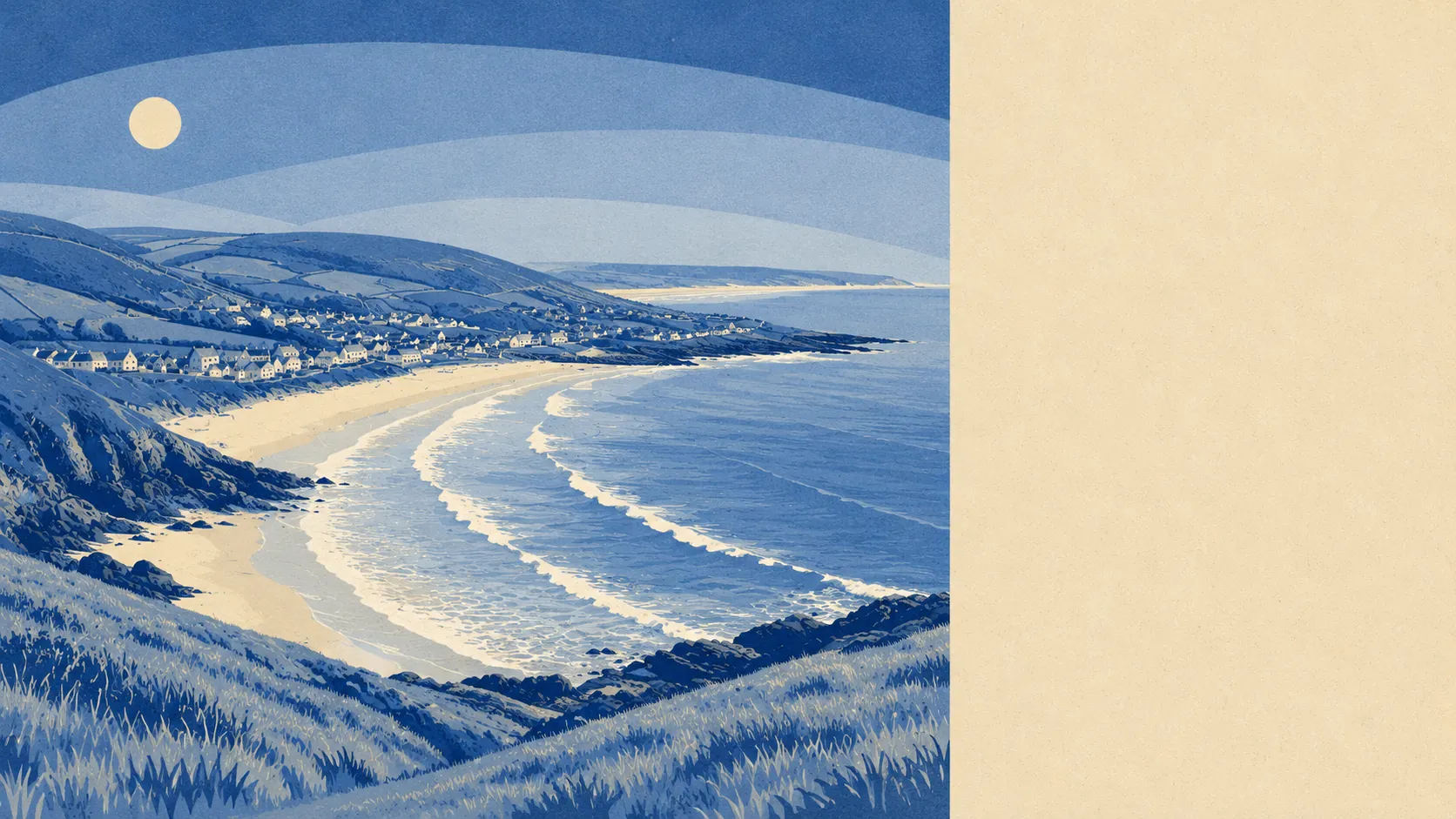
Yes, if you like the sea more than you like leaving. Three-quarters own their homes. The median resident is fifty. Over half drive to work and almost nobody touches a train. Braunton is comfortable the way a good armchair is comfortable: nothing here is in a hurry, and inside a fortnight neither are you.
The bungalow is the local building type, at around 26% of every dwelling on the council-tax valuation list, with detached houses at about 24%, terraces at 21%, semis at 17% and flats scraping 9%. Only about 18% of the stock was built before 1930, so the postcard version of the village is a small minority of what actually comes up for sale. Around 75% of homes run on mains gas and about 8% on electricity alone, which is the figure worth establishing before the viewing rather than after the first winter bill. On energy certificates, roughly 46% sit at band D and about 16% at band E or worse, against 38% managing A to C. Nobody buys here for the insulation.
The Land Registry's last twelve months, to May 2026, put the typical sale at £375,000 across 90 transactions. It splits hard by type: detached around £495,000, semis about £365,000, terraces about £295,000, and flats about £205,000 across only six sales, a base thin enough that one unusual conversion shifts it. Council tax sits mostly in band C, with about 34% of dwellings in bands A or B. For North Devon that reads as ordinary. For a parish containing the largest sand dune system in England and an international-standard surf beach at Saunton Sands, it reads as the thing nobody puts in the listing.
Renting is measured across the whole North Devon area rather than the village on its own, and the typical private rent there runs at about £850 a month as of April 2026, up about 3% over the year. By size that is around £590 for a one-bed, about £780 for a two-bed, about £970 for a three-bed and roughly £1,340 for four bedrooms or more. Those numbers describe the district's shape, not Braunton's own price list. A beach postcode has never yet lowered anybody's rent.
Recorded crime runs at about 37 offences per 1,000 people in the year to May 2026, against about 73 per 1,000 across North Devon as a whole. That is the published rate rather than a back-of-envelope sum. The sting arrives afterwards: Devon and Cornwall Police charge someone in about 8% of cases against about 12% nationally, and the force ranks last of the 42 forces in England and Wales on that measure. The village's difficulty is not what happens. It is what happens next.
About 54% drive to work, 23% work from home, 12% walk, 4% cycle and 2% take a bus. The train share rounds to nothing. There are 20 bus stops averaging 41 scheduled weekday departures each, roughly two an hour at peak, and every stop carrying service data runs at weekends too, which is more than most places this size manage. The Department for Transport's modelling puts the nearest town centre at about 19 minutes by car and about 28 by public transport, and the nearest hospital at about 20 minutes driving against about 44 on the bus. Those public transport figures were modelled in 2019, so the car and walking times are the reliable half. Broadband compensates: about 97% of premises can get superfast, 28% can get gigabit, and none fall below the minimum service level. Nearly every address gets a mobile signal from at least one operator, and about 96% from all of them.
Water is the thing to check properly. On the postcode indicators, which include surface water, about 18% of Braunton's postcodes carry a high rating on at least one measure, 13% medium and 31% low. On the Environment Agency's river-and-sea zones, about 14% of the place sits in flood zone 3 and 3% in zone 2, with roughly 21% falling inside the modelled climate-change extent. Ten flood events are on record, the most recent in December 2012, when a main river came over its defences. There is an organisation called the Braunton Marsh Drainage Board covering a small share of postcodes, and its existence tells you most of what you need to know about the ground underneath.
Set against that, the outdoors is close to unbeatable. Green space averages about 150 metres from the front door, with around 17 sites within a kilometre. Water sits about 290 metres away. The National Cycle Network is roughly 350 metres from the average postcode and within easy reach of 72% of them. The Great Field and the Burrows are working landscape rather than scenery, which is why the village has never had to try to look picturesque.
Forty-eight listed buildings sit in and around Braunton, one of them Grade I, three Grade II star and the remaining 44 Grade II. The Grade I is the Church of Saint Brannock, Norman tower with a spire on top. Two conservation areas apply, Braunton itself and Heanton Punchardon. If a house sits inside one, or carries a listing, then windows, doors, roof and anything solar become a conversation with the council before they become a purchase. Owners of the other five thousand or so dwellings on the valuation list can get on with it.
Around 75% own their homes and a quarter rent, which for somewhere with a beach on the doorstep is low churn. The median age is 50. Household income runs at about £56,500 gross before tax for the financial year to March 2023, or about £42,900 once the tax has gone. High ownership, late middle age, comfortable rather than wealthy: that combination is the social physics of the place. People arrive, buy, and stay long enough to develop firm views on everything the parish does.
It suits anyone whose daily life happens within a mile of the front door. Retired, semi-retired, working from home, or working in Barnstaple and content to drive it. It suits families who want a bungalow with a garden, a beach in reach, and a relaxed attitude to the energy certificate. It suits people who want the dunes and the estuary as background rather than as a day trip.
It does not suit a commuter who needs a railway line, anyone who wants a night out past ten, or a buyer chasing a period house with modern running costs. And any household thinking about flood cover should get the exact address checked before falling for the road, because here the gap between two streets can be the gap between two very different insurance quotes.
For a village this size the export record is odd. Saint Brannoc arrived from South Wales in the sixth century and got a church out of it. Richard Knill left as a missionary. William Scott left the Church of England to become colonial astronomer for New South Wales. Charlotte Eliza Bousfield stayed put and wrote the whole thing down, temperance convictions included. Norman Leslie Falcon went off and helped find petroleum and natural gas. A place that turns out stargazers, oil-finders and diarists is not short of imagination, whatever the bus timetable suggests.
Braunton earns its keep on what surrounds it. The green space, the water, the dunes and the Great Field are its real strength, and no quantity of money buys that arrangement in a town. The weak spot is getting anywhere: transport and connections are the thinnest part of the case, and the car quietly does the job the timetable declines to. Buy here for the walk to the sand and the sort of neighbours who never move. Do not buy here waiting for a station to turn up.