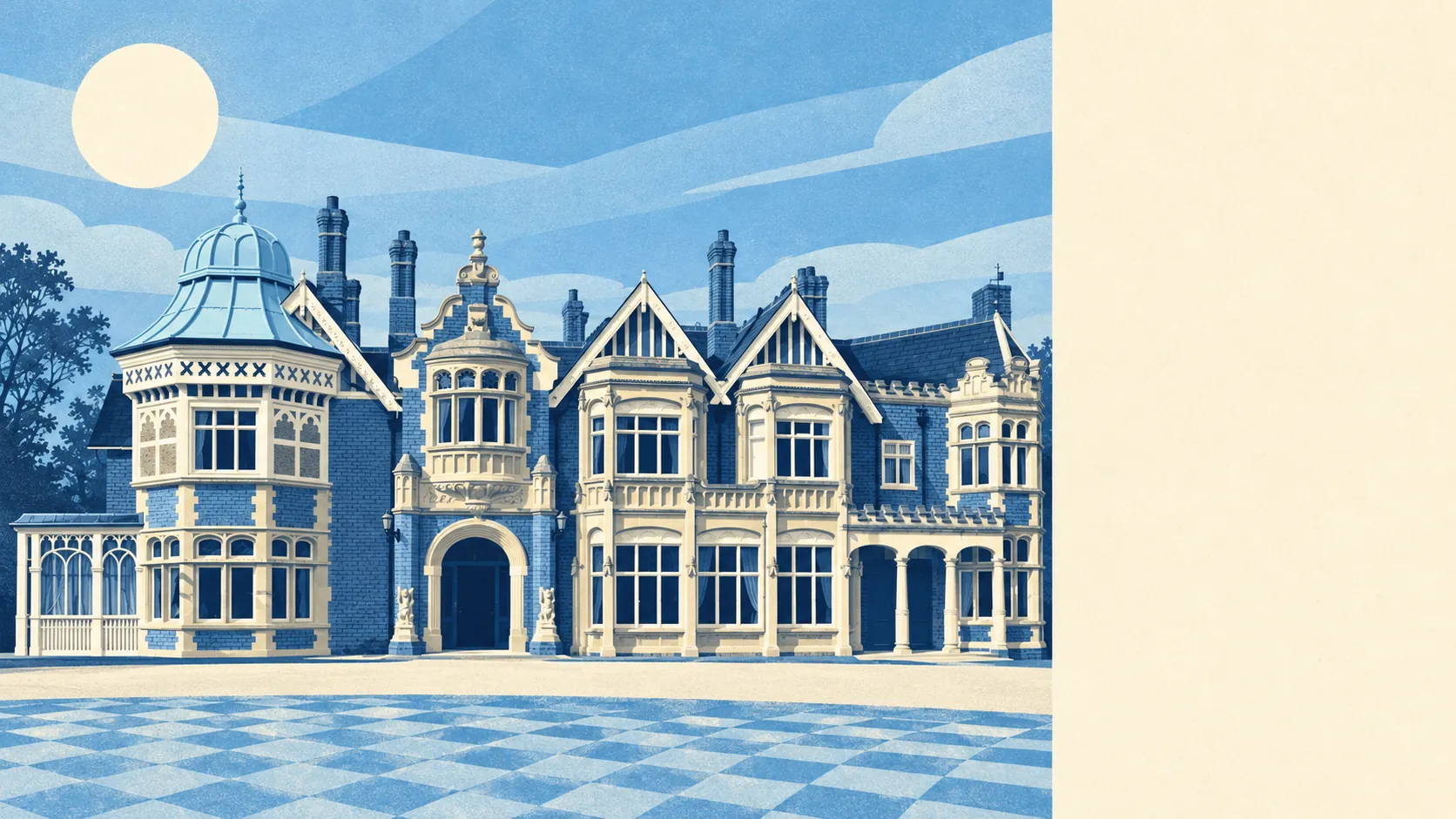
Bletchley does well by people who want a proper family house in Milton Keynes without paying central prices for it, and a park at the end of the road comes thrown in. It is a working town of post-war semis, a big railway junction and more grass than anyone expects, built in a hurry for people who needed homes. The most romantic thing about it is a Roman town buried beside Watling Street. Buyers after space and value will do well here. Buyers after charm will find it mostly in the outlying villages.
The Land Registry's sales for the year to late May 2026 put the typical Bletchley price at about £325,000. A terraced house went for around £289,000, a semi for about £338,000 and a detached house for roughly £455,000, while flats changed hands at around £188,000. Council tax stays low for most homes. Band C is the most common, and about 44% of homes are in bands A or B. In 1933 the Bletchley Gazette campaigned for a "Bigger, Better, Brighter, Bletchley", and the price list suggests the town got as far as bigger.
Renting is priced at authority level. Typical private rent across the Milton Keynes area ran at about £1,330 a month in April 2026, the Office for National Statistics' average for the whole authority. The same index puts a one-bedroom let there at about £970 and three bedrooms at around £1,440.
The council-tax valuation list makes Bletchley a semi town. About 29% of homes are semi-detached, 25% terraced, 18% detached, 18% flats and 10% bungalows, and only 8% were built before 1930. Most of the rest went up after the war, when the council took in people and businesses from bombed-out London sites and the Lakes Estate followed in Water Eaton. Around 62% of homes with an energy certificate rate C or better, and about 82% of households heat with mains gas. Bletchley sits on Oxford Clay and made its own bricks until the brickworks shut in 1990, so the town was literally built out of the ground it stands on.
Thames Valley Police figures for June 2025 to May 2026 put recorded crime in Bletchley at about 106 per 1,000 people, against roughly 107 for Milton Keynes as a whole. That is level with the city around it, and for a busy junction town with a bus station on South Terrace, level is a fair result.
The railway made the town, though the commute belongs to the car. Bletchley Rail Station is on the West Coast Main Line, with London Northwestern services to London Euston, and Fenny Stratford and Bow Brickhill stations are on the Marston Vale Line towards Bedford. Even so, under 2% of working residents took the train to work at the 2021 Census, against about half who drove and 28% who worked from home. There are 236 bus stops across the area, and gigabit broadband reaches about 97% of premises. The Oxford to Cambridge line closed in 1967, the same year Milton Keynes was designated, which was a strange way to welcome a new city.
Flooding needs two measures kept apart. About 23% of Bletchley's postcodes are at high risk on at least one Environment Agency flood indicator, surface water included, and another 21% are at medium. The river-and-sea flood zones are far smaller, with under 1% of postcodes in the highest zone. The gap between those numbers is rainwater with nowhere to go, and no river map was ever going to show it.
For schools, the 19 primaries counted in Bletchley's postcode districts average about 105 in Key Stage 2 maths, and the four secondaries average an Attainment 8 score of about 45. Names on the local list include Newton Leys Primary School, Water Hall Primary School, Denbigh School and Lord Grey Academy. For a family buying a three-bed, this is the paragraph that matters.
About six in ten households own their home, the typical resident is 38, and the Office for National Statistics' modelled figures put gross household income at about £59,000 on average across the area in the financial year to March 2023. This is a town of people in the middle of things: the mortgage, the school run, the extension they keep pricing up.
That extension is usually straightforward. There are 91 listed buildings, two of them Grade I and 86 Grade II, and two conservation areas, Bletchley and Newton Longville. On the post-war estates of West Bletchley and Denbigh the designations are somebody else's problem. In the older cores of Fenny Stratford or Newton Longville, new windows can turn into a conversation with the council.
The outdoors is where Bletchley does better than its reputation. The nearest green space is roughly 140 metres from the average front door, with about 25 within a kilometre, and water lies within about 450 metres. Newton Leys, Stoke Hammond, Bow Brickhill, Great Brickhill and Dunton add villages and fields on the edges. Bletchley's best feature is the land nobody built on.
Overall Bletchley comes out a little better than average, and the reasons are practical. A family that wants three bedrooms, a walk to the park and a mortgage that leaves something over for the rest of life will find all three here. A buyer who wants a historic postcode, or a ground floor that has never had water anywhere near it, should look elsewhere, because rain here causes more trouble than the rivers ever do.