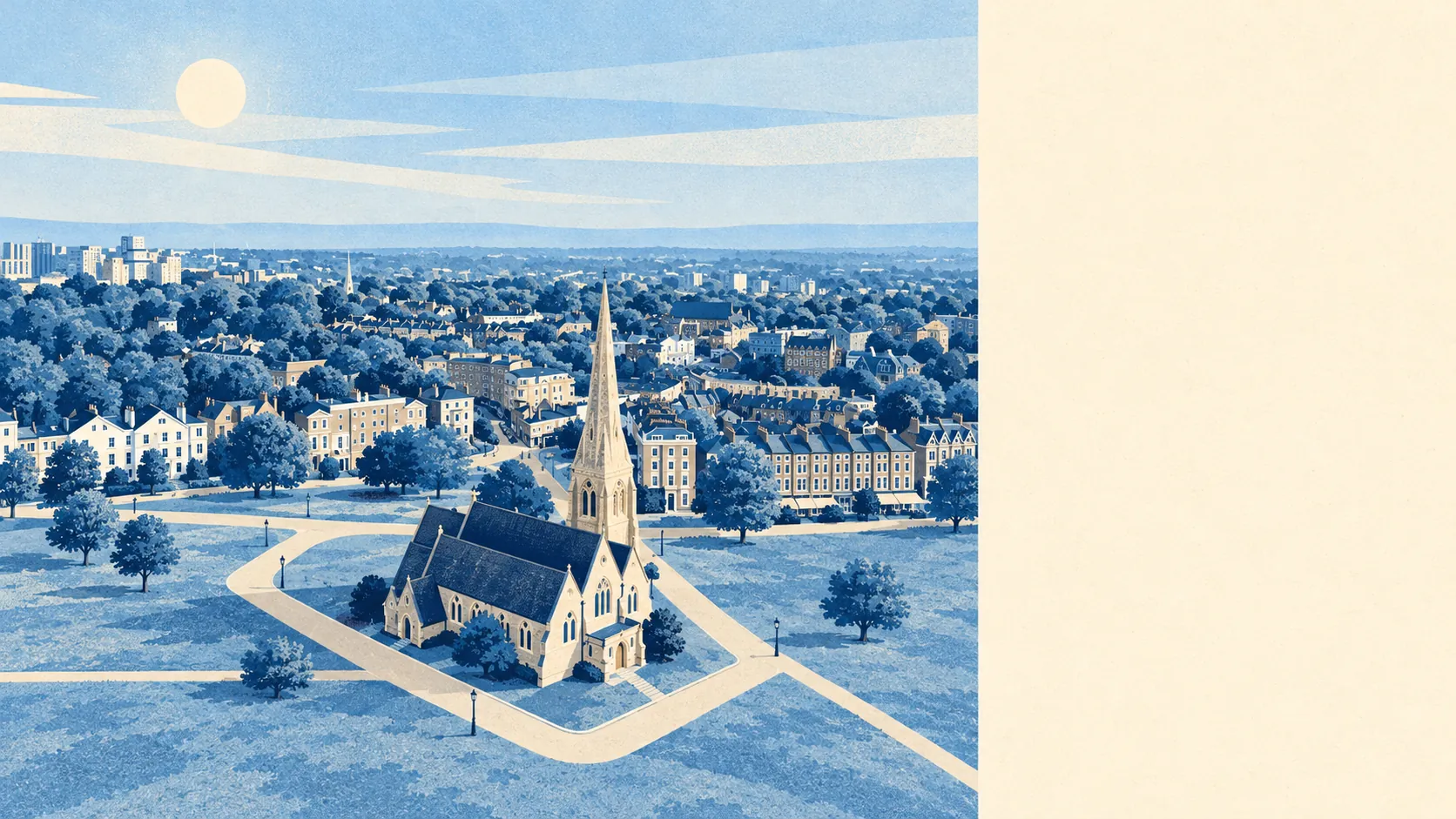
Blackheath is open ground with a town around it, and the ground wins. Green space is about a minute's walk from the average front door. Royal parkland runs straight off the common. Ponds, acid grassland and the odd rare weed fill in the rest. For somewhere this close to central London, the surroundings feel close to rural.
On average, the nearest public green space is about 110 metres from a Blackheath home, and about 34 green spaces sit within a kilometre. The heath itself is one of the largest commons in Greater London, shared between Greenwich and Lewisham councils, and it runs straight into Greenwich Park. Manor House Gardens, on the Lee side, is the smaller, tidier option for anyone who finds a common too exposed.
Water is about 580 metres away on average, with about 16 bodies of water within a kilometre. Most of them are the heath's own ponds: the Long Pond near the Greenwich Park gate, and three on the Lewisham side, where Hare and Billet pond is the most natural and the best for wildlife. Bats still hunt over them. Natterjack toads, hares and nightingales were recorded on the heath in 1859, and the nightingales have since been replaced by buses.
The nearest National Cycle Network route is about 2 kilometres away on average, and only about 1% of postcodes are close to it. There is no ancient woodland in the area. Most of the getting out here happens on foot, across the grass.
Across rated premises, the high street and the streets around it hold about 230 shops, 26 restaurants, 9 pubs and 88 offices. That is a working village centre, with plenty of places to buy things and a pub count that suggests the residents do their drinking with some discipline.
Greenwich's fine-particle level was about 9 micrograms per cubic metre in 2024, a figure that covers the whole Royal Borough, so it averages Blackheath's open air with streets much closer to the main roads.
The feel of the place comes from a few fixed points. All Saints church, built in 1857, stands out on the heath, and the Paragon's crescent of Georgian houses faces the open grass. On the Lewisham side, the acid grassland supports locally rare plants such as common stork's bill, fiddle dock and spotted medick. One story has Carl Linnaeus falling to his knees at the sight of the gorse here, though the story is more often told about Putney Heath. Blackheath gets the great botanist, but only on a split decision.
Private gardens add about 56,000 square metres per 1,000 residents across the area. For an area where flats make up the bigger share of homes, that is a decent amount of outdoor space of people's own, alongside the common everybody shares.
The valuation list for the area carries 532 rateable premises, led by shops, then offices and restaurants, with warehouses and a scattering of other uses behind them. These count premises on the list, so some may be empty and some have changed what they do since.
Of 168 rated food businesses, about 85% hold the top hygiene score and about 1% fall at the bottom end. Eating out here is a safe bet on the kitchen as well as the menu.
No area of outstanding natural beauty, site of special scientific interest or ancient woodland overlaps Blackheath. The heath carries no official designation and doesn't need one. It is protected common land, and the common has done its own protecting for centuries.
Blackheath's surroundings are one of the best things about it. Few places this close to the centre of London give their residents this much open ground just outside the door.